

The pitch sounds almost too simple: deploy warehouse robots before they're perfect, let humans bail them out when they fail, then train the AI on those exact failures while everyone sleeps.
That's the wager InLoop Robotics emerged from stealth to make last week. The startup, fresh from Y Combinator's Spring 2026 cohort, is testing a premise that cuts against decades of industrial automation wisdom—that reliable robotic systems must arrive in warehouses fully baked, meticulously programmed, and exhaustively tested. InLoop's bimanual arms instead ship deliberately imperfect, relying on remote teleoperators to step in whenever the AI freezes up. Every intervention becomes training data. Every mistake, theoretically, makes tomorrow's robot smarter.
According to cofounder Pasha Rizali's Launch YC announcement around May 20, the company already has paying customers running pilots. The robots are reportedly managing over 300 picks per hour across hundreds of different products—numbers that, if sustained beyond controlled demonstrations, would put the system in the same performance tier as established players. But there's a catch, or perhaps the whole point: the robots aren't working alone.
When the Robot Doesn't Know, a Human Does
The architecture centers on what InLoop terms a "Safety Module," though the name undersells its function. This isn't just a kill switch. When the robot's vision system encounters something outside its confidence threshold—a crumpled box, an unfamiliar orientation, packaging it hasn't seen before—it stops and alerts a human operator somewhere else. That operator takes control remotely, solves the problem, and the Safety Module logs the entire episode.
Then comes the overnight update. The failure scenario syncs into the training pipeline, the model retrains, and by morning the robot should handle that situation autonomously. In theory.
"Ship imperfect policies," reads the company's directory listing on Y Combinator's site. It's a software mantra transplanted into the physical world, where imperfection traditionally means broken pallets and missed shipments. The company frames this as "zero downtime, infinite learning"—operations continue because humans are always on standby, while the AI gradually absorbs the messy reality of actual warehouses.
At MODEX 2026 in Atlanta this past April, InLoop demonstrated just how aggressive that timeline could be. Rizali posted on LinkedIn that the team collected one hour of demonstration data, trained overnight, and ran a fully autonomous picking demo the following morning at their booth. One hour to training to deployment. It's a striking compression of the months-long integration cycles that typically accompany industrial robotics, though a trade show booth is not a fulfillment center running holiday peak volumes.
The Work and the Limits
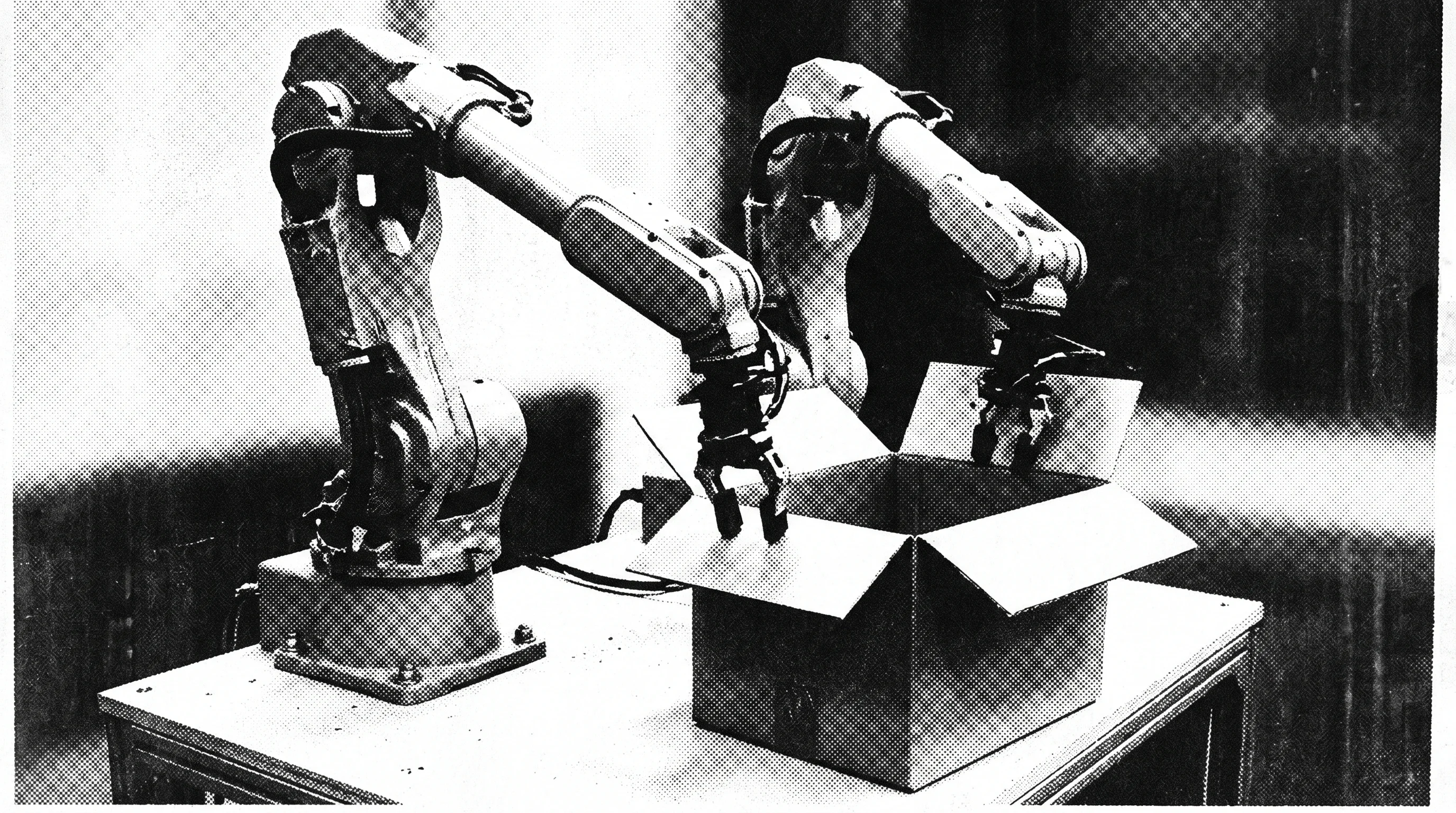
The bimanual arms tackle standard warehouse choreography: assembling boxes, kitting multi-item orders, visual quality inspection, labeling, wrapping, unpackaging. General pick-and-place work across induction, packing, and palletizing. The robots are stationary—bolted to fixed workstations—which simplifies the hardware but constrains where and how they can operate.
InLoop emphasizes that customers don't need facility redesigns or custom tooling. No six-figure integration projects per station, the company claims on its website, positioning the system as something approaching plug-and-play. What that actually means for warehouses with legacy layouts, diverse inventory, and fluctuating throughput demands remains largely undocumented outside the early pilots.
The website includes a curious detail: a mini-game where visitors can remotely operate a robot arm themselves. It's playful branding, but it also telegraphs the core product dependency—human operators will be part of this system indefinitely, not a temporary scaffold that falls away once the AI matures.
Robotics-as-a-Service, Price Unknown
InLoop sells this as RaaS—Robotics-as-a-Service. Customers pay a flat monthly fee covering hardware, continuous AI updates, and round-the-clock teleassistance. "Why buy a robot when you can hire one?" goes the tagline. No capital expenditure, deployment in hours rather than months.
Missing from all the marketing materials: actual numbers. The website mentions replacing "$100k+ integration projects per station," but that's a savings comparison, not pricing. For logistics operators accustomed to calculating total cost of ownership across multi-year contracts—factoring in maintenance, downtime, labor displacement, and throughput guarantees—the opacity complicates evaluation. Perhaps that's intentional at this stage.
The paid pilots are live, per the May announcement. InLoop hasn't named customers publicly or released case studies yet. The "Trusted by" section on the company site lists NVIDIA Inception, Y Combinator, and RoboTUM—all ecosystem affiliations, not commercial deployments. The distinction matters.
Four Founders, Fuzzy Funding
CEO Zakariea Sharfeddine comes from AI and manufacturing R&D roles at Bosch and BMW, with academic ties to KIT and TU Munich. CTO Stepan Feduniak reportedly began robot learning research at 18, also connected to German technical universities. Pasha Rizali, handling product and operations, co-founded student robotics networks including RoboTUM and previously worked with Boston Dynamics' Spot platform. Founding engineer Martin Mohammed is listed as a former CTO at a venture-backed San Francisco startup, bringing distributed systems expertise.
The funding picture has inconsistencies. Rizali announced in a LinkedIn post that InLoop raised $500,000 from Y Combinator. Dealroom's database shows a $125,000 seed entry dated March 2026. CB Insights lists $500,000 total with an update logged mid-May. The $500,000 figure aligns with Y Combinator's standard deal structure, which often involves SAFE agreements and milestone tranches beyond the initial check. The discrepancy may reflect reporting lags or how different databases categorize pre-seed versus seed capital.
InLoop joined NVIDIA's Inception Program in April—a startup ecosystem membership, not an equity investment. The company exhibited at MODEX 2026 from April 13-16, posting from what Rizali identified on LinkedIn as booth B7428, though independent exhibitor directories don't clearly confirm that specific location.
Entering a Crowded, Skeptical Market
InLoop is stepping into a warehouse robotics sector that has seen a drumbeat of AI-centric product launches this year, each promising to finally crack the generalization problem that has bedeviled the industry. Dexterity unveiled its "Foresight" world model for truck loading in March. Covariant continues expanding AI-driven picking systems across European retail chains. AutoStore has pivoted toward self-optimizing warehouse orchestration with predictive analytics. Even Locus Robotics, the established leader in autonomous mobile robots, has been emphasizing software partnerships and integration depth over pure hardware sales.
An ABI Research analysis following MODEX 2026 in late April noted that warehouse buyers are increasingly focused on "well-planned point solutions" and leaning heavily on simulation to de-risk deployments before committing capital. That trend could favor InLoop's live demonstration approach—here's one hour of training, now watch it run—or it could amplify concerns about whether such rapid iteration truly generalizes to the chaotic variability of real fulfillment operations during peak season.
The company is hiring robot operators, robotics engineers, and robot learning researchers, according to open positions listed on its website as of late May. With a team size listed on Y Combinator's directory as four—though LinkedIn shows a range of 2-10 employees—any serious scaling will demand both talent acquisition and the operational infrastructure to support multiple remote pilots running simultaneously across different geographies and time zones.
The Real Bet
InLoop's fundamental wager is that the bottleneck in warehouse automation isn't hardware capability. It's not even initial AI accuracy. It's the feedback loop—the speed at which real-world failures can become model improvements.
If every robot stumble truly converts into training data, and if that data can refine the system faster than traditional programming cycles, the company might compress integration timelines that have historically stretched across quarters into overnight updates. The architecture is elegant in concept: don't wait for perfect, ship functional, let humans cover the gaps, learn constantly.
The harder question is whether warehouse operators will trust robots that arrive admittedly imperfect, even with teleoperators standing by. Industrial automation has always carried risk—broken merchandise, missed throughput targets, safety incidents. Introducing systems explicitly designed to fail, learn, and improve asks buyers to embrace a different kind of uncertainty. To bet, essentially, that iteration speed matters more than day-one reliability.
For a small startup challenging incumbents with decades of deployment experience and installed bases numbering in the thousands, that's asking customers to make two leaps of faith simultaneously. First, that the technology works as advertised. Second, that imperfection today is worth accepting for capability tomorrow.
Whether warehouse operators are ready to make that trade—well, that's the pilot program InLoop is running right now.


