

The pitch sounds almost too simple to work. While Runway builds editing studios around its generative models and Adobe weaves AI across its creative empire, a two-person startup out of Y Combinator is betting on something closer to air traffic control: routing video generation requests to whichever third-party model handles them best.
It's a strategy that either reflects clear-eyed pragmatism about where capabilities actually live today—or a dangerous lack of defensibility in a market moving at breakneck speed. Perhaps both.
Palette Technology emerged from Y Combinator's Summer 2026 batch with a routing layer that spans video generation systems including ByteDance's Seedance 2.0, Google Veo 3.1, Kling 3.0 Pro, and MiniMax Hailuo 02. Users can select a model manually or let Palette's orchestration layer decide based on the task at hand. The company describes its platform as "your entire studio, in one prompt," which is either audacious positioning or just the latest iteration of a promise the industry has been making—and struggling to keep—for the better part of two years.
The Orchestration Play
What Palette isn't doing is training its own models. That's the bet, really. While competitors pour resources into proprietary generation engines, Palette founder Serena Pei—an MIT computer science alum serving as CTO—is building connective tissue instead.
The model roster tells you something about where high-quality video generation actually happens right now, which is to say: everywhere and nowhere in particular. Google's Veo 3.1 arrived in early 2026 through Vertex AI, pitched for granular prompt control. Kling 3.0 Pro rolled out native 4K generation capabilities on April 23, 2026. ByteDance integrated Seedance 2.0 into CapCut within weeks of launch. MiniMax's Hailuo 02 rounds out the roster.
The interface itself is straightforward. Start with a prompt, an image, a document, a reference file. Convert that input into video, visuals, or structured content. Palette determines which backend to hit based on what you're trying to make. Whether that routing intelligence proves sticky enough to build a business around is the central question.
Inside the Workflow
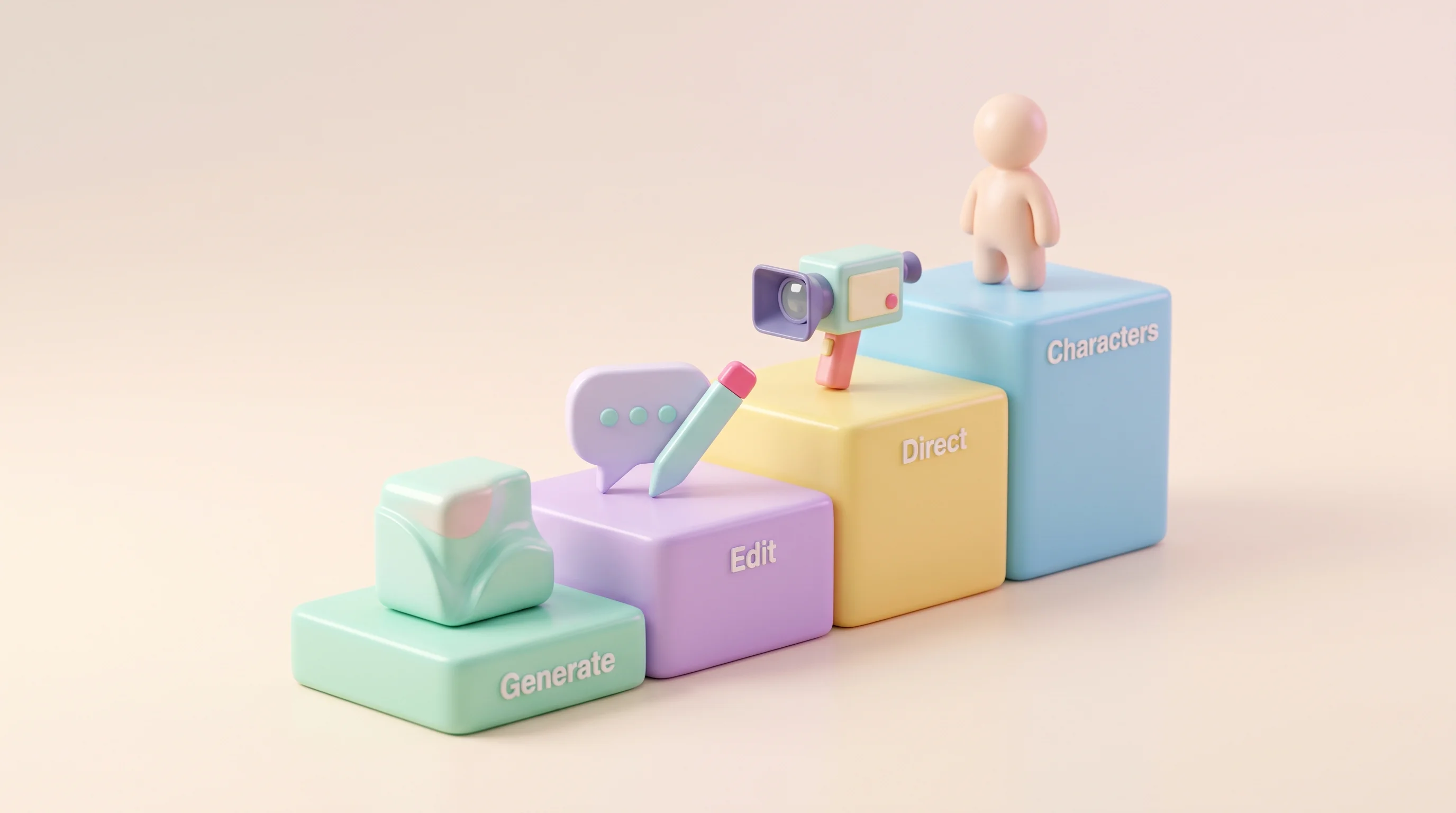
Palette organizes itself around four stages: Generate, Edit, Direct, and Characters. Generation pulls from whichever model the system deems appropriate. Editing happens conversationally—restyle footage, replace objects, revise sequences without leaving the prompt window. The "Direct" feature lets users specify audience, pacing, and visual intent, which theoretically informs smarter backend routing.
Characters, flagged on the roadmap as still in development, aims to maintain consistent identity across shots and sequences. That's table stakes in 2026, but execution is notoriously difficult.
Other features listed as in progress—brand kits, storyboard-to-sequence tools, real-time collaboration, performance direction, auto-repurposing across formats, a developer platform—read like a fairly standard enterprise wishlist. Whether a two-person team can deliver on that roadmap before competitors close the gap is unclear.
The company's trust and security documentation, updated on June 29, 2026, outlines encryption standards, multi-tenant architecture, and compliance roadmaps for SOC 2 Type II and ISO 27001. A subprocessors page lists third-party service categories—cloud hosting, LLM providers, email, analytics—though vendor names are only disclosed under NDA. That level of opacity may frustrate enterprise buyers, or it may be immaterial if the product sells itself.
Palette is live at studio.palettetechnology.com, gated behind login. Three tiers are offered: Individual (pay-per-credit), Teams (presumably seat-based), and Enterprise (with governance features). Pricing isn't public.
A Crowded, Fast-Moving Field
The timing is aggressive. Runway unveiled Aleph 2.0 in May with an integrated editing studio. Adobe expanded its Creative Agent across Premiere and Photoshop in June, positioning itself as the connective layer for creative work. Luma's incremental improvements to Ray 3.2 continued through spring. D-ID launched Agentic Videos in late April, turning static clips into interactive experiences.
On the enterprise side, Kaltura released its Avatar Video Production Studio to general availability for automated workflows. Shutterstock launched a commercial-ready AI video generator around the same time. The underlying message across the market has converged: unify generation and editing, collapse tool sprawl, make video production conversational.
Within YC's own cohort, Palette faces direct competition. Koyal describes itself as an agentic AI filmmaking platform. Ozone pitches as the fastest way to edit videos with AI. Flick bills itself as "Figma/Cursor for AI filmmaking." All are chasing some version of the same workflow consolidation thesis. Differentiation, it seems, will come down to execution velocity, model performance, and which verticals each team captures first.
That's a lot of companies making nearly identical promises.
The Two-Person Question

Here's where the story gets interesting, or concerning, depending on your vantage point.
Palette is fundamentally a two-person operation. Serena Pei is listed as CTO. The company went through Y Combinator's Summer 2026 batch under partner Ankit Gupta. LinkedIn lists the company in media production with two to ten employees—a range that suggests the headcount is closer to two than ten.
The homepage displays logos for Y Combinator and OpenAI under "Backed by," though the nature of OpenAI's involvement—whether program credits, API partnerships, or equity investment—hasn't been publicly clarified. Palette hasn't disclosed a priced round, valuation, or customer count.
The site lists target use cases across marketing, entertainment, learning and development, customer support, product, manufacturing, healthcare, retail, field service, and safety training.
That's a staggering breadth for a two-person team. Whether Palette can serve even a fraction of those verticals effectively—or whether this is just standard startup land-grabbing—remains to be seen. The company's immediate challenge isn't technical architecture. It's translating a clean product story into traction with paying customers in a market where the window for differentiation may already be closing.
The Routing Thesis on Trial

There's an elegant logic to the routing approach. Why build models when you can orchestrate the best ones? Why lock users into a single system when capabilities are fragmenting across providers?
But elegance doesn't always translate to durability. If Google, Adobe, or Runway decide to offer similar cross-model routing—or if one model pulls decisively ahead—Palette's core advantage evaporates. The company is betting that orchestration complexity, workflow integration, and speed to market can create enough of a moat before that happens.
It's a race. And the clock is already running.


