

On a Tuesday in late June, while Agility Robotics was announcing its $2.5 billion SPAC deal and nine active customer sites, two engineers in San Francisco were sketching out a very different kind of humanoid robotics company. Their target market wasn't warehouses or factories. It was nursing homes.
That's the bet behind Twolabs, a startup so new it barely has a footprint beyond a Y Combinator profile and a pitch deck. Sardor Rahmatulloev, who spent time at Meta's Superintelligence Labs, and Danyal Ahmad, a former Salesforce engineer with an AI master's from Georgia Tech, think they've spotted an opening. Not in logistics, where robots are already moving boxes for Amazon and GXO. Not in manufacturing, where Figure AI and Boston Dynamics are vying for production-line real estate. But in eldercare—a sector where labor shortages are structural, the work is relentlessly unstructured, and the consequences of getting it wrong are, well, human.
Their pitch? A modular humanoid platform they're calling "Tobi," paired with a workflow they describe as "Record → Upload → Train → Deploy." The idea is to let nursing home staff teach robots new tasks without needing a PhD in robotics or machine learning. Show the robot how to deliver medication reminders. Demonstrate mobility assistance. Record it, upload it, let the system learn, then deploy. Simple, at least in theory.
Whether that theory survives contact with reality is another matter entirely.
A Market Suddenly Crowded With Builders
Twolabs is entering a moment when humanoid robotics is experiencing something it hasn't had much of before: genuine commercial momentum alongside a proliferation of platforms designed explicitly for people who want to build with robots, not just buy them off the shelf.
The signs are everywhere. Amazon acquired Fauna Robotics earlier this year, snapping up its developer-friendly Sprout platform barely two months after it launched. Nvidia unveiled its Isaac GR00T Reference Humanoid at Computex, positioning it as a standardized body-and-brain stack to accelerate deployment. Rainbow Robotics got its RB-Y1 dual-arm system into live warehouse pilots at Coupang in mid-June. Even Alphabet folded its robotics software unit Intrinsic back into Google, integrating its no-code Flowstate tools with Gemini in a signal that abstraction layers are where Big Tech sees value accruing.
The common thread? Make robotics feel less like rocket science and more like configuring an API. Pollen Robotics keeps iterating on Reachy 2, an open-source bimanual humanoid with ROS 2 integration. Microsoft introduced its Rho-alpha robotics model targeting perception and bimanual manipulation. The infrastructure is thickening—Nvidia's Jetson Thor compute modules are shipping, foundation models are moving toward on-device inference, and teleoperation tooling from outfits like Formant and InOrbit is getting more sophisticated.
Twolabs' founders argue that existing humanoids are "overfit" to single use cases. Their modular design and demonstration-driven training pipeline, they say, can adapt across environments. Fair enough. But the execution details that would validate that claim—how the hardware actually sources and assembles, how the data engine handles sensitive care contexts, how quickly they navigate safety certification—remain undisclosed. McKinsey's supply-chain analyses this year flagged persistent bottlenecks in hands, actuators, and gearsets. HIPAA and patient privacy considerations, as outlined in ISO 13482:2014 and related healthcare robotics guidance, loom large in any care setting. And safety certification for public-facing environments is not a formality.
Why Nursing Homes? And Why Now?
The U.S. median age hit 39.4 last year. Adults 80 and older are projected to double between now and the mid-2040s. The Bureau of Labor Statistics forecasts 17% growth in home health and personal care aides through 2034—the fastest-growing occupational category in the country—even as facilities that took a beating during the pandemic remain stretched. Axios reported in June that staffing improvements are real but fragile.
Goldman Sachs projects the global humanoid market will reach $38 billion by 2035, a forecast materially revised upward from an earlier $6 billion estimate. ABI Research pegs the nearer-term market in 2030 at $6.5 billion with roughly 195,000 units shipped. The demographic pressure is structural, not cyclical.
Caregiving tasks, though, are notoriously messy. They require dexterity, environmental perception, and something closer to social intelligence than pure manipulation. That complexity is both the opportunity and the trap. Stanford's HAI AI Index reported that robots succeed in only about 12% of real household tasks, despite high simulation success rates. The gap between lab performance and deployed reliability remains stubbornly wide. Eldercare environments layer on safety, regulatory, and ethical complexities that industrial or warehouse settings sidestep.
ISO 13482:2014 provides the principal safety standard for personal care robots in non-industrial spaces. In the U.S. and Canada, UL 3300—revised in April 2025—sets requirements for public-facing service robots. OSHA added it to its "Appropriate Test Standards" list at the end of last year, and Simbe Robotics' Tally grabbed the first global UL 3300 certification this past March. Twolabs hasn't publicly disclosed which certification path it's pursuing, nor has it named pilot sites or testing timelines. Those milestones will matter more than the hardware specs, however promising the modular design sounds.
From Polished Demos to Paying Customers
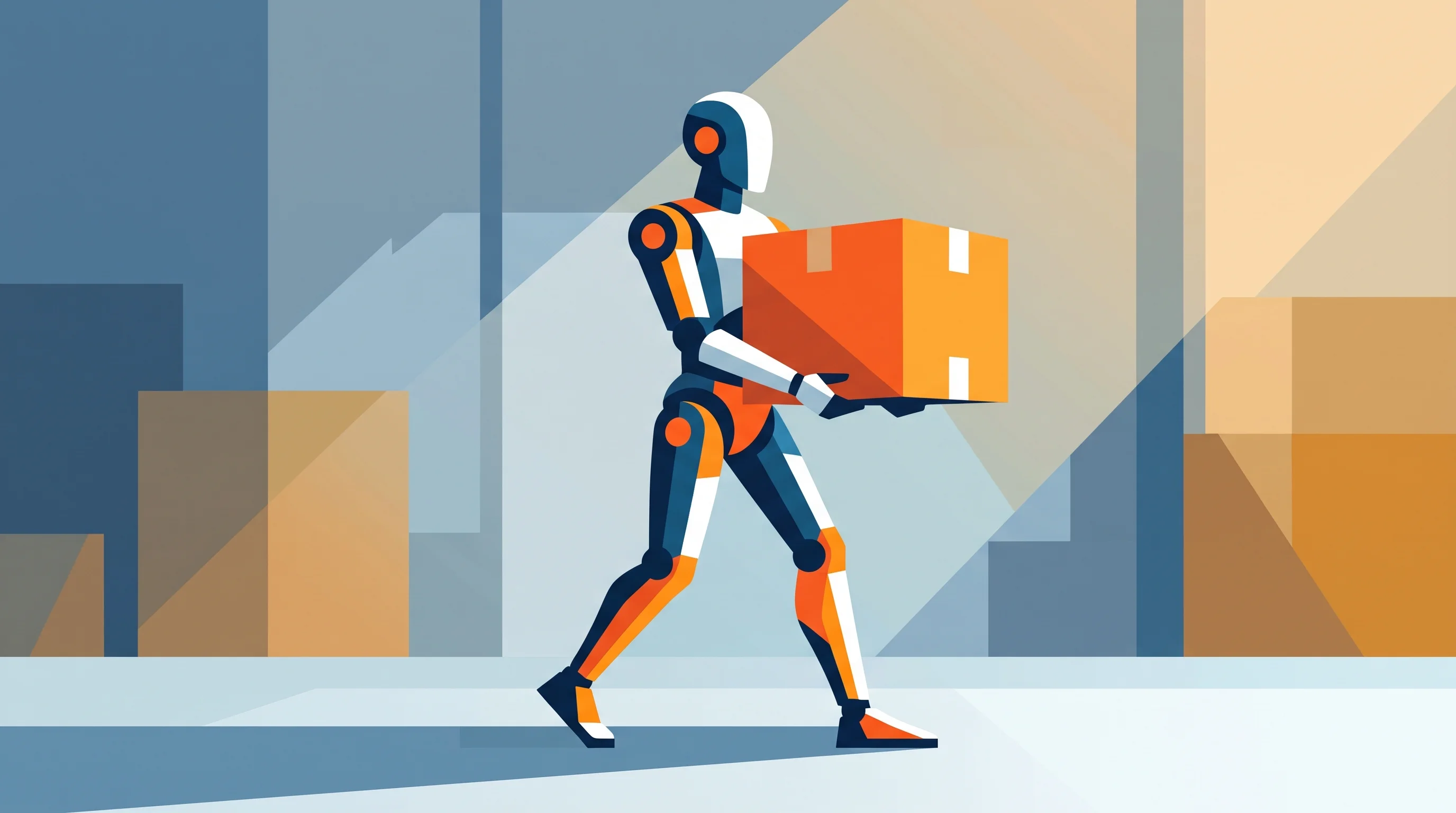
The industry's credibility pivot over the past 18 months has been unmistakable: fewer choreographed demos, more paying customers. Agility's Digit moved from its first revenue-generating deployment with GXO in 2024 to nine named customer sites by mid-year, including Schaeffler and Toyota Motor Manufacturing Canada. CEO Peggy Johnson has positioned Agility as an early mover in commercial humanoid deployment, a benchmark the company cited repeatedly in its recent SPAC filing.
Figure AI deployed its Figure 03 humanoid at BMW plants in 2024 and 2025, handling production-assist roles at facilities in Spartanburg and Germany. Apptronik raised $93.5 million by February and claims pilots with Mercedes and GXO for its Apollo platform. Boston Dynamics unveiled the electric Atlas as a product line at CES in January, targeting industrial settings with Hyundai backing. Tesla's Optimus remains in limited internal deployment; CEO guidance in January suggested consumer sales might begin by late 2027, a timeline best treated with caution.
Even the "builder-first" platforms are gaining traction. Rainbow Robotics' RB-Y1 entered its first live commercial warehouse trial at Coupang in June, a Samsung-backed milestone. Unitree's G1, priced around $13,500 to $16,000 depending on configuration, is shipping to developers globally. TrendForce projects Chinese humanoid output will surge 94% this year, with Unitree and AgiBot capturing roughly 80% of shipments.
The shift reflects maturing stacks—Nvidia's GR00T foundation models, on-device inference via Jetson Thor, Microsoft's Rho-alpha—and growing recognition that teleoperation and imitation learning pipelines remain central to reliability. Recent research demonstrates improved whole-body teleop with sim-to-real validation on Unitree platforms, underscoring that human demonstration data is still the workhorse of deployment readiness. Platforms that streamline data capture, labeling, training, and deployment workflows are addressing a recognized bottleneck, not inventing a new category.
The Data Problem No One Talks About
Here's the uncomfortable truth: the real-world gap persists, stubbornly. The AI Index technical performance chapter is blunt—robots succeed in roughly 12% of household tasks when tested outside simulation. Vision-Language-Action models are maturing. Systematic reviews published in Nature Machine Intelligence and MDPI Sensors detail progress on cross-embodiment learning, multimodal perception, and sim-to-real transfer. But the underlying challenge remains data.
Daniela Rus of MIT CSAIL, in an interview with McKinsey this summer, emphasized that many manipulation tasks are too complex for classical modeling and require human demonstration data plus learning-based approaches. "Data, human-robot collaboration, and the limits of current AI" frame the bottleneck, she said.
Open datasets like Open X-Embodiment and RT-X enable pretraining, but they can't substitute for domain-specific demonstrations in high-stakes environments. Twolabs' "Record → Upload → Train → Deploy" pitch assumes nursing home staff or operators can generate sufficient quality demonstrations to fine-tune task-specific policies—though practical effectiveness in real-world care settings remains to be validated. That workflow must account for patient variability, environmental dynamics, and edge cases that could have serious consequences if handled poorly.
The company hasn't disclosed how it plans to manage data labeling, privacy (HIPAA and PHI considerations in care settings are non-trivial), or the toolchain for VLA fine-tuning. Those operational details will determine whether the platform delivers on its accessibility promise or simply shifts the engineering burden from robotics specialists to care operators who may lack ML fluency.
Perhaps more concerning, Twolabs hasn't yet named a single pilot site or testing timeline. In a field where commercial deployments have become the benchmark of credibility, that absence is notable.
A Narrow Path Forward
Twolabs is entering a market that's simultaneously heating up and fragmenting. Agility's SPAC path validates the commercial model for humanoid-as-a-service in logistics. Amazon's Fauna acquisition signals hyperscaler interest in developer platforms. Nvidia's reference design and foundation model roadmap aim to standardize the stack. A wave of low-cost, modular systems from Unitree, Pollen Robotics, and others is expanding the builder base.
The caregiving thesis is compelling on paper—urgent labor shortages, aging demographics, tasks requiring adaptive intelligence. But the execution path is narrow. Safety certification for public-facing care robots isn't a formality; it's a months-long process that can surface hard trade-offs between capability and compliance. The data engine must be robust enough to generalize across facilities and patient populations without creating liability exposure. And the hardware supply chain remains bottlenecked on critical components.
Whether Twolabs can navigate those constraints with a two-person founding team and what appears to be early-stage capital remains very much an open question. The company's YC profile lists a team size of two and a founding year of 2026, suggesting it's pre-seed or in its initial fundraising cycle. Comparable builder platforms—Fauna, Reachy, even the open-source Asimov V1 kit targeting a $15,000 price point—have required sustained engineering effort and ecosystem partnerships to reach developer adoption, let alone commercial pilots.
The market opportunity is real. Industry analyses, including Forrester's research on humanoid robotics deployment, point to where value is accruing and flag deployment risks. The International Federation of Robotics reported 9% year-over-year growth in professional service robot sales in 2024, with transportation and logistics leading at 102,900 units. The question is whether a startup betting on caregiving—a domain with lower commercial velocity than warehouses but higher social stakes—can thread the needle on hardware, software, safety, and go-to-market before the platform window narrows.
What Proof Actually Looks Like

The industry's turning point, as Nvidia CEO Jensen Huang framed it at Computex, is about moving from reference designs to real work. For Twolabs, that means proving "Record → Upload → Train → Deploy" is more than a tagline. It means naming pilot sites. Publishing safety test results. Demonstrating that a modular humanoid can learn bedside tasks reliably enough for operators to trust it around vulnerable populations.
The next 12 months will clarify whether the company is building toward that standard—or whether caregiving robotics remains a few product cycles away from being genuinely accessible. In a market suddenly crowded with builder platforms and commercial deployments, the bar for credibility has been set. And it's not in a pitch deck or a YC demo day. It's in a nursing home hallway, with a patient waiting and a task that needs doing. That's where the real test begins.


