

Julian Fried knows what happens when the last welder walks out. As a former welding foreman, he's watched shops scramble when the guy who can run 6010 uphill on pipe—the one who just knows when to tighten the arc—gives his two weeks. That knowledge doesn't get written down. It doesn't transfer in a training manual. It just vanishes.
Now Fried is co-founder of a Y Combinator-backed startup betting that machine learning can capture what master welders know before an entire generation retires. He's not alone in that wager. Across the industrial landscape, a quiet race is underway to build welding systems that don't just automate motion but actually learn—absorbing the tribal wisdom of the trade before it disappears for good.
The urgency is arithmetic. American manufacturing will need 320,500 new welding professionals by 2029, according to the American Welding Society—a projection AWS has reiterated in multiple reports from March 2025 through 2026. Meanwhile, AWS cites more than 157,000 welders nearing retirement by 2029. The Bureau of Labor Statistics projects annual openings influenced by replacement demand due to retirements and job changes across welding, cutting, soldering, and brazing occupations. Do that math. Even if every vocational program ran at full capacity, the gap keeps widening.
And it's widening at exactly the wrong moment. Trillion-dollar infrastructure bets are coming due, reshoring momentum is building from shipyards to semiconductor fabs, and Buy America provisions are amplifying demand for domestic fabrication. The bottleneck, increasingly, isn't steel or capital. It's people who know how to make metal stick together under pressure.
A Workforce on the Edge
The data tells two overlapping stories, neither particularly comforting. AWS reports the U.S. welding workforce at roughly 771,000 professionals as of 2025, pulling from WeldingWorkforceData.com, which casts a wide net around welding-adjacent roles. The Bureau of Labor Statistics, using its May 2025 employment figures under occupational code 51-4121, counts just 416,210 welders, cutters, solderers, and brazers—with a mean annual wage of $56,760. The discrepancy reflects definitional boundaries more than contradictory realities. AWS captures the broader industrial ecosystem; BLS hews to narrower categories.
What both agree on: the pipeline is broken. BLS projects modest 2% employment growth from 2024 to 2034 for core welding occupations. But replacement demand—driven by Baby Boomer retirements and workers leaving for less physically punishing careers—swamps that growth entirely. The real story isn't expansion; it's backfill. And the backfill isn't happening fast enough.
Demand, meanwhile, is compounding. The Infrastructure Investment and Jobs Act, signed in November 2021, continues pumping billions into multi-year projects well into 2026. Federal Transit Administration contracts with Buy America requirements are forcing fabrication back onshore. Defense industrial base assessments flag welding skills as critical; the Department of Defense's LIFT program doesn't mince words about pipeline gaps. And construction—fueled by data center buildouts and manufacturing reshoring—needs an estimated 500,000 additional workers this year, according to Associated Builders and Contractors forecasts cited by Fortune in February.
The work itself isn't getting simpler, either. AWS D1.1/D1.1M:2025 structural welding code was first issued April 17, 2025; Amendment 1 followed on January 12, 2026. Pipeline work references API 1104, with PHMSA incorporation timelines that vary by jurisdiction. ASME BPVC Section IX governs pressure equipment qualifications. The regulatory substrate demands certified expertise—not warm bodies holding torches.
Why Now?
Three forces have converged to make AI-augmented welding feel less like futurism and more like necessity.
First, the knowledge-transfer crisis has teeth. Fried's story isn't unique; it's epidemic. Skilled welders carry years of tacit expertise—how to read a molten puddle, when to adjust travel speed, which torch angle works for a fillet in 7018 rod versus 6010. That pattern recognition doesn't survive PowerPoint decks. When 157,000 welders retire, they take irreplaceable instincts with them unless someone builds systems to capture and codify what they know.
Second, the technology stack has reached an inflection of accessibility and price. Collaborative robots from Universal Robots, FANUC's CRX line, and integrated packages like Miller Electric's Copilot family—expanded in 2026 to handle larger weldments and aluminum—are designed for small and medium manufacturers, not just automotive giants. Hirebotics and Vectis Automation offer pre-engineered cobot welding cells marketed as no-code deployments. Centerline Brackets, profiled in AWS Welding Digest last November, reported completing over one million welds with a Vectis cobot and hitting ROI in under three months.
The entry price for automation has dropped from mid-six-figures requiring dedicated engineers to turnkey systems that welding shop owners can deploy in weeks. Perhaps more importantly, the sensors and AI components have matured. Keyence sells laser profilers built specifically for weld seam tracking. LMI Technologies launched Gocator 2D Smart Cameras in January 2026, promising low-latency inline inspection. Cognex brought its OneVision AI vision platform to general availability in May 2026, targeting defect classification across manufacturing lines. These aren't lab projects anymore; they're production-grade components that bolt onto existing robotic arms and welding power sources.
Third, the research community is moving faster than trade press sometimes acknowledges. Papers published over the past two years explore physics-informed neural networks for weld-pool behavior, transfer learning to generalize defect models across joint geometries, and closed-loop control that compensates for actuator lag using predictive models. Some of this work remains in arXiv preprint territory, yes. But the gap between academic proof-of-concept and commercial deployment is narrowing fast.
Who's Building What
Advanced Metal Research—Fried's startup—emerged from Y Combinator's Spring 2026 batch with a value proposition compressed to six words: "Machine intelligence for American Welding." Founded in 2025 and based in Los Angeles, the three-person team brings an unusual blend of expertise. CEO Angus Muffatti previously scaled a startup to $1 million in annual recurring revenue in 18 months and has published work in machine learning and AI. He also designed and built rocket engines, suggesting a comfort level with high-consequence fabrication. Fried contributes frontline welding knowledge. Stephen Lin worked at NASA on spacewalks and planetary exploration, building systems used in mission control for 19 extravehicular activities.
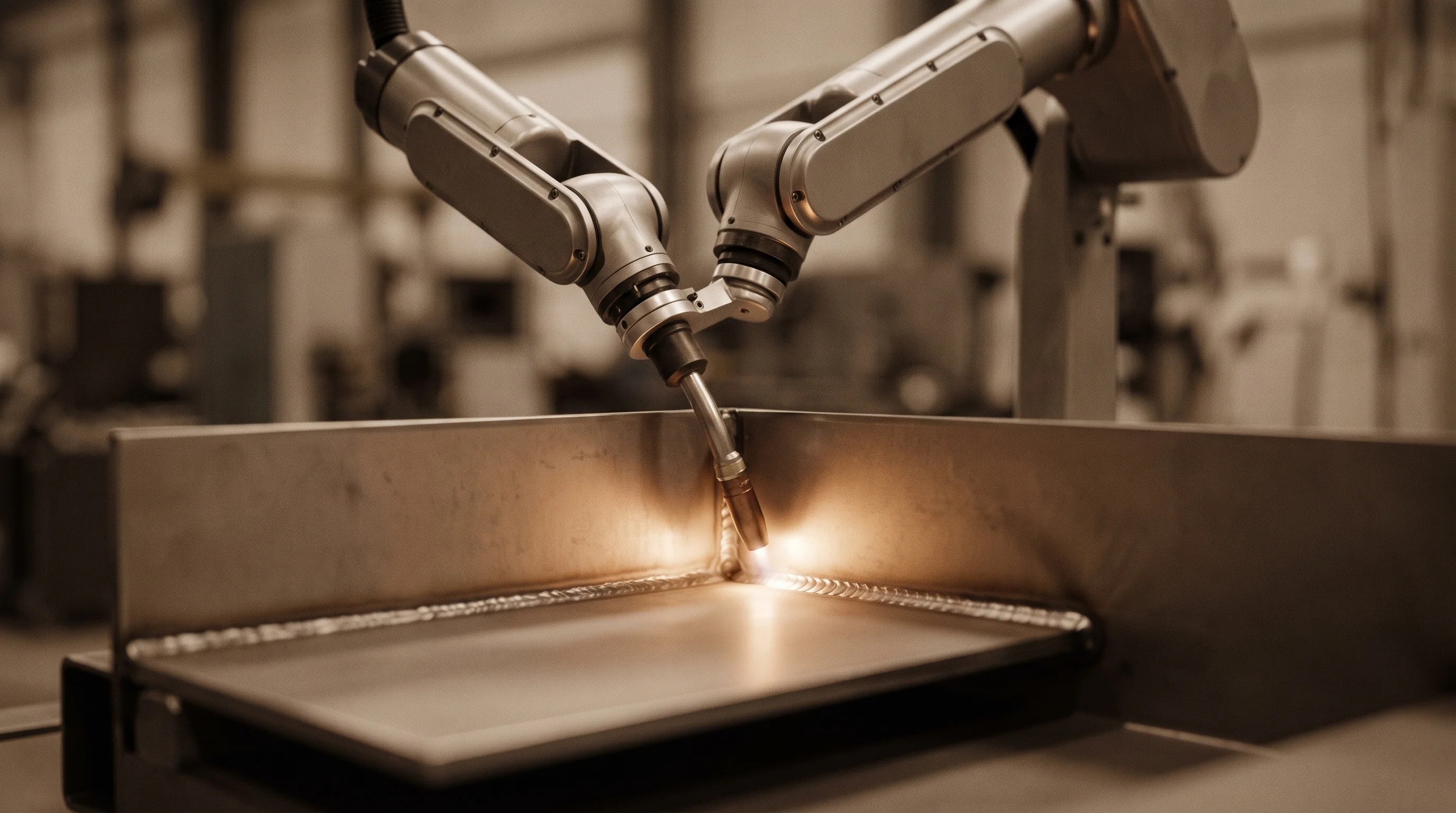
AMR is building American-made robotic welding cells with computer vision for real-time seam tracking and post-weld inspection. The pitch centers on closed-loop manufacturing that learns from every weld—not static automation, but adaptive systems. The company's YC page frames the problem using AWS's 320,500-by-2029 shortfall and the annual openings driven by replacement demand, positioning its solution as scaling welding knowledge rather than merely adding robotic capacity. As of late June 2026, AMR has disclosed no public funding amounts beyond Y Combinator's standard deal, placing them somewhere pre-Demo Day in the funding lifecycle.
Path Robotics, further along the capital curve, announced its Rove mobile welding system on April 16, 2026. Rove represents Path's bet on "physical AI"—systems that perceive and adapt to real-world variability without extensive pre-programming. The same month, Huntington Ingalls Industries, a major naval shipbuilder, announced the HYPR program partnering Path Robotics and GrayMatter Robotics to accelerate production scale. Shipyards face brutal welder shortages and have parts measured in meters, with joint prep that varies weld to weld. Path's adaptive approach, if it delivers, could prove pivotal in defense contracting—where schedule slips don't just cost money but cascade into geopolitical risk.
Novarc Technologies signed a memorandum of understanding with Yaskawa on June 15, 2026, to advance AI-powered autonomous welding. Novarc's product line includes the SWR-TIGMIG (launched November 2025) and SWR+TIPTIG Autonomy (announced September 2025), all built around the NovAI platform. A case study from the Mechanical Contractors Association of America featured Waldinger Corporation reporting that Novarc's SWR system delivered output equivalent to three to four welders, with arc-on time hitting 6.8 hours per shift. That's a productivity metric traditional manual welding struggles to approach, given setup, positioning, and inspection intervals.
The cobot incumbents aren't standing still. Miller Electric's Copilot family now spans configurations from the original benchtop unit to the Builder variant with FANAC's CRX-130 arm, targeting fabricators who need to handle larger assemblies or switch to aluminum. FANUC itself has pushed CRX cobot welding packages emphasizing touch sensing and through-arc seam tracking, reducing the programming burden. Hirebotics markets a Beacon controller and Cobot Welder package designed to be deployed by shop personnel without robotics expertise; Iron Supports, a case-study customer, scaled output without adding headcount by deploying Hirebotics cells on repeatable parts.
What these examples share: a focus on reducing variability through fixturing and part control, then letting adaptive perception handle the residual unknowns. The technology works best—so far—when the process is ergonomically taxing (overhead pipe welding, confined-space work) or when parts arrive with consistent geometry. High-mix, low-volume job shops with constantly shifting fixtures and joint access challenges remain harder targets, though offline programming tools like Octopuz, RoboDK, and Verbotics Weld are compressing setup time from days to hours.
The Data Layer No One Talks About
A parallel driver, often underweighted in automation discussions: the tightening compliance and traceability landscape. ISO 3834, the international standard for quality requirements in fusion welding, is gaining traction in export-oriented and regulated sectors. Automotive PPAP (Production Part Approval Process) demands weld parameter documentation. Nuclear and pressure-equipment codes require genealogy that links every weld to qualified procedures, certified welders, and lot-traceable filler metals.
Lincoln Electric's CheckPoint platform and Fronius's WeldCube Premium answer this need by logging weld parameters, part serial numbers, and operator credentials in centralized databases. Fronius WeldCube Navigator, highlighted in press materials from 2023 through 2026, offers digital sequence plans that guide operators through complex assemblies while capturing every step.
This isn't just a quality play. It's a knowledge-capture mechanism.
When an experienced welder adjusts voltage mid-bead to compensate for a gap, that adjustment gets timestamped and tied to a part number. Over time, the data becomes training fodder—for both human apprentices and machine-learning models. The technology can be as mundane as structured data collection or as sophisticated as real-time defect prediction. Research published in 2026 demonstrates transfer learning models that generalize across weld types, using labeled data from one joint geometry to improve classification accuracy on another. Cognex's OneVision platform, which went generally available in May 2026, packages deep learning for visual inspection into a framework that manufacturing engineers—not data scientists—can deploy.
Industry commentary from Pemamek and trade publications points toward connected cells, digital twins, and service models where equipment vendors monetize uptime and data insights rather than just selling capital goods. That shift favors solutions with embedded intelligence.
The Workforce Development Hedge

Technology alone won't close the gap. Workforce pipelines still matter, and efforts are expanding—if not at the scale required. Airgas announced in April 2025 an expansion of its High School Welding Education Initiative to 72 schools, citing the same AWS 320,500-by-2029 projection driving startup pitches. Technical colleges are deploying Lincoln Electric's VRTEX and Miller's AugmentedArc virtual reality simulators, which allow students to practice weld mechanics and develop muscle memory without consuming consumables or generating fumes. Research in 2026 shows VR training can accelerate skill acquisition for novices, though real-world transfer still requires supervised live-arc time.
The AWS Welding Automation Exposition & Conference, held in Minneapolis from June 2 to 4, 2026, drew fabricators, integrators, and educators focused on practical adoption pathways. FABTECH 2026, scheduled for Las Vegas in October, promises larger-scale showcases from OEMs like ABB, KUKA, and Yaskawa. The industry dialogue has shifted—subtly but unmistakably—from "whether to automate" to "how to automate without losing the craft."
Deloitte's 2026 U.S. manufacturing outlook projects that 81% of task hours will remain human-driven even as automation spreads. The framing matters: automation is positioned as augmentation—handling the repetitive, ergonomically punishing, or precision-critical tasks—while skilled welders focus on setup, inspection, repair, and the high-variability work that still defies cost-effective automation.
The Next 36 Months
The immediate future will test whether AI-powered welding systems can scale from pilot deployments to fleet adoption across the fragmented landscape of American metal fabrication. The easy wins are already happening. Centerline Brackets' million-weld milestone and sub-three-month ROI suggest cobot welding has crossed a viability threshold for certain applications—repeatable parts, controlled fixturing, substitution for ergonomically brutal tasks.
The harder question? High-mix, low-volume work. Job shops that weld custom brackets one week and structural steel the next, often with hand-cut prep and minimal fixturing. Offline programming and vision-guided path correction are narrowing the setup-time gap, but these shops will likely remain human-intensive longer than production environments. That's not a failure of the technology so much as a reminder that welding encompasses a spectrum—from mass production to something closer to artisan fabrication.
For manufacturing executives, the calculus is shifting whether they like it or not. Waiting for welders to materialize won't work when retirements are outpacing vocational program graduations by structural margins. The question becomes: which parts justify automation investment now, and how do we build internal capability to deploy and maintain these systems? The answer increasingly involves hybrid teams—experienced welders who understand metallurgy and joint mechanics working alongside engineers who can tune vision parameters and maintain robot kinematics.
Investors evaluating industrial tech startups should scrutinize not just the AI models but the deployment model itself. Can the system be installed and commissioned by the customer's own team, or does it require vendor technicians on-site for weeks? How does it handle the unexpected—part variation, tack weld spatter, joint access constraints? Path Robotics raised substantial funding betting on physical AI that adapts. Advanced Metal Research is betting on learning systems that improve with every weld. Novarc and Hirebotics are betting on turnkey simplicity. The market is large enough for multiple winners, but the approaches differ materially.
Policy makers face a harder problem, one without elegant solutions. Workforce development programs take years to produce certified welders, and even aggressive expansion won't close a 320,500-person gap by 2029. Automation offers a multiplier—one skilled welder overseeing three cobot cells instead of working solo at a bench—but it requires capital and technical literacy that many small fabricators lack. Tax incentives for manufacturing automation, grants for technical college equipment upgrades, and Buy America provisions that favor domestic fabrication with technology adoption all pull in the right direction. But legislative sausage-making often lags the on-the-ground urgency by years.
What's certain: the welding workforce shortage is structural, not cyclical. Retirements are a demographic fact, not a projection that might swing with economic headwinds. Infrastructure spending is legislated and multiyear. Reshoring momentum isn't reversing. The 320,500 figure isn't a worst-case scenario; it's the baseline projection from the industry's own workforce data as of 2025, reiterated consistently through 2026.
The companies building AI-powered welding systems—whether three-person YC startups in Los Angeles or established OEMs in Ohio—are making a different wager. Not that robots will replace welders, exactly. But that intelligent systems can scale the knowledge of the welders we have, capturing decades of expertise before it retires and deploying it across hundreds of cells.
If that wager pays off, America's manufacturing renaissance has a fighting chance. If it doesn't, the gap between infrastructure ambitions and fabrication capacity will keep widening. And the bottleneck will be measured not in steel or capital, but in the scarcity of people who know how to make metal stick together under pressure.
That's the bet. We'll know soon enough if it was the right one.


