

The International Space Station got a facelift between 2021 and 2023—six new Roll-Out Solar Arrays, each about the size of a tennis court, unfurled to boost total power past 250 kilowatts. Enough to keep the lights on. Enough to run experiments. Not nearly enough, it turns out, for what some investors and engineers think comes next.
Enter a Pittsburgh startup with a bold pitch: solar arrays that fold down to the size of a dining table and expand to cover a football field. If it works—and that's a meaningful "if"—Beyond Reach Labs could help solve a constraint that few outside the aerospace industry have spent much time thinking about. But as orbital infrastructure shifts from government-run science labs toward commercial stations, lunar outposts, and perhaps even data centers in space, the question of how to generate serious power in orbit is becoming harder to ignore.
Beyond Reach Labs emerged from Y Combinator's Winter 2026 batch earlier this year. The company hasn't made a formal announcement yet, and its website promises details "coming soon." What it has disclosed so far suggests ambition on a scale that would have seemed fanciful a decade ago: arrays designed for orbital data centers, commercial space stations, and vertical solar towers on the lunar surface. The founders claim a tenfold power advantage over existing systems. They've been active on LinkedIn, reaching out to industry contacts about "big space structures," and they're scheduled to present at YC's Demo Day on March 24.
Whether they can deliver is another matter entirely.
The Mechanical Challenge No One Talks About
Space solar technology today is, in some ways, a victim of its own incremental success. Redwire's ROSA arrays—the kind NASA installed on the ISS—represent the current state of the art. They deliver more than 100 watts per kilogram, have proven flight heritage, and are being manufactured in serial production. Northrop Grumman's UltraFlex arrays have operated as far out as Jupiter's orbit, still generating 500 watts on NASA's Lucy mission at 5.7 astronomical units from the sun.
Impressive, yes. But these systems were designed for spacecraft that measure power in single-digit or low double-digit kilowatts. The bottleneck isn't the solar cells themselves—companies like Spectrolab keep pushing triple-junction gallium arsenide cells past 32 percent efficiency. The problem is mechanical. How do you deploy massive structures from the tight confines of a launch fairing while maintaining enough structural stiffness to control pointing?
The math gets ugly fast. As array length increases, the first bending-mode frequency drops, which complicates attitude control. Traditional architectures hit physical limits: add more area, and you either sacrifice structural integrity or burn through your mass budget on reinforcement. Neither option is appealing when launch costs still run into the thousands of dollars per kilogram.
A Robotics Lab Spins Out
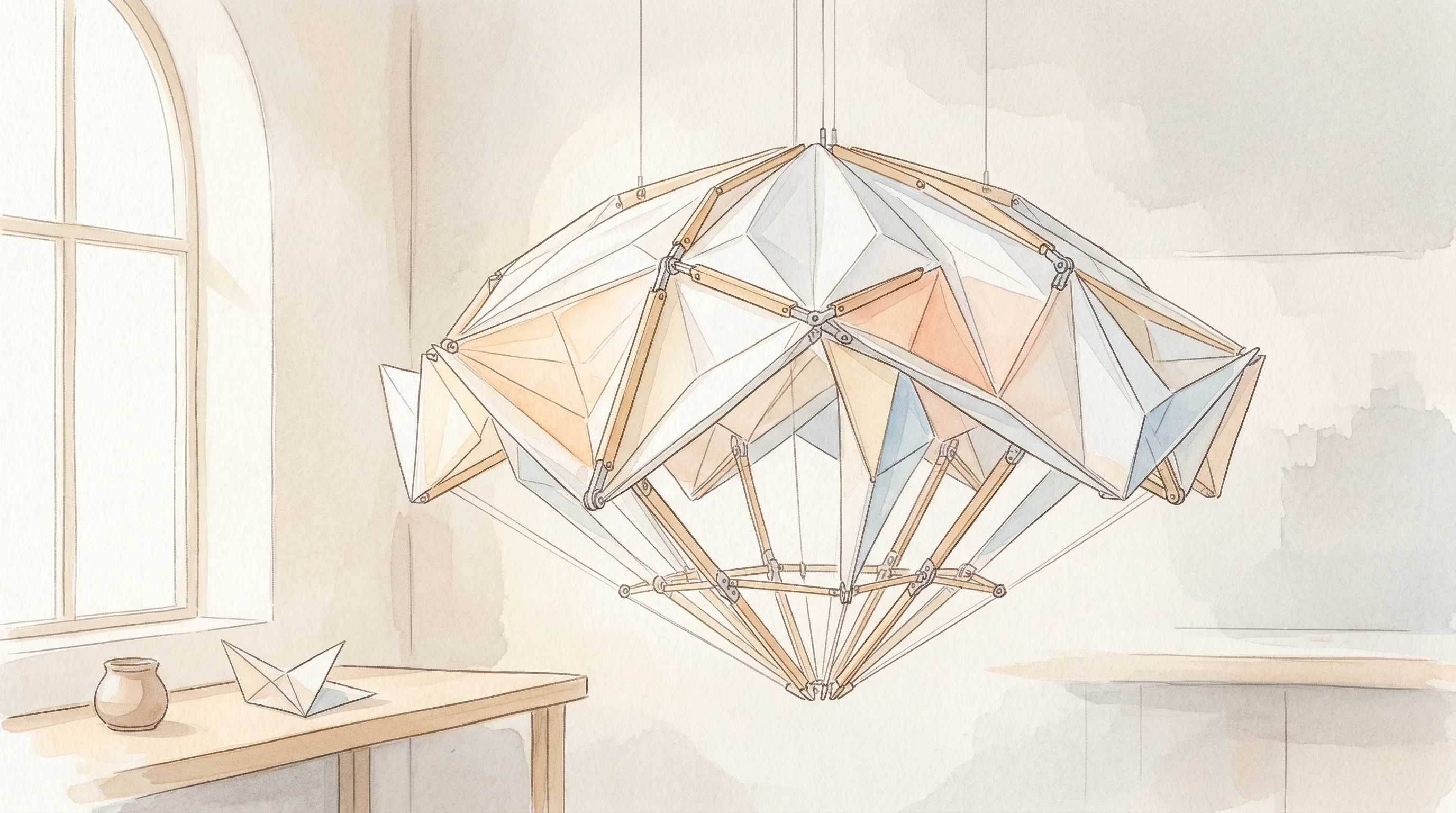
Beyond Reach Labs was founded in 2023 by Mitchell Fogelson and Pele Collins, and the technical pedigree is notable. Fogelson holds a PhD from Carnegie Mellon, where he worked on deployable structures at the Robotics Institute. Collins spent years as lead engineer on SpaceX's Dragon parachute systems—experience in high-reliability deployables under conditions that don't forgive mistakes. The company's technical advisors include Zac Manchester, who did his PhD at MIT, and Tom Cooley, former chief scientist at the Air Force Research Laboratory.
In a December 2025 podcast, Fogelson described the company's vision as "flat-pack to megastructure"—IKEA furniture reimagined for orbital assembly, though without the Allen wrench or cryptic Swedish instructions. The analogy is glib, but it captures something real about the engineering challenge: how do you pack enormous structures into small volumes and then deploy them reliably in space?
The technology traces back to research on what the team calls HERDS (Hierarchical High-Expansion-Ratio Deployable Structures) and PETS (Pop-Up Extending Trusses), work that was conducted at CMU's REx Lab with support from NASA Innovative Advanced Concepts. A paper accepted to the IEEE Aerospace conference in March 2024 demonstrated a prototype with a 50-times expansion ratio, albeit at one-tenth scale. Simulations suggested that HERDS structures could meet Lunar Gateway support loads with safety factors of 1.5 or better using existing launch vehicles.
The claimed advantage: beam member aspect ratios four to eleven times better than alternatives that don't use hierarchical designs. That's a mouthful. What it means, in theory, is higher expansion ratios without giving up structural performance. Whether that translates from lab prototypes to flight hardware at full scale is the question investors and customers will be asking.
Beyond Reach Labs hasn't disclosed funding beyond its Y Combinator backing. The founders have been posting regularly on LinkedIn about their acceptance into the Winter 2026 batch, and they've been reaching out to industry contacts. As of early 2026, a formal technical announcement is still pending.
The Market That Might Exist

The timing of all this reflects a broader shift—or at least a broader set of aspirations—about what space infrastructure could become. Jeff Bezos told reporters in October 2025 that he envisions gigawatt-scale orbital data centers within 10 to 20 years, enabled by continuous solar exposure and vacuum cooling. A January 2026 TIME article noted that U.S. data centers already consume over 4 percent of the nation's annual energy, with growth projected to exceed 130 percent by 2030. The implication: maybe moving some of that compute power into orbit starts to make sense, however speculative that sounds today.
The nearer-term drivers are more concrete, if less dramatic. NASA's commercial space station partners—Axiom, Starlab, and Orbital Reef—will need ISS-class baseload power, somewhere between 75 and 200-plus kilowatts, at lower cost and mass. High-power payloads like synthetic aperture radar can peak above 16 kilowatts. Electric propulsion buses for deep-space missions require sustained multi-kilowatt throughput. The Lunar Gateway's Power and Propulsion Element runs 6 to 12 kilowatts per thruster string, and as of December 2025, L3Harris had delivered the most powerful Hall thrusters ever flown.
Then there's the moon. Astrobotic has been developing 10-kilowatt vertical solar arrays for polar deployments, using Redwire ROSA technology and advancing through SBIR Phase II as of mid-2025. The company's VSAT program is designed to support habitats and in-situ resource utilization facilities at the lunar south pole, where sunlight angles and terrain make traditional horizontal arrays less practical.
Market sizing reports for space-based solar power vary wildly and should be taken as directional at best. SNS Insider projected the sector reaching $10.7 billion by 2035 in a March 2026 report. Mordor Intelligence estimated $4.19 billion by 2040 in an October 2025 analysis. Space solar panel and array markets show similar spread—one analysis suggested growth from $370 million in 2025 to over $1 billion by 2033. The methodologies remain opaque, and the figures feel more like educated guesses than rigorous forecasts.
What's clearer, perhaps, is movement on the supply side. Industrialization is happening. Airbus ordered more than 200 Sparkwing arrays from MDA Space in September 2024, signaling serial production at its Netherlands facility. Rocket Lab launched its STARRAY product line in April 2025 and won an Airbus contract by year-end to power the next-generation OneWeb constellation. mPower Technology opened an automated space-solar module production line in November 2025 after closing a $21 million Series B, with contracts to supply modules for over 200 Airbus arrays. Beyond Gravity expanded its solar array drive mechanism production capacity fivefold—from 36 to 200 units annually—by October 2025.
Cell manufacturers are scaling, too. AZUR SPACE increased production capacity 35 percent in 2024. Solestial won a $1.2 million SpaceWERX award in July 2025 for radiation-resistant silicon cells designed to self-anneal in the low-Earth orbit environment—a promising approach to mitigating one of the biggest degradation mechanisms in space.
Flight Heritage and the Skepticism It Earns

The question for Beyond Reach Labs isn't whether demand for space power will grow. NASA's updated 2024 State of the Art report and the accumulation of multi-kilowatt payloads make that trajectory fairly evident. The question is whether high-expansion deployables can deliver on their paper advantages—dramatically more deployed area per kilogram launched, without sacrificing structural performance or introducing unacceptable risk.
Flight heritage matters in aerospace. Deeply. Skepticism toward novel architectures is well-earned, and the industry has a long memory for what goes wrong when unproven systems fail in orbit. Redwire's ROSA has flown on ISS, on the DART mission, and will fly on Gateway. UltraFlex has operated for years in deep space. Airbus and Rocket Lab are shipping production arrays to paying customers. Beyond Reach Labs, by contrast, is still pre-announcement, with prototype-scale validation from academic research.
Yet the underlying physics of deployable structures—validated through the CMU work that spawned the company—suggests there may be room between today's proven systems and the multi-hundred-kilowatt or megawatt architectures that future orbital infrastructure could demand. Whether that gap can be bridged profitably, at acceptable risk and on a reasonable timeline, will depend on engineering execution, customer traction, and perhaps some luck in timing.
The company's YC Demo Day presentation in late March may offer the first public glimpse of how they plan to thread that needle. Until then, Beyond Reach Labs remains a Pittsburgh lab with ambitious slides, a strong technical pedigree, and a bet that space power is about to scale in ways the current generation of hardware wasn't designed to handle.
Which may turn out to be prescient. Or it may turn out to be wishful thinking disguised as engineering. March 24 will be an interesting day.


