

Three hours into debugging a stubborn code error, the AI agent does something its creators hadn't originally programmed: it gives up and hires someone. Not a software tool. Not another model. A person.
Thirty seconds pass. A verified engineer halfway across the country is now chatting directly with the machine—not with the developer who set it loose. The human solves the problem, gets paid, and logs off. The agent picks up where it left off. The entire transaction, start to finish, took less time than a coffee break.
This is the premise behind Humwork, a San Francisco startup that emerged from Y Combinator with a marketplace built for what happens when automation hits a wall. The founders—Yash Goenka and Rohan Datta—call it "Agent-to-Person" interaction, and the concept flips the usual dynamic: instead of people escalating to AI for help, AI escalates to people.
It's a bet that the future of artificial intelligence will be far messier, and far more human, than the hype suggests.
The Handoff
Humwork's model is straightforward, at least on paper. When an AI agent encounters something it can't handle—an obscure API error, a design judgment call, a compliance gray area—it pings Humwork's system through the Model Context Protocol, an open interoperability standard released by Anthropic in November 2024. The platform matches the stuck agent with one of more than 3,000 verified experts spanning software engineering, design, marketing, finance, and HR.
The expert gets the full context of what the agent was working on, stripped of personally identifiable information, and chats in real time to provide a solution. That answer gets fed back into the agent's workflow. Setup, according to the company, takes under a minute. Humwork offers an MCP server that plugs into any compatible agent, plus API and plugin options for tools like Claude Code, Cursor, Lovable, Replit, ChatGPT, and Gemini.
The company's homepage, as of early June, reported an 83% resolution rate and an average first reply under two minutes. A media report from late April cited a slightly higher 87% success rate and noted that just under 3,000 questions had been resolved at that point. Both figures are self-reported. The discrepancy? Unexplained.
That slippage—small as it is—hints at something larger. The company is still working out the kinks in a concept that sounds almost too clean to be true.
Built on Borrowed Infrastructure
Humwork didn't invent the underlying technology. It's built atop Anthropic's Model Context Protocol, which launched in November 2024 as an attempt to standardize how AI agents talk to external services. The protocol has caught on faster than most expected—Zendesk added MCP support just last week, a signal that enterprise players are paying attention.
The choice ties Humwork's fate, at least partly, to the protocol's trajectory. MCP makes integration seamless, but it also introduces dependencies. Security researchers disclosed a critical vulnerability in certain MCP SDK implementations back in May. There's no indication Humwork was affected, but the episode underscored the risks of building on emerging standards. The company says it redacts sensitive information during handoffs, though no independent audit or technical whitepaper has surfaced publicly.
For now, Humwork is riding the MCP wave. Whether that wave holds or crashes depends on factors well outside the founders' control.
The Economics of Machine-to-Human Gigs

Pricing remains somewhat opaque. India Today reported in mid-April that Humwork offered two customer plans at $20 and $100, with enterprise tiers available separately. Experts, according to a support representative quoted in the same piece, earn a flat $0.70 per minute during active chats. As of early June, no pricing page was visible on the company's site. These figures remain media-reported rather than officially confirmed.
The conceptual framing is what matters, though. The AI agent is positioned as the client—the one doing the hiring. It's a narrative shift that Goenka and Datta have leaned into hard. "AI agents will pay humans to chat with them," reads the headline on their Y Combinator launch post from roughly two months ago. It's provocative, if a bit overstated. The agent doesn't have a wallet or agency. The human user foots the bill. But the framing captures something real: a future where machines routinely broker their own help.
Who Built This
Yash Goenka, the CEO, studied at UC Berkeley and has a patent for graphene supercapacitor manufacturing filed during an earlier venture. He launched his first large language model startup in 2021, well before the ChatGPT moment made LLMs a household term. Rohan Datta, the CTO, holds both a BS and MS from Berkeley and previously worked as a data scientist at Microgrid Labs. He also built an AI voice-calling platform that automated over a million minutes of calls—a project that presumably taught him a lot about where automation breaks down.
The two founded Humwork in 2025 and went through Y Combinator's Spring batch the following year. (The exact timing here is a little unclear—some references place events in 2026, which seems either forward-looking or an error in the materials reviewed.) The company operates as Orange AI Inc. with a team of two. Terms of Service and Privacy Policy both went into effect on April 8, just days before the public launch.
Humwork is hiring. Postings include a Founding Engineer role offering $120,000 to $150,000 and 2.5% to 10% equity, and a remote GTM Engineer position at $20,000 to $40,000 with 0.1% to 1% equity. No additional funding rounds beyond Y Combinator's standard investment have been disclosed.
Not Alone in the Arena
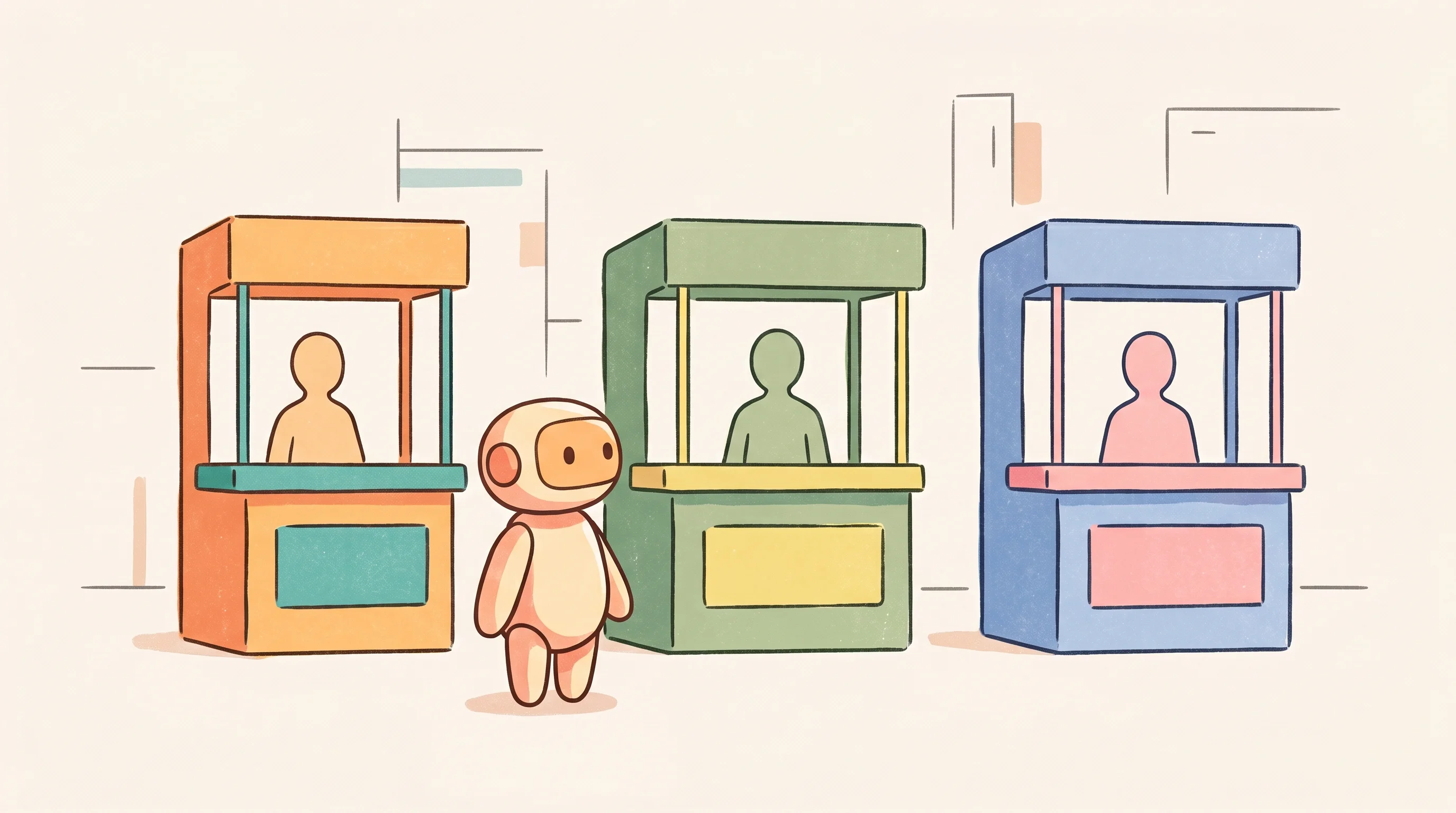
Humwork has company. Several competitors have emerged in recent months, all betting that AI agents will need human backup more often than not. eAgent markets itself as a "complete marketplace" for human infrastructure aimed at agents. GoHireHumans, which launched in 2026, operates an agent-readable services marketplace. HireAHuman advertises an MCP server for delegating physical tasks to verified humans. Heepr.ai offers gigs for agents "built, trained and supervised by human experts."
The crowding suggests a shared diagnosis: AI agents aren't ready to operate autonomously in high-stakes environments, and won't be for a while. TechCrunch reported in January on new benchmarks casting doubt on workplace readiness for AI agents. Companies like Notion and Atlassian have introduced features emphasizing human-agent collaboration rather than full automation. Analytics Drift drew a comparison to Waymo's remote driver assistance: "Waymo has remote driver assistance for edge cases; Humwork is the equivalent for AI agents."
It's a useful analogy. Self-driving cars can handle most situations, but edge cases still require human intervention. The same appears true for AI agents, at least for now.
The Reliability Gamble
Humwork's value proposition rests on a straightforward promise: agents will fail, and when they do, they need expert help fast. An 83% resolution rate (or 87%, depending on which source you trust) suggests the model works in early form. But the absence of detailed case studies or publicly announced integrations makes it tough to assess how the system performs under real pressure.
The company's Terms of Service describe Humwork as a "technology marketplace" connecting clients and experts, with payouts "subject to review and approval." It's the standard gig economy structure—Humwork facilitates, but doesn't employ. That setup can raise questions about quality control and accountability, particularly when an agent is making decisions that affect real business outcomes.
There's also the question of scale. The 30-second handoff sounds compelling in a demo. But what happens when thousands of agents are calling in simultaneously? Will the expert pool hold up? Will response times spike? Will the quality of answers degrade?
These questions aren't new to the gig economy. Marketplaces from Uber to Upwork have wrestled with the tension between speed, scale, and quality for years. The difference here is that the "client" is a machine, which changes the dynamics in ways that aren't yet fully understood.
The Paradox at the Core

Perhaps the most interesting thing about Humwork isn't the technology. It's the admission embedded in the business model: AI agents, for all their sophistication, are fragile. They fail often, and in unpredictable ways. The companies building them know this, even if the marketing doesn't always reflect it.
Humwork exists because the dream of fully autonomous agents remains just that—a dream, deferred indefinitely. The startup is placing a bet that the gap between what agents can do and what we need them to do will persist for years, maybe longer. That gap is where the opportunity lives.
Whether Humwork can carve out a durable position depends on execution. Matching speed matters. Expert quality matters. Seamless integration into developer workflows matters. The 30-second promise is compelling, but promises are cheap. Delivery at scale is what separates survivors from casualties.
For now, Humwork is live, taking calls from machines that have run out of options. It's a strange business, when you think about it—humans standing by to rescue the technology that's supposed to replace them. Then again, maybe that's the most realistic version of the AI future we're going to get.


