

The shop floor smells like ozone and hot metal. Arc flash. Sparks scattering. A human welder, masked and focused, running a bead along a structural beam—a scene that's been playing out in American fabrication shops for a century. Except now, in an increasing number of facilities from Michigan to the Gulf Coast, there's a machine doing the same work. And it doesn't take smoke breaks.
The numbers tell a story that fabrication shop owners already know in their bones: According to the American Welding Society, America needs something close to 320,500 new welding professionals by 2029. Break that down and you're looking at roughly 80,000 recruits annually from 2025 to 2029, just to replace the 157,000 workers nearing retirement and absorb demand from infrastructure spending, reshoring, and defense projects. The nation's existing 771,000-strong welding workforce is stretched thin, earning a median wage of $51,000—a figure that hasn't kept pace with how complex or critical the work has become.
The gap isn't closing.
But across the industry, a shift in thinking is underway. The question isn't merely "where will we find welders?" anymore. It's evolved into something more pragmatic, perhaps more urgent: "how do we scale the expertise we already have?"
Tailwinds and a Stubborn Bottleneck
The U.S. welding industry sits at an unusual intersection—multiple secular tailwinds converging on a singular, stubborn constraint. Infrastructure spending continues to flow, particularly through the IIJA's Bridge Investment Program, driving structural steel fabrication demand at least through fiscal 2026. The CHIPS Act has triggered what looks like a multi-year wave of semiconductor fab construction, with groundbreakings scheduled through 2029 that will need process piping, equipment skids, heavy fabrication. The Reshoring Initiative tallied 244,000 job announcements in 2024, though more recent data suggests certain industrial sectors may have cooled somewhat.
Against that backdrop, robot adoption is picking up speed. North American manufacturers ordered 36,766 industrial robots worth $2.25 billion in 2025—a 6.6% year-over-year increase, according to the Association for Advancing Automation (A3). First-quarter 2026 data showed 9,055 units and $543 million in orders. Collaborative robots, or cobots, represented 18.1% of units and 12.9% of revenue. That cobot share is climbing.
Here's where things get interesting, or perhaps confusing depending on who you ask. The Bureau of Labor Statistics projects just 2% employment growth for welders from 2024 to 2034, with roughly 45,600 openings annually. That's less than half what industry groups like the American Welding Society are warning about—a discrepancy that reflects both definitional differences and the reality that BLS models may not fully capture what fabricators are reporting from shop floors.
Someone's math is off. Or maybe both sets of numbers are right, just measuring different things.
What Changed? Not the Shortage—the Answer to It
The labor shortage itself isn't news. Fabricators have been sounding alarms for a decade. What's different now is the technology available to address it, and the speed at which that technology is maturing.
In September 2025, Path Robotics unveiled something called Obsidian—a foundational AI model purpose-built for welding. Unlike traditional robotic welding systems that demand fixed programs and near-perfect part positioning, Obsidian uses computer vision and real-time parameter adaptation to handle fit-up variation and complex joint geometries. The tolerance and judgment calls that have historically required a human welder, in other words. By February 2026, Huntington Ingalls Industries, the largest U.S. military shipbuilder, had signed a memorandum of understanding with Path to explore deployment in shipyards, where high-mix, low-volume work has resisted automation for decades.
Novarc Technologies, a Canadian company, launched NovAI in September 2025—a real-time adaptive welding system that tracks the weld pool and adjusts parameters on the fly. By June 2026, Novarc had inked a strategic agreement with Yaskawa to advance what they're calling autonomous welding. At Waldinger Corporation, a mechanical contractor, Novarc's SWR spool welding robot is reportedly delivering 300 to 345 feet of deposited inches per day, with up to 6.8 hours of arc-on time per shift. Those are productivity metrics that would be exceptional for a manual welder working overtime.
ABB Robotics and NVIDIA announced a partnership in March 2026 to scale something they're calling "physical AI" for industrial applications—a term that's gaining traction to describe domain-specific models merging sensor data, physics simulations, and machine learning. The idea is enabling robots to operate in messier, less-structured environments than traditional automation could handle.
Miller Electric and ICS debuted their Copilot cobot welding system in September 2025, explicitly targeting smaller fabrication shops without in-house robotics expertise. SEC Automation, part of the ESAB ecosystem, launched AutonoWeld with an integrated AI-driven welding intelligence engine the same month.
The common thread here? These aren't systems designed to mimic human welders. They're designed to extend the reach of experienced welders by embedding their decision-making into machines that can operate longer, more consistently, and with less setup overhead. It's a subtle but important distinction.
Theory Meets Metal
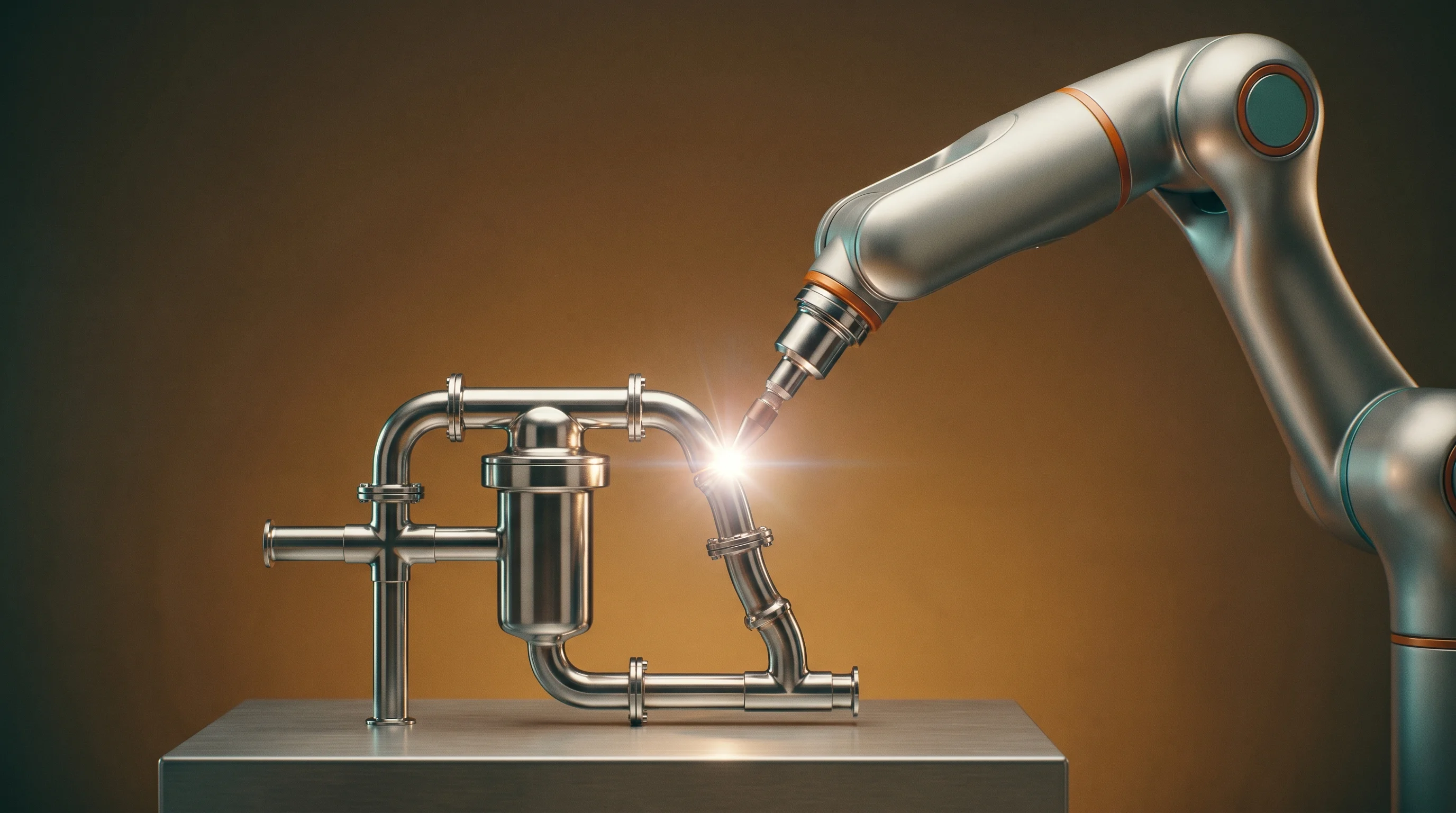
A filtration systems manufacturer in Michigan slashed cycle times from 60-plus minutes for manual welding of complex stainless and dissimilar joints to roughly 10 minutes with robotic welding. A sixfold throughput gain while maintaining quality specs. At Pik Rite, collaboration with THG Automation—using Universal Robots and Fronius equipment—enabled coordinated motion and multipass welding on complex paths without requiring an in-house robotics expert.
Intercon, a job shop working with Vectis Automation, reported positive ROI on the first job using multipass cobot capability. That's the kind of stat that gets passed around at trade shows.
Not all deployments are low-volume. Hutchison Inc. installed a dual-robot cell using Fanuc and Lincoln Electric integration, with simulation-led design enabling rapid commissioning. Athena Manufacturing, working with Hirebotics' Cobot Welder, reported welds up to 70% faster than prior methods—gains that matter when you're trying to scale production without scaling headcount proportionally.
Perhaps most telling is Oak Ridge National Laboratory's decade-long partnership with Lincoln Electric on wire arc additive manufacturing, or WAAM—using multi-robot coordination to build large-scale metal parts layer by layer. What began as R&D is migrating toward production, with applications in aerospace, tooling, and repair. Pemamek, which supplies heavy-fabrication automation for shipbuilding and wind energy, announced a multi-pass submerged arc welding automation project targeting first contracts in 2026–2027, and a robotic welding line for Damen Galati shipyard in January 2026.
These aren't isolated pilots anymore. They're early indicators of a deployment curve that appears to be steepening.
Advanced Metal Research, a Y Combinator Spring 2026 company, frames the opportunity differently. The shortage isn't just labor, the founders argue—it's knowledge. Building American-made robotic welding cells with real-time seam tracking and post-weld inspection creates a closed-loop system that scales expertise, not just capacity.
The distinction matters. A robot that requires perfect part positioning and a flawless program replaces a welder. A robot that adapts to variation and learns from feedback? That amplifies one.
Bifurcating Trajectories
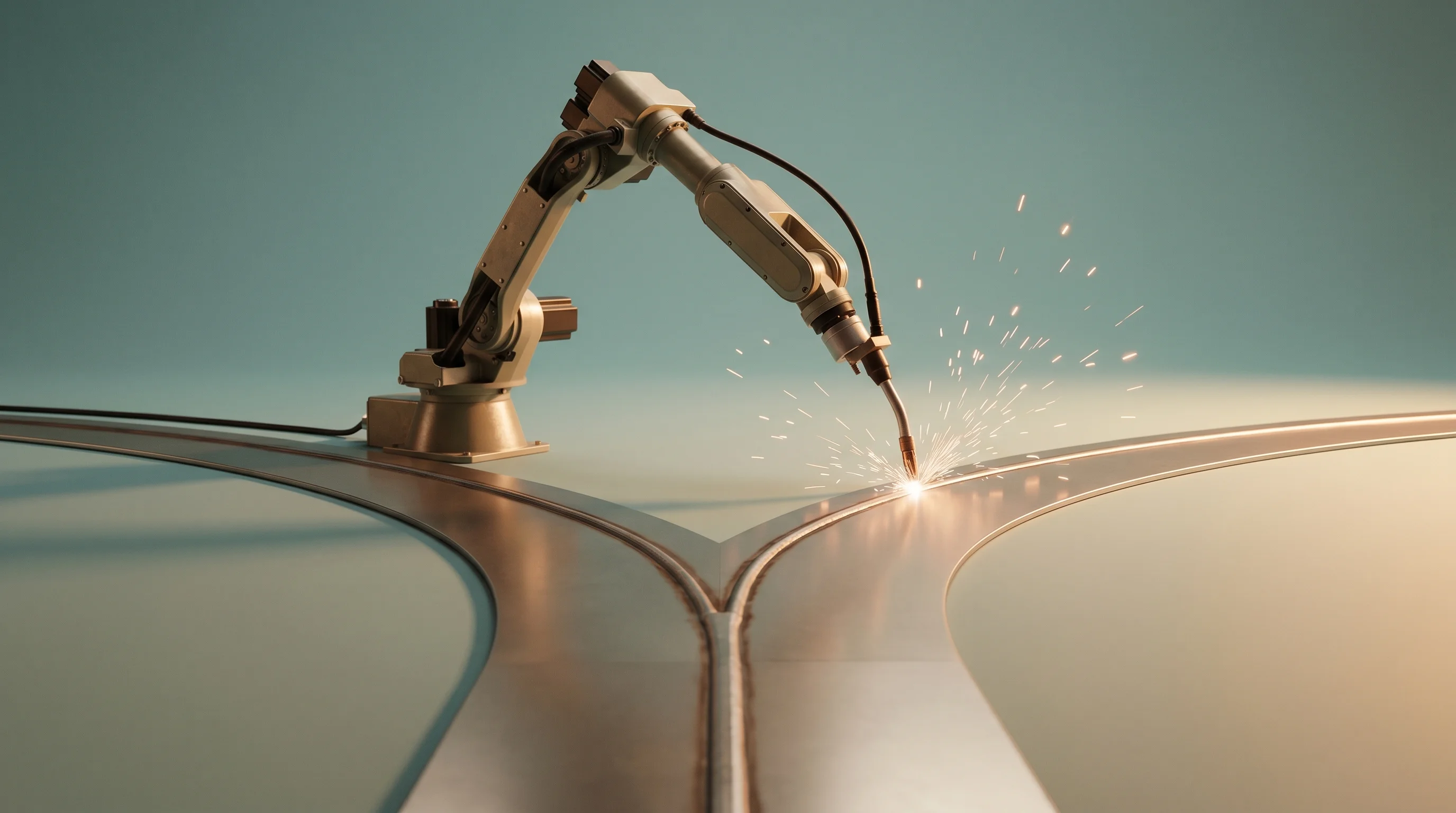
The near-term picture is splitting in two.
High-volume manufacturers—automotive, heavy equipment, appliance makers—are integrating AI-powered welding systems into greenfield lines and retrofitting brownfield facilities as part of broader enterprise AI deployments. The World Economic Forum's Global Lighthouse Network added 23 sites in January 2026, with enterprise-wide AI becoming increasingly standard among the 220-plus facilities recognized for manufacturing excellence. Deloitte's 2026 manufacturing outlook highlights agentic AI and automation as central to productivity and quality gains, though execution gaps around data infrastructure and skills remain.
For the tens of thousands of smaller fabrication shops—the job shops, contract manufacturers, regional steel fabricators that employ the bulk of U.S. welders—the calculus is more complex, more uncertain. Cobots, with faster setup and lower cell costs, are making automation accessible to operations that couldn't justify traditional robotic cells. Documented payback periods of six months at two-shift operations (per Acieta's FastARC CW claims) are compressing the decision window. Partner ecosystems like Universal Robots working with Hirebotics, Vectis, and THG are delivering turnkey solutions with ongoing support.
But accessibility isn't adoption.
The Society of Manufacturing Engineers noted in January 2026 that this year represents an inflection point—AI, robotics, and connected systems moving toward default status. That assumes capital availability, training pipelines, and process redesign that many smaller operators haven't undertaken. The technology is ready. Whether the industry structure can adapt fast enough is another question.
Policy Crosscurrents and Standards

Policy creates both headwinds and tailwinds, as it tends to. The Build America, Buy America Act's final rule on manufactured products, effective for FHWA-funded projects obligated after October 1, 2025, requires domestic content and assembly thresholds that could boost U.S. fabrication demand—or create compliance bottlenecks, depending on execution. IIJA programs are front-loaded through fiscal 2026, and industry commentary in mid-2026 has begun flagging "funding cliff" concerns without reauthorization. The CHIPS Act's fab construction wave is a known quantity through 2029, but timing slips and scope changes are typical in megaprojects of that scale.
Standards are catching up, quietly but importantly. The American Welding Society released D16.4:2025, the first comprehensive standard for qualification of robotic arc welding personnel, alongside updates to D1.1 (structural steel) and D1.5 (bridge welding). ANSI/A3 R15.06-2025, the updated robot safety standard, provides clearer guidance for industrial and collaborative welding cells. These aren't glamorous developments, but they're foundational to scaling deployment responsibly.
The Three-Year Question
What founders, executives, and policymakers should be watching: the interaction between labor scarcity and capital deployment. If the 320,500-welder gap materializes as projected and wage pressure intensifies, automation ROI accelerates and adoption compounds. If reshoring stalls or infrastructure spending drops post-2026, the urgency dissipates and deployment timelines stretch.
The technology exists now. The business case is increasingly clear, at least on paper. The workforce gap appears to be widening.
What remains uncertain—genuinely uncertain, not in a rhetorical sense—is whether American manufacturing moves quickly enough to turn a crisis into a competitive advantage, or whether the shortage itself becomes the constraint that limits what reshoring and infrastructure investment can actually achieve.
The next three years will likely provide the answer. Maybe sooner.


