

The catch in enterprise robotics, according to Agility Robotics' chief technology officer, isn't always the robot itself. "The cost of deployment can be more than the price of the robot by a lot," he observed—a reality now settling into the bones of anyone trying to run these machines at scale.
The initial outlay—hardware, installation, baseline programming—that's the easy part. What blindsides operations teams comes later: debugging cycles that stretch longer than anyone budgeted for, failure analysis that reveals problems no simulation predicted, the slow drip of edge cases accumulating like technical debt. As regulatory deadlines approach and Physical AI graduates from controlled pilots to actual production lines, that operational gap is hardening into something that looks suspiciously like a market opportunity.
Enter Shotwell.ai, a four-person startup from Y Combinator's recent cohort. Their thesis: the industry needs an automated intermediary layer between robot fleets and their training loops. The pitch is clean enough—send over your video data, and they'll detect failures in both training datasets and live deployments, annotating them faster than human teams can manage. It's a familiar software playbook: find a manual bottleneck, automate it with models. But timing, as they say, is everything. Shotwell is launching as three trends converge: regulatory compliance requirements are crystallizing, production deployments are moving past pilot phase, and the underlying technical infrastructure is finally—perhaps more than anyone expected—standardizing.
The Data Problem Nobody Anticipated
Jensen Huang, NVIDIA's CEO, put it bluntly at Computex in June 2024: "For agentic systems, robotic systems and physical AI, data is the hardest problem." Not compute. Not even algorithms.
Data.
The industry's shift toward generalist policies and vision-language-action models created a bottleneck that's only now becoming visible. Earlier robot systems might log a few thousand trajectories and call it a day. Modern training pipelines demand something else entirely—multi-robot, multi-task datasets that need indexing, searchability, and outcome metadata attached to every frame. The DROID dataset, to take one example, contains over 76,000 manipulation trajectories spanning 564 scenes and 84 tasks. Manual review at that scale isn't just impractical; it's impossible.
Production deployments make things messier. BMW's pilot at its Spartanburg plant—launched in 2025 with Figure 02 humanoids—logged more than 1,250 operating hours. Those robots moved 90,000 components, executed 1.2 million steps, supported production of over 30,000 BMW X3s across ten months. Each step generates telemetry: video feeds, joint states, force sensors, LiDAR sweeps. Scale that across a fleet deployment and the data volume becomes something between overwhelming and absurd.
The technical community's response has been infrastructure standardization, mostly. ROS 2 adopted MCAP as its default storage plugin in recent releases, creating a de facto logging standard across modern robotics stacks. That interoperability matters—it means fleet-wide data can be replayed, searched, analyzed without wrestling with a dozen incompatible formats. But standardization creates its own problem: now that everyone can log everything, who's actually going to make sense of it all?
Factory Floors Don't Wait for Debuggers
The industry's deployment pace is picking up. In February 2026, Toyota contracted for seven Agility Digit humanoids at a Canadian facility following a yearlong pilot. BMW is running a second humanoid trial in Germany after Spartanburg. Symbotic, the warehouse automation company, reported $676 million in revenue for its fiscal Q2 2026—up 23% year over year—numbers that reflect growing demand for systems that generate, well, massive operational telemetry.
These aren't lab demos anymore. They're production systems where downtime shows up in quarterly earnings. A study published last year in The International Journal of Advanced Manufacturing Technology documented a wafer-handling robot that failed at precisely 1,180 pick-ups, traced to belt-teeth wear through stacked-LSTM analysis of positioning drift. The researchers caught it within an actionable window, but only because they'd instrumented the system and were actively watching.
That kind of prognostic capability requires labeled failure data—lots of it. Academic work has followed demand: researchers published frameworks like I-FailSense and Guardian using vision-language models to detect robotic planning and execution errors across environments with minimal fine-tuning. An April paper combined statistical filtering with conformal prediction and VLM-based semantic analysis to distinguish harmless anomalies from genuine failures in imitation learning datasets.
The research validates the approach. But production teams don't have time to implement custom pipelines from academic papers. They need tools that work Tuesday morning.
Compliance Isn't Optional Anymore
Observability is migrating from operational best practice to regulatory mandate. The EU AI Act's high-risk classification for certain robotic systems triggers post-market monitoring, logging, and traceability requirements. Implementation timelines remain somewhat fluid—a Council communication from last spring proposed December 2027 for stand-alone high-risk systems, August 2028 for AI embedded in regulated products like machinery—but the trajectory is unmistakable.
The EU Machinery Regulation 2023/1230 takes effect January 20, 2027, imposing CE conformity assessment requirements and documented risk management for robotics. In the United States, ANSI/A3 R15.06-2025 updated industrial robot safety standards with cybersecurity considerations aligned to ISO 10218:2025. The Industrial Mobile Robots standard R15.08 saw Part 3 approval last spring.
These aren't abstract compliance exercises. They require audit trails, event logs, incident documentation. Failure labels that can prove a system was behaving within design parameters—or catch when it wasn't. McKinsey's analysis earlier this year positioned observability architectures as "gating factors for scaling pilots to production," noting that ecosystem trust depends on transparent safety regimes.
For companies operating across jurisdictions, that means building data pipelines that can satisfy regulators in Stuttgart and Sacramento simultaneously. Which is harder than it sounds.
Building the Layer Between Chaos and Clarity
Shotwell's founding team brings relevant scar tissue. CEO Farhan Khan worked on humanoid robots at Sunday Robotics and self-driving cars at Tesla. Co-founders Ali Abdalla and Ali Abid previously co-founded Gradio, which Hugging Face acquired in December 2021. The fourth co-founder, Nour Eldifrawy, has done time at Merge.dev, Roblox, and a YC company from the 2018 winter batch.
The Gradio background is worth noting. That project built tooling to make machine learning models more accessible and debuggable—precisely the problem Shotwell is tackling one layer down the stack. If Gradio democratized model interfaces, Shotwell is attempting to automate the feedback loop between deployment failures and training dataset improvements.
Their early customers reportedly include Ultra and Parametric, according to the company's website. The product offering centers on segmenting training videos into labeled actions and providing what they call "fast, accurate, dense annotations" for robotics data. It's positioned as infrastructure—a "quality layer for robotics data"—rather than a vertical application.
The competitive landscape includes platforms like Foxglove, which raised $40 million late last year to expand its data lifecycle and observability capabilities for Physical AI. There's Rerun, an open-source "data layer" for multimodal logging and visualization. Formant's fleet observability platform. Viam's broader robotics software stack. Each approaches the problem differently—Foxglove as enterprise platform, Rerun as code-first tooling, Formant with a fleet operations lens.
Shotwell's angle appears to be automation. Rather than providing visualization and search tools that still require human analysis, they're offering models that auto-label failures. That could matter if—when, really—the volume of data makes manual triage untenable. Given current deployment trajectories, that seems less like a question of if and more like when.
The Stack Is Forming
The observability layer for robotics won't be winner-take-all. Different segments—industrial automation, warehouse logistics, humanoid deployments, agricultural robotics—have different data profiles and failure modes. A wafer-handling robot's positioning drift looks nothing like a bipedal humanoid's balance recovery. The telemetry differs accordingly.
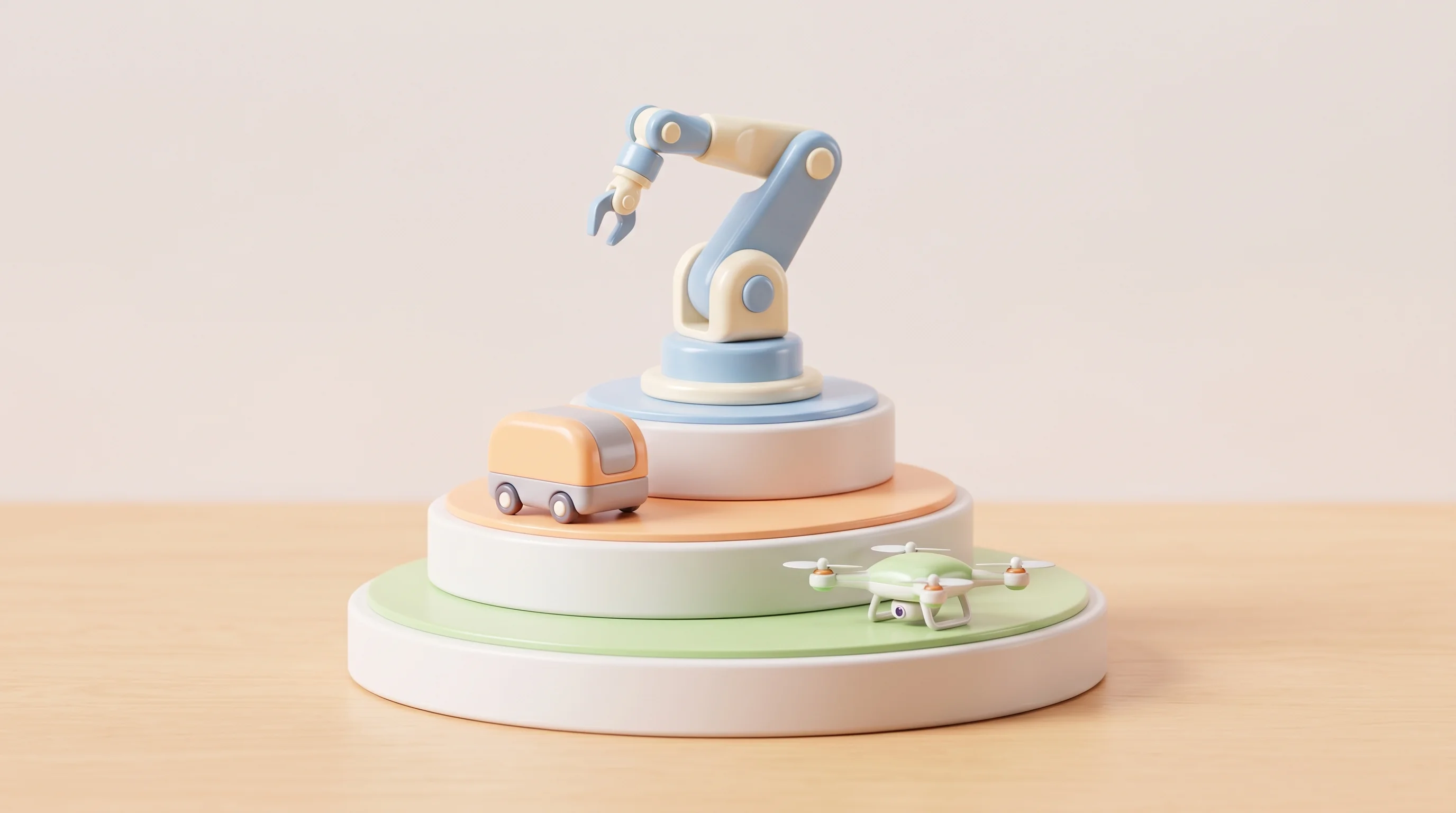
What's emerging instead is a stack. At the bottom, standardized logging formats like MCAP and frameworks like LeRobot, which Hugging Face released early this year as an end-to-end robot learning pipeline. In the middle, data platforms for storage, search, and replay. At the top, analysis layers—both human-driven tools and automated detection systems.
Shotwell is betting on the automation layer, launching as the volume of robot deployments creates enough data to train generalist failure-detection models. Whether four people can build that before larger platforms extend downward or hyperscalers bundle similar capabilities into their robotics clouds—that's the execution question.
But the tailwinds look real enough. BCG's analysis from this spring noted that "software-led integrators and safety assurance will differentiate production deployments." McKinsey's contemporaneous research emphasized ecosystem partnerships between OEMs and startups, with observability as a critical trust mechanism. And NVIDIA's ecosystem announcements around Isaac GR00T and Cosmos world models presume robust data pipelines as table stakes.
The robotics industry is entering a phase where the hard part isn't building a robot that works in the lab. It's building one that works reliably enough, long enough, and transparently enough to satisfy factory managers, regulators, and shareholders all at once.
Observability, in other words, won't be optional for long.


