

Gravis Robotics, the Swiss spinout that makes excavators dig themselves, has reportedly closed a $200 million round from SoftBank, according to Axios Pro Rata in mid-August, though neither SoftBank nor Gravis has officially confirmed the deal. If confirmed, the financing would mark the largest Series A ever disclosed in construction robotics, double the size of TerraFirma's $100 million raise from July, per Construction Dive.
But the details don't quite add up. Neither SoftBank nor Gravis had issued an official statement as of late August, and the round naming itself poses a riddle. Just nine months earlier, in November 2025, Gravis announced a $23 million Series A co-led by IQ Capital and Zacua Ventures. The relationship between SoftBank's reported investment and the earlier Series A remains unclear without official confirmation from the company.
The confusion deepens when you rewind a few weeks. In late July, Bloomberg reported that SoftBank was weighing an outright acquisition of Gravis at a valuation north of $500 million. Yahoo Japan Finance, Sifted, The Next Web and swissinfo all picked up the story; CB Insights logged an "Acq – Rumored" event on July 24, though the acquisition remains unconfirmed. Whether the $200 million round is a prelude to that deal, a defensive maneuver, or something else entirely remains anyone's guess.
What Gravis Actually Builds
The company sells a retrofit autonomy platform for excavators and earthmovers. Think of it as a brain transplant for heavy machinery. The system pairs a hardware backbone—called the Gravis RACK—with LiDAR, cameras, GNSS and hydraulic sensors, plus a Slate tablet that lets operators toggle between assisted control, teleoperation and full autonomy. Gravis claimed in November 2025 that the platform was boosting output by 30 percent, cutting rework and improving safety, though independent validation of those figures has not been published.
The customer list, disclosed last year, hints at serious traction. Taylor Woodrow deployed autonomous excavation at Manchester Airport in what it called the UK's first large-scale rollout on an active construction site. Holcim, the Swiss materials giant, both bought the system and invested through its MAQER Ventures arm. Flannery, a UK plant-hire firm, now offers turnkey excavator rentals pre-equipped with Gravis controls. Add in partnerships with Develon and Kibag, and you've got a footprint that spans OEM dealers and Swiss job sites.
SoftBank's Bet on Machines That Move
The Gravis deal, if it closes, slots neatly into SoftBank's broader push into physical AI—robots that don't just think but act in the real world. The conglomerate agreed last October to acquire ABB's entire Robotics business, a transaction expected to wrap sometime this year according to SoftBank's press office. In March, SoftBank Robotics America snapped up GCC. Corporate communications materials emphasize edge intelligence and AI-RAN technologies, the plumbing for embodied AI stacks.
Construction robotics remains fragmented, though. Built Robotics focuses on autonomous piling for utility-scale solar farms. Teleo sells retrofit kits for supervised autonomy and teleoperation. SafeAI offers a vehicle-agnostic autonomy platform for mining and construction fleets. Gravis competes in that scrum, but its emphasis on full autonomy—not just driver assistance—sets it apart, at least in theory.
The Team Behind the Machines
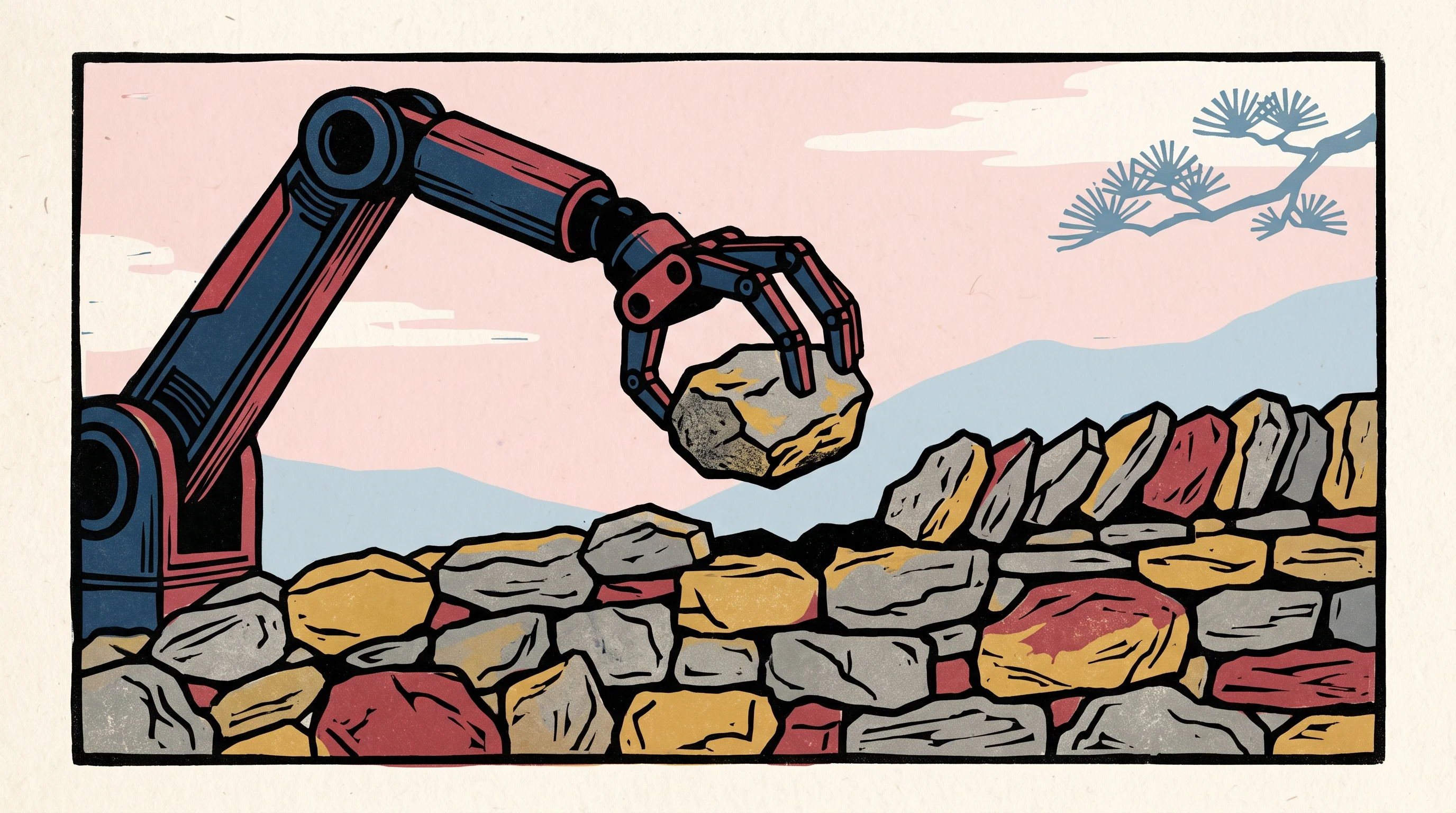
Co-founder and CEO Dr. Ryan Luke Johns brings an unusual résumé to the role: he's both an architect and a roboticist, and he holds a Guinness World Record for the largest dry-stone wall built by a robot. (Yes, really.) In November 2025, Johns wrote on LinkedIn: "We've raised $23 million to scale that technology to the sites that impact you." Co-founder and CTO Dominic Jud came out of ETH Zurich's Robotic Systems Lab, and co-founder Marco Hutter, an ETH professor, sits on the board.
The company employed 63 people as of April 2026, according to Caplight, and operates offices in Zurich, Austin and Oxford. Gravis said in November it was live in seven countries across the UK, EU, US, Latin America and Asia, though it hasn't disclosed headcount targets, use of proceeds or board changes tied to the SoftBank investment—assuming that investment is real.
For now, the construction robotics world is watching and waiting. SoftBank has a history of big, bold bets on automation. Whether Gravis becomes the next chapter in that story, or a footnote in the acquisition rumors that never quite materialized, depends on an announcement that hasn't yet arrived.


