

Inside Mercedes-Benz's sprawling Digital Factory Campus in Berlin, something unusual is happening. Apollo humanoid robots—machines that look vaguely like they stepped out of a science fiction film—are learning to handle parts kits. They work alongside human employees, moving with a deliberate, almost cautious gait. Down in South Carolina, at BMW's massive Spartanburg facility, Figure's robots are beginning factory trials. Amazon has Digit robots testing warehouse tasks in a handful of fulfillment centers.
The demonstrations, in other words, are over. The robots are clocking in.
This isn't the distant future sketched out in venture capital pitch decks or breathless tech conference keynotes. In February 2026, Apptronik—one of the leaders in humanoid robotics—closed a $935 million Series A at a $5.3 billion valuation. Google participated. So did Mercedes-Benz, through a strategic agreement. Goldman Sachs, not typically given to wild-eyed forecasts, projects the humanoid robotics market will hit $38 billion by 2035, with more than 250,000 units shipped by 2030 alone.
After decades of research labs, promotional videos, and carefully staged demos, humanoid robots are entering the factory floor in measurable numbers. The question is no longer if they'll work in manufacturing. It's how quickly they can prove they're worth the investment.
What's Already Here
To understand where humanoid robots fit, it helps to look at what's already operating in factories. As of 2023, some 4.28 million industrial robots were at work worldwide—up 10 percent year-over-year, according to the International Federation of Robotics. In 2024 alone, manufacturers installed 542,000 new units. Asia accounted for 74 percent of those deployments. China, predictably, dominated: 295,000 installations, or 54 percent of the global total.
But those are traditional industrial robots. Fixed-position arms. Machines designed for specific, repetitive tasks: welding, assembly, material handling. They're good at what they do, exceptionally so, but they require carefully engineered environments.
Humanoids represent something fundamentally different. They're built to work in spaces designed for humans—navigating environments that were never retrofitted with automation in mind. The value proposition isn't just productivity. It's flexibility.
Grand View Research valued the global humanoid robot market at $1.55 billion in 2024 and projects growth to $4.04 billion by 2030, a 17.5 percent compound annual growth rate. Morgan Stanley goes considerably further: a $5 trillion market by 2050, with roughly one billion units deployed, 90 percent in industrial or commercial settings. UBS forecasts 2 million humanoids within a decade and 300 million by 2050, with a total addressable market somewhere between $1.4 trillion and $1.7 trillion by mid-century.
The numbers diverge wildly. Which tells you something about the uncertainty still baked into this market. What's less uncertain is the direction of travel.
Three Forces Converging
Several forces are pushing humanoid robots from lab curiosity to factory asset, but three stand out.
Labor shortages. Deloitte and The Manufacturing Institute project U.S. manufacturing will need 3.8 million new hires between 2024 and 2033. Without intervention—automation, immigration reform, wage increases—1.9 million of those positions could remain unfilled. That's not an HR problem to solve later. It's a present constraint on production capacity, and it's happening while baby boomers age out of the workforce and younger workers show little appetite for factory jobs.
AI breakthroughs in embodied intelligence. Nvidia launched Project GR00T at its 2024 GTC conference, bringing together Apptronik, Agility Robotics, Boston Dynamics, Figure, and others around a foundation model for humanoid control. By March 2025, the company announced GR00T N1, an open foundation model capable of generating 780,000 training trajectories in 11 hours using synthetic data. Google DeepMind followed with Gemini Robotics, applying vision-language-action models to physical robot control. Apptronik partnered with DeepMind on this work.
These aren't incremental improvements—tweaks to existing systems. They represent a fundamental shift from hand-coded robot behaviors to learned, generalizable policies. The control problem, which has bedeviled roboticists for decades, is becoming tractable. Perhaps more quickly than many expected.
Costs are dropping. Fast. Goldman Sachs notes that humanoid robot costs fell roughly 40 percent year-over-year from 2023 to 2024, landing in a range of $30,000 to $150,000 depending on capabilities. Companies like 1X Technologies are targeting price points around $20,000, or $500 per month for their Neo platform. China's Unitree is selling its R1 humanoid—admittedly more of an R&D platform than a factory-ready machine—starting around $5,900.
As manufacturing scale increases, costs will compress further. Agility Robotics opened RoboFab in Salem, Oregon in 2023, billing it as the first high-rate humanoid production facility, with eventual capacity for 10,000 Digit robots per year. They started with hundreds. Now they're ramping from 1,200 to 7,500 to the full 10,000 annual run rate.
Who's Actually Deploying Them
The partnership announcements are one thing. Actual deployments are another.
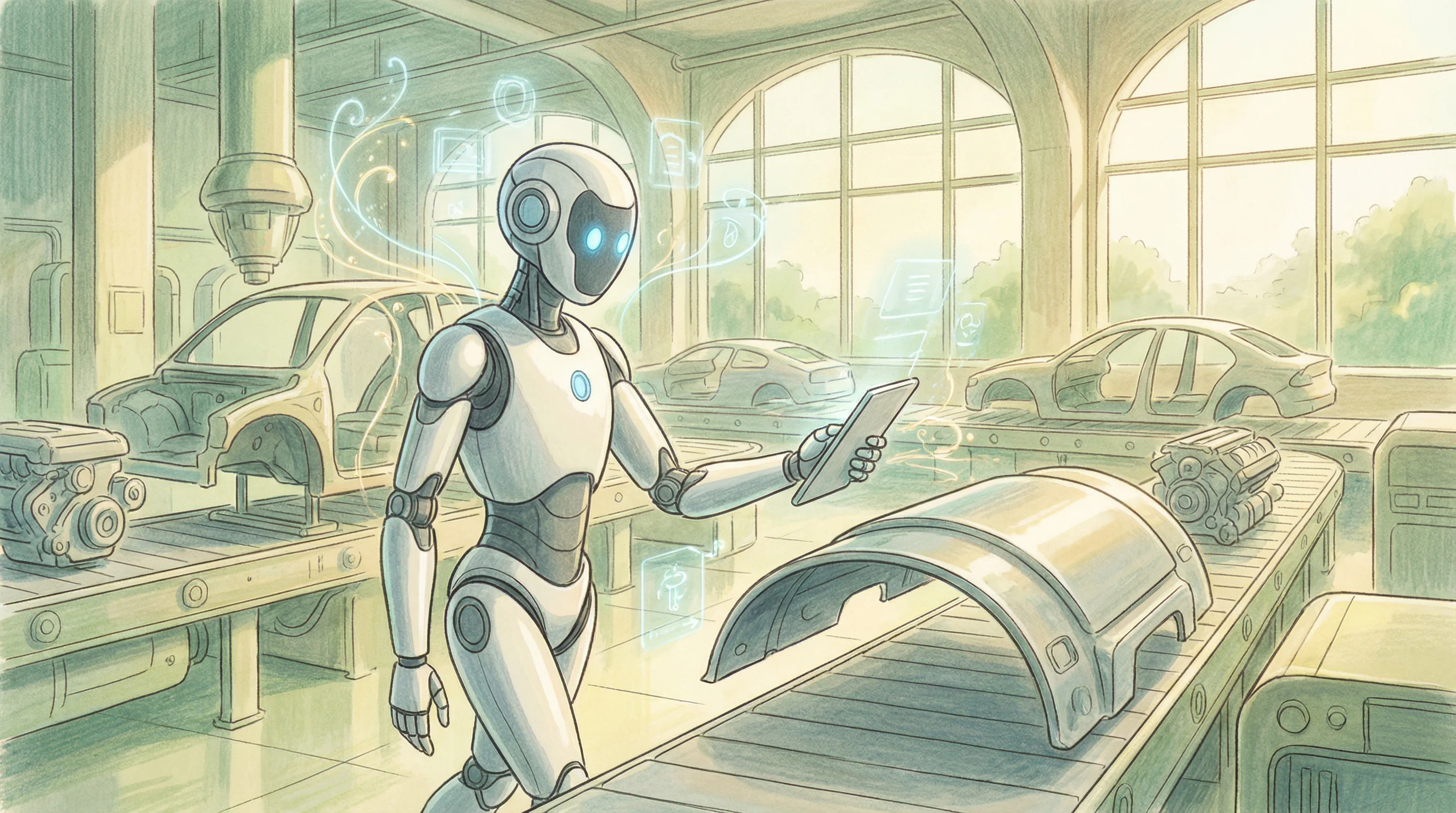
Apptronik and Mercedes-Benz announced their collaboration in March 2024, putting Apollo robots into logistics and inspection workflows at the Berlin-Marienfelde campus. Mercedes is using what might be called a teleoperation-to-autonomy pathway: human operators control the robots via augmented reality interfaces while the system collects training data. That data feeds supervised learning algorithms for autonomous operation in constrained tasks—parts kitting, delivery, basic inspection.
Jörg Burzer, the Mercedes board member overseeing production, described it as part of the company's MO360 production ecosystem, using AI and humanoids to make manufacturing more efficient. The language is careful, notably. Not "replace workers." Make manufacturing more efficient.
Apptronik also signed with Jabil, the electronics manufacturing services giant, for factory deployment. The business model is taking shape: robots that can be trained on human-demonstrated tasks, then deployed across multiple workflows without requiring facility redesign. That matters more than it might seem. Retrofitting a factory for traditional automation can cost millions.
Figure and BMW offer another data point. Figure raised $675 million at a $2.6 billion valuation, backed by Microsoft, OpenAI, and Nvidia—a who's-who of AI infrastructure. The company has a commercial agreement with BMW to pilot its humanoid at the Spartanburg plant. Figure's integration with OpenAI enables natural language interaction; the robot can respond to spoken instructions and explain what it sees and does.
This isn't parlor trick territory, or at least it's not intended to be. It's aimed at the reality that factory workers need to communicate intent to machines sharing their workspace. "Move that pallet to the left" is easier than reprogramming a fixed-arm robot.
Agility Robotics and Amazon announced a pilot of the Digit robot in October 2023, part of Amazon's broader warehouse automation push. The company already operates more than 750,000 mobile robots across its fulfillment network—mostly traditional wheeled units that move shelves or packages. Tye Brady, Amazon's Chief Technologist for Robotics, frames the Digit deployment as removing "menial, mundane, repetitive" work while keeping humans central to operations.
The company is staging rollouts carefully, acutely aware of labor relations and the optics of replacement. Amazon has faced union organizing efforts and public scrutiny over working conditions. Introducing humanoid robots into that environment requires, at minimum, skillful messaging.
Tesla's Optimus serves as a useful counterpoint. Elon Musk has promoted aggressive timelines for the humanoid project, at one point projecting thousands deployed by the end of 2025. In January 2026, however, Musk acknowledged that no Optimus robots were yet doing useful work in Tesla factories. The roadmap now points to a V3 unveil in Q1 2026 and a production line toward year-end.
It's a reminder that hardware is hard. Manufacturing at scale is harder. And predicting deployment timelines for novel robotics platforms is, historically, an exercise in optimism meeting reality.
UBTECH in China began mass production and delivery of its Walker S2 humanoid in late 2025, with several hundred units deployed and orders exceeding 800 million yuan (roughly $110 million). What's notable is the honesty: a company executive stated publicly that today's robots operate at 30 to 50 percent of human efficiency, with a target of 80 percent by around 2027.
That kind of candor is useful. It sets realistic expectations for what these machines can and cannot do today, and it undercuts the hype cycle that tends to surround robotics announcements.
Boston Dynamics, meanwhile, retired its hydraulic Atlas robot in April 2024 and unveiled an all-electric version designed for factory work. The new Atlas is being developed for deployment in Hyundai facilities later this decade. CEO Robert Playter stepped down in February 2026, but the commercialization trajectory continues under new leadership.
The Next 18 Months Will Matter
The key question facing the industry isn't whether humanoid robots work in controlled demonstrations—they clearly do—but whether they deliver return on investment in messy, real-world manufacturing environments. With all the complexity and unpredictability that entails.
Current productivity levels present a constraint. If robots operate at 30 to 50 percent of human throughput, the business case depends on several factors: 24/7 operation, multi-tasking flexibility after software updates, and dramatically lower total cost of ownership compared to human labor plus benefits. In high-wage markets with severe labor shortages—Germany, Japan, parts of the United States—that math can work. In lower-wage manufacturing regions, it's less obvious.
Safety and regulatory frameworks are catching up, though not uniformly. The EU's Machinery Regulation 2023/1230 takes effect January 20, 2027, establishing requirements for humanoid robots sold into European markets. In the U.S., existing standards like ISO 10218 for industrial robots and ANSI/A3 R15.08 for mobile manipulators provide some coverage, but humanoids blur established categories. Manufacturers are conducting risk assessments under ISO 12100 and aligning with collaborative robotics standards in ISO/TS 15066.
The technology stack, at least, is maturing rapidly. Nvidia's GR00T N1 provides an open foundation model that companies can build on, reducing the barrier to entry for new entrants. Google DeepMind's Gemini Robotics similarly democratizes access to vision-language-action control systems. Apptronik, Figure, and others are partnering with cloud providers—Azure in Figure's case—to handle the computational overhead of training and inference.
Manufacturing capacity is scaling up. Beyond Agility's RoboFab, Chinese manufacturers are ramping production of lower-cost platforms. UBTECH, Unitree, and Fourier Intelligence are all bringing humanoids to market at volume, supported by China's deep robotics supply chain and policy incentives. The Wall Street Journal reported in February 2026 that China is "going all-in" on humanoids, with government backing and heavy investment across the sector.
What should founders and executives watch? Proof points from BMW, Mercedes, and Amazon over the next year. If these pilots translate into purchase orders and facility rollouts—plural, not singular—the inflection is real. If they remain limited trials that don't scale beyond a handful of units, the timeline extends and capital becomes more selective. Venture investors have seen this pattern before.
McKinsey outlined preconditions for widespread deployment in a July 2025 report: battery life sufficient for full shifts, hand dexterity for complex manipulation tasks, cost parity with human labor over three to five years, and supply chain standardization. Those are solvable engineering problems, not fundamental barriers. The question is pace.
Jeff Cardenas, Apptronik's CEO, calls humanoid robotics "the space race of our time" and points to manufacturing partnerships with companies like Jabil as the path to affordability at scale. Brett Adcock, Figure's CEO, is betting on deep integration with foundation model providers like OpenAI to accelerate the transition from teleoperation to full autonomy.
What Comes Next

Goldman Sachs' $38 billion market projection assumes more than 250,000 humanoid robot shipments by 2030, mostly into industrial settings. That's roughly 46 percent of the total industrial robot installations globally in 2024. It's an aggressive target.
It's also perhaps not impossible.
Factories, after all, are designed for human workers. Humanoid robots don't require retrofitting production lines, rebuilding infrastructure, or rethinking spatial layouts. That flexibility is the entire value proposition—the reason companies are willing to tolerate lower initial productivity and higher upfront costs compared to traditional automation.
Whether that flexibility is sufficient to justify the cost, complexity, and integration overhead is what the next few years will determine. The demos are done. The deployments have begun. Now comes the data. And in manufacturing, data has a way of cutting through hype.
The robots are clocking in. Whether they keep showing up for their shifts—and whether companies keep paying for them—will tell us whether this moment is a genuine inflection point or just another chapter in robotics' long history of promising more than it delivers. The answer, as always, lies somewhere between the venture deck and the factory floor.


