

Sean Cole didn't set out to make headlines. The independent developer just wanted to see if a clump of living brain cells could navigate Doom—the 1993 first-person shooter that launched a thousand LAN parties and, apparently, one very odd chapter in computing history.
By March 2026, Cole had his answer. Roughly 200,000 cultured human neurons, grown atop a microelectrode array in an Australian lab, were moving, shooting, dodging. Visual game states arrived as electrical pulses; spiking outputs became movement commands. Within a week, the neurons had figured it out. They were learning.
The stunt went viral, covered breathlessly by GameSpot and PC Gamer. But beneath the novelty—brain cells playing video games!—lay something more consequential. The semiconductor industry is staring down an energy crisis it can't simply engineer away with better chips, and a handful of biotech startups think the solution might not be silicon at all. It might be neurons. Living ones.
The math is brutal. Data centers consumed around 415 terawatt-hours of electricity in 2024—roughly 1.5% of global supply—and the International Energy Agency projects that figure could hit 1,200 TWh by 2035. Bloomberg New Energy Finance's forecast is even starker: U.S. data centers alone may claim 20% of domestic power by that same year. Amortized costs for frontier AI models have grown roughly 2.4 times annually since 2016, according to a 2024 analysis. The question facing the industry isn't whether this is sustainable. It's what comes next.
When Moore's Law Hits Biology
The numbers kept coming, relentless and unfriendly. Gartner expects global data center electricity demand to grow by 27% in 2026. Bloomberg New Energy Finance doubled its U.S. forecast to 194 GW. Southeast Asia alone expects consumption to quadruple from 2.6 GW in 2025 to 10.7 GW within a decade. The IEA's January 2026 "Electricity 2026" report framed it bluntly: AI and data centers are driving demand toward a cliff, and the industry needs "new efficiency paradigms."
Silicon has delivered Moore's Law dividends for decades, shrinking transistors and boosting performance. But the physics are tightening. Training large language models devours megawatt-hours; inference at scale compounds the problem. Against this backdrop, a cohort of biotech startups is making a counterintuitive bet: that clusters of lab-grown human brain cells, wired to microelectrode arrays and taught through closed-loop feedback, might compute certain tasks with orders-of-magnitude less energy than transistors.
It sounds like science fiction. Maybe it is. But the early experiments are real enough to attract venture capital, DARPA funding, and a growing roster of academic collaborators willing to entertain the possibility that wetware—living tissue interfaced with electronics—could carve out a niche in the AI stack.
The Proof-of-Concept That Changed Minds
Cole's Doom demo wasn't the first time cultured neurons learned a game. Cortical Labs, the Melbourne-based startup that supplied the hardware, published a "DishBrain" study in Neuron back in December 2022 showing neurons mastering Pong in minutes. But Doom was different—more complex, more visually arresting, and crucially, more accessible. Cole used Cortical Labs' CL1 biological computer, launched commercially in March 2025, which pairs roughly 800,000 neurons on a microelectrode array with a Python API that abstracts the wetware into something programmable.
The setup was deceptively straightforward. Visual game state encoded as electrical stimulation. Spiking output decoded into movement. Reinforcement signals—charge-balanced biphasic pulses measured in microamps—delivered to guide learning. The neurons responded. They adapted.
Brett Kagan, Cortical Labs' chief scientific officer, was careful in interviews to frame the milestone not as FLOPS-for-FLOPS competition with GPUs but as validation of energy and data efficiency as design pillars. The company had already launched "Cortical Cloud" by 2026, letting researchers rent neuron time remotely. Cole's integration demonstrated the platform's accessibility: a developer without a neuroscience PhD could prototype within days.
Scientific American and PC Gamer covered it extensively. The underlying closed-loop training loop—visual encoding, spike decoding, surprise-based reinforcement—pointed toward a broader truth, perhaps unsettling: biological neural networks, for all their fragility, can learn adaptive behavior with minimal power draw. Whether they can do it reliably, at scale, for months on end, remained an open question.
The Startups Racing to Industrialize Wetware
A handful of companies are trying to turn lab proofs into infrastructure, each attacking different layers of what might charitably be called a "stack."
Cortical Labs remains the most visible. The Australian firm attracted $10 million in funding led by Horizons Ventures in April 2023, with later participation from In-Q-Tel—the CIA's venture arm—and Gobi Partners for Malaysia expansion as of March 2026. The company positions itself as infrastructure: hardware and software enabling "synthetic biological intelligence" for robotics, drones, cyber domains where adaptability matters more than raw throughput.
In March 2026, Cortical Labs partnered with DayOne and the National University of Singapore's medical school to deploy 20 Cortical Cloud units in a prototype "wetware data center." Plans call for scaling to 1,000 units if early results validate the approach. That's a big "if."
The Biological Computing Co. (formerly Biological Black Box, because biotech loves a rebrand) secured $25 million in seed funding in February 2026 led by Primary Ventures. Founded by neurosurgeon-scientists Alex Ksendzovsky and Jon Pomeraniec, TBC is opening a flagship lab in San Francisco's Mission Bay and pitching "neuron-based alternatives to silicon AI" for computer vision, generative video, and AI infrastructure. The company's public materials reference "neural dynamics adapters" bridging biology and silicon, though detailed technical benchmarks remain sparse. That opacity is typical of the sector.
FinalSpark, a Swiss outfit, launched the "Neuroplatform" in mid-2024—wetware-as-a-service. Researchers run experiments on living neural organoids remotely, no in-house neuroscience team required. A 2024 peer-reviewed paper in Frontiers in Artificial Intelligence described the platform's ability to support months-long experiments with 24/7 stimulation. By late 2025, FinalSpark reported organoid lifespans extending from around 100 days to roughly seven months—progress, though still far short of silicon's indefinite shelf life.
Intactis Bio raised $250,000 from Nucleus Fund in March 2026 and has leaned into public engagement with "BioStack," a Tetris-like game where humans compete against neuron-powered bioprocessors. The company also demonstrated "Hello, World" and matrix math operations on cultured neurons, positioning early-stage proofs as stepping stones toward commercial bioprocessing units. The marketing is slick; the substance is harder to evaluate.
Parasma, a YC Summer 2026 company, is positioning as a software layer rather than hardware. Founded by Sean Cole—yes, the Doom developer—Parasma describes itself as writing "the algorithms to turn brain cells into compute." A June 2026 blog post detailed its technical approach: a roughly 200,000-neuron culture trained via surprise-based reinforcement learning with a silicon "critic" providing feedback. Parasma's stated mission is reducing AI energy strain through programmable living neurons. The team has also published a detailed ethics note on consciousness and suffering, committing to design guardrails that avoid systems capable of sentience. Whether those guardrails will matter remains, like most things in this space, speculative.
How Wetware Actually Works
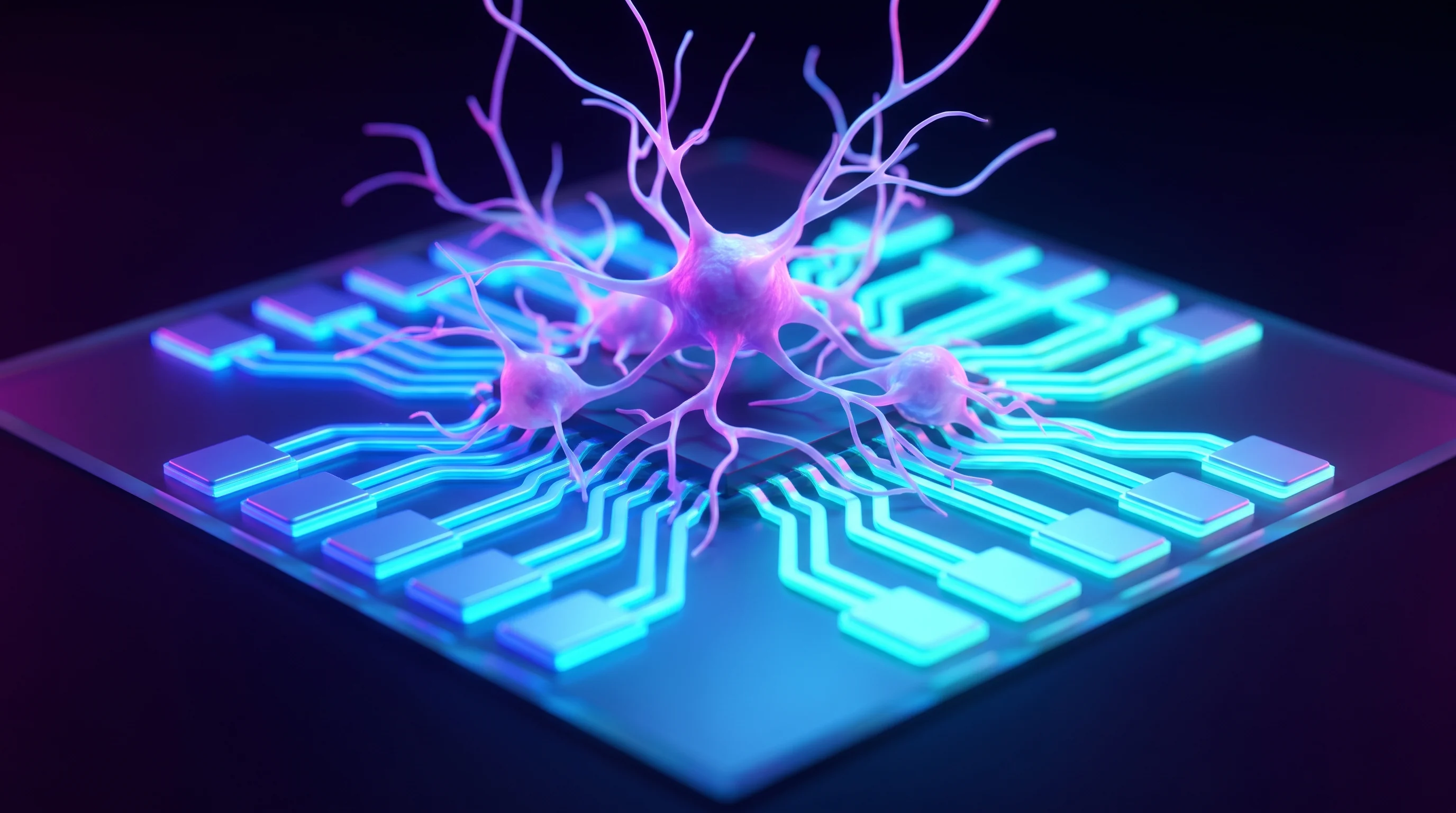
The core technology—sometimes called "organoid intelligence" or biohybrid computing—rests on multi-electrode arrays (MEAs) that interface living neural cultures with electronics. In 2D systems like Cortical Labs' CL1, neurons grow atop arrays of tiny electrodes that both stimulate cells and record their electrical activity. Three-dimensional brain organoids, used by FinalSpark and others, support more complex circuitry but require more sophisticated fluidic and environmental control.
Training happens in closed loops. Sensory data is encoded as patterns of electrical stimulation. The neurons respond by firing spikes, which are decoded into outputs—movement commands in a game, classifications in a vision task. Reinforcement signals, delivered as low-amplitude biphasic pulses to avoid damage, guide the network toward desired behaviors.
A December 2023 paper in Nature Electronics demonstrated brain organoid-based reservoir computing for speech recognition and nonlinear prediction. A May 2024 preprint showed that biological neural networks could match state-of-the-art reinforcement learning algorithms in sample efficiency under real-time constraints. These are promising results. They're also lab-scale proofs, and the gap between lab-scale and production deployment is littered with failed startups.
The practical constraints are real. Cultures require sterile environments, temperature control, nutrient media, regular replenishment. IEEE Spectrum reported CL1 units achieving up to six months of viability by May 2025; FinalSpark's late-2025 update extended organoid lifetimes to roughly seven months. Scaling remains unproven. Singapore's prototype wetware datacenter will validate whether 20-unit clusters can run reliably under production loads, let alone the 1,000-unit deployment DayOne envisions.
Cortical Labs has pushed tooling accessibility aggressively. A February 2026 arXiv paper described the CL API as enabling "sub-millisecond closed-loop interactions with biological neural networks via declarative Python." The Doom demo proved non-neuroscientists could prototype within days. FinalSpark's Neuroplatform documentation similarly details APIs, best practices, and experiment templates, lowering the barrier for academic and corporate researchers. Whether ease of use translates to commercial viability is another matter.
The Ethics Problem Silicon Never Had
Organoid intelligence raises questions silicon never did. What if the neurons become conscious? What if they suffer?
In March 2024, the UK's Nuffield Council on Bioethics released a briefing on neural organoids, mapping the field and calling for anticipatory regulation. A January 2025 academic analysis suggested dedicated Organoid Research Oversight Committees, warning that science might outpace law. A 2026 study in Scientific Reports explored how public attitudes toward biocomputers shift depending on whether potential consciousness or applied uses are emphasized—predictably, people are more uncomfortable when you mention consciousness.
Parasma addressed the issue head-on in a June 2026 policy note. The company cited leading theories of consciousness, argued that current scales and architectures—roughly 200,000 neurons, no thalamo-cortical loops, no pain pathways—are unlikely to support subjective experience, and committed to reassessment as capability grows. The technical design deliberately avoids nociception; reinforcement comes from surprise-based feedback optimizing policy, not aversive stimulation. "Self-preservation behavior emerges from the policy optimizing surprise," the company wrote, "not from suffering."
There is no regulatory consensus yet. The UK scholarship suggests thresholds for possible consciousness remain undefined. Industry players like Parasma and Cortical Labs are navigating a governance vacuum with public disclosures and internal guardrails. A July 2026 review in Nature Computational Science framed organoid intelligence as a frontier with "significant technical, biological, and ethical challenges ahead." That's academic-speak for "nobody really knows."
DARPA's involvement signals government interest, if not answers. The O-CIRCUIT program, announced in March 2026, funds a 42-month effort to develop "unconventional biological processing units for AI training and inference at the edge." Defense applications—adaptive control for drones, cybersecurity, robotics—align with Cortical Labs' stated positioning. The timeline suggests deliverables and potential transition paths to programs of record around 2029–2030. Whether those materialize depends on whether the technology proves itself in the next few years.
What Happens Next
The immediate trajectory is pilots and validation. Singapore's wetware datacenter prototype will produce data on uptime, culture replacement cadence, and energy-per-task metrics through 2026 and 2027. TBC's $25 million seed round funds customer case studies in computer vision and generative video. Parasma, still at YC team size, will need to prove its algorithms generalize beyond Doom. FinalSpark's platform expands access, but the lack of standardized benchmarks means performance claims remain difficult to verify against GPUs or neuromorphic silicon.
Biological computing is not replacing GPUs anytime soon. The systems are fragile. Their lifespans are measured in months. Their computational throughput is tiny compared to a modern datacenter rack. But the energy economics are compelling enough that early niches—edge inference, adaptive robotics, lab-scale simulation—could justify deployment if stability improves. A 2026 Nature review positioned the field as moving "from algorithms to organoids," framing organoid intelligence as the next frontier with substantial hurdles. Translation: interesting, but not ready.
UC Santa Cruz's Braingeneers group, led by genomics pioneer David Haussler, called in June 2026 for collaborators and funding to parallelize organoid experimentation. The University of Milan partnered with Reply in February 2026 to research Cortical Labs' CL1. The ecosystem is forming—academic labs, defense programs, commercial platforms, venture-backed startups—around a bet that living neurons, for all their biological messiness, can carve out a role in the AI stack.
Perhaps the real shift is conceptual. For decades, computing meant transistors, clock speeds, FLOPS. Wetware computing reframes the question: what if intelligence isn't about silicon logic gates but about adaptive, self-organizing networks that evolved over millions of years to solve problems efficiently?
The answer may not power the next GPT model. But it might teach a drone to navigate, an edge device to classify, or a researcher to rethink what compute can be.
The neurons playing Doom in a Melbourne lab aren't a gimmick—they're a proof-of-concept that biology, properly interfaced, can learn. Whether that scales is the question the next few years will answer. And if it does, the AI industry's energy crisis might have a solution stranger than anyone predicted: not better chips, but better cells.


