

Neuromorphic, a Y Combinator S26 startup, says its autonomous robots completed more than 2,000 tasks at a success rate above 97 percent in daily production, and that they can be installed inside an existing wet lab in about a week. As of Nov. 1, 2026, the company has made no public funding announcement and has not named a customer, so for now the figures are claims rather than verified results.
A robot technician, not a workcell
The company's website describes its product as "a robot technician." The machines move between workstations, handle lab equipment and run workflows in labs that already exist, rather than requiring a facility built around them. Neuromorphic says it operates "in the largest autonomous lab in the US," though it has not said where that is or who runs it.
What the robot does, according to the company, is the "last mile" of physical work: ferrying samples, loading instruments, handling consumables and recovering when something goes wrong. A large language model, the same kind of software behind chatbots, composes the robot's individual skills into full workflows. Neuromorphic positions that mobility against fixed workcells, the stationary robotic stations common in automated labs.
The numbers themselves do not line up perfectly. Neuromorphic's LinkedIn page cites more than 1,500 tasks in the first week of deployment at "a leading biotechnology company," while its website cites more than 2,000. Whether the two figures cover different periods is unclear. The biotech is unnamed, and as of Nov. 1, 2026, no third party had confirmed either metric.
A very young company
The founders are Vatan Aksoy Tezer, the chief executive, along with Cem Seref Toker and Ege Doğanay, according to a LinkedIn post by Tezer. "I am pleased to announce Neuromorphic (YC S26) is joining Y Combinator," he wrote. Webrazzi, a Turkish outlet, reported the acceptance on July 24, 2026.
LinkedIn lists the company as founded in 2026, with 2 to 10 employees. The tracking site ycwatcher.info puts the San Francisco team at three. A job post on the company's alternate site points to hiring for forward-deployed engineering and hardware integration, and the site invites inquiries at [email protected].
Why the lab has become the bottleneck

The timing is not accidental. AI tools now generate hypotheses faster than labs can test them, and trade coverage has begun to say so. SelectScience's April 2026 trend report on SLAS 2026 and Drug Discovery News in June 2026 both framed the physical lab as the constraint. The Drug Discovery News piece carried the headline "Orchestration over automation."
Staffing adds pressure. A Harris Poll for Siemens Healthineers, which surveyed 408 U.S. lab professionals in June 2024, found 83 percent expect demand to rise. That is more than a year old, though it remains the most recent large survey in the available research.
Market forecasts differ mostly by how the category is defined. MarketsandMarkets projects the global lab automation market at $6.60 billion in 2026 and $8.62 billion by 2031, a compound annual growth rate of 6.6 percent. Grand View Research, looking only at automated liquid handling, estimates $2.8 billion in 2026 and $6.1 billion by 2033, or 11.6 percent annually.
Crowded ground
Investors are putting money behind AI-ready lab infrastructure:
- Multiply Labs announced a $75 million Series B on Oct. 6, 2026, with AstraZeneca among the new investors.
- Opentrons announced a $40 million Series E on Oct. 29, 2026, led by Avego with participation from BroadOak.
- Automata raised a $45 million Series C on Jan. 29, 2026, led by Dimension, with Danaher Ventures joining the board.
"AI-first biology requires fundamentally different infrastructure," Automata's chief executive, Mostafa Elsayed, said in the announcement. Nan Li, managing partner at Dimension, said in the same release: "Scalable, software-defined lab operations are foundational to the AI wave in life science."
Mobile hardware in labs is hardly new. Thermo Scientific sells an autonomous mobile robot for moving labware between rooms, and HighRes BioSolutions' AutoPod works with its Cellario orchestration software. Biosero pairs OMRON mobile robots with its Green Button Go orchestrator. Tactus AI showed a humanoid lab assistant called "Elsie" at ADLM 2026, and Kyber Labs announced an autonomous wet lab assistant in March 2026. By its own account, Neuromorphic's differentiator is manipulation and mobility driven by an LLM.
Government money is also in play. The Department of Energy announced a $30 million program in October 2026 for robotics and automation testbeds, and SLAC launched a self-driving laboratory project on Oct. 8, 2026.
What buyers will worry about
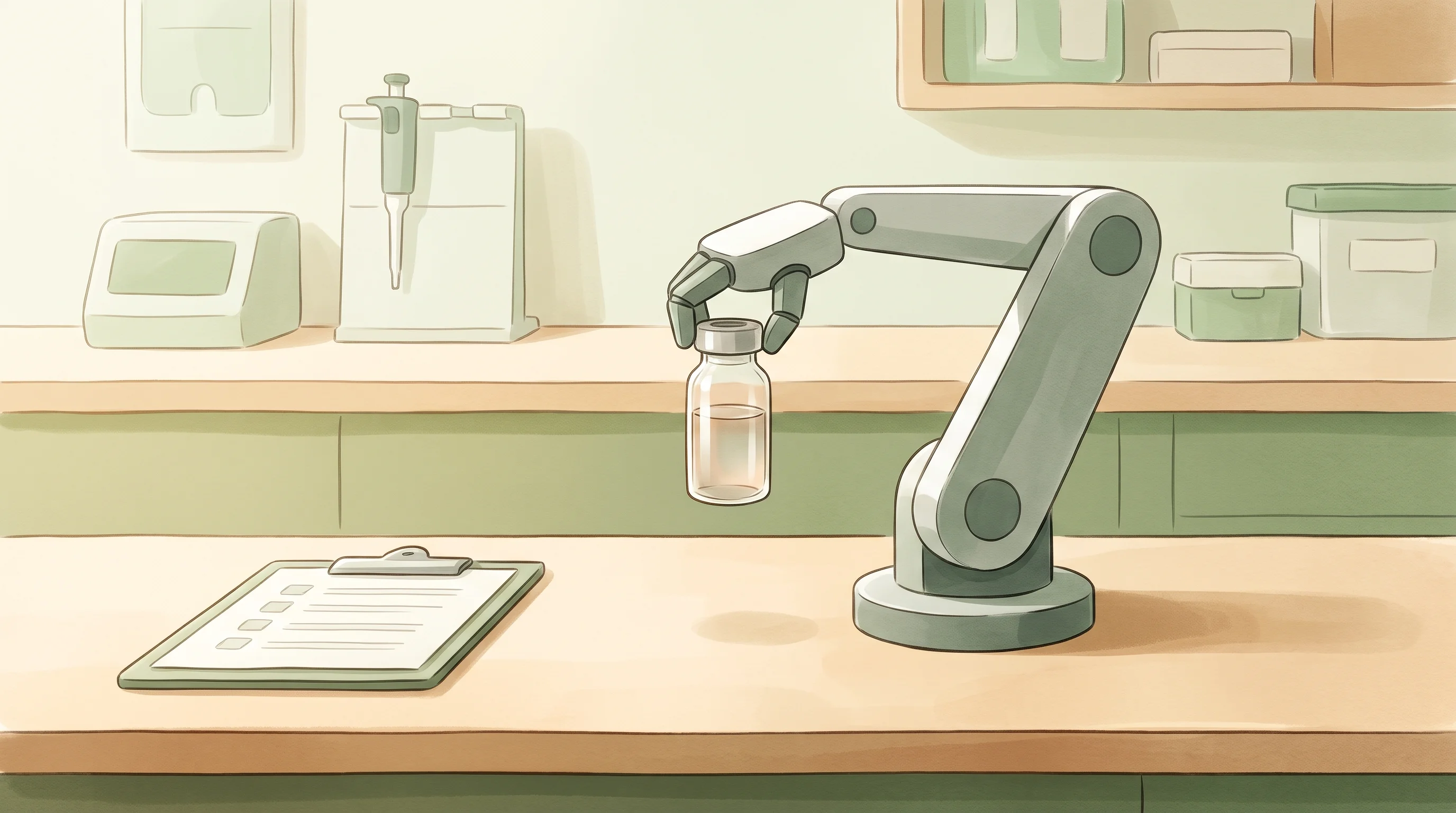
Technical hurdles remain. A Google Research blog post on Oct. 16, 2026 said autonomous wet labs must solve "two intertwined challenges," which it named as 3D reasoning and reliable liquid handling, and it stressed the need for human oversight.
Clinical settings bring regulation. CLIA rules apply to all U.S. facilities that test human specimens, and the Centers for Medicare & Medicaid Services opened a request for information on July 16, 2026 about oversight of AI and automation. A proposed rule followed on Oct. 8. Robots working alongside people also fall under safety standards ISO 10218 and ANSI/A3 R15.08.
Then there is integration. SiLA 2 and OPC UA LADS, two standards for getting lab instruments to talk to one another, are gaining ground, but many labs still depend on custom work, according to a 2026 review in Heliyon.
What to watch

Neuromorphic's next test is a named customer. Until one appears, the 97 percent figure is the company's own, and the one-week deployment is the claim prospective buyers are most likely to check first.


