

Ayla Ergun remembers when a standard set of cell-painting and transcriptomic analyses at Ginkgo Bioworks meant blocking off weeks on the calendar. Ten separate workflows. Multiple handoffs. The usual grind of scientific computation.
Now? Hours.
Ergun, Ginkgo's Senior Director of Data Science, isn't prone to hyperbole. But the transformation she describes—automated end-to-end, publication-ready figures materializing with almost no human meddling—is the kind of productivity leap that venture capitalists dream about and scientists, frankly, didn't think was coming this fast.
Her experience forms the centerpiece of the pitch for Biomni Lab, which Phylo is positioning as the first "Integrated Biology Environment" purpose-built for AI-native research. The Stanford spin-out emerged from stealth on February 3, 2026, armed with a $13.5 million seed round co-led by Andreessen Horowitz and Menlo Ventures' Anthology Fund. Anthropic joined as an investor—a telling signal, perhaps, given the foundation model maker's growing interest in scientific tooling.
An Environment, Not Just a Chatbot
So what exactly is an Integrated Biology Environment?
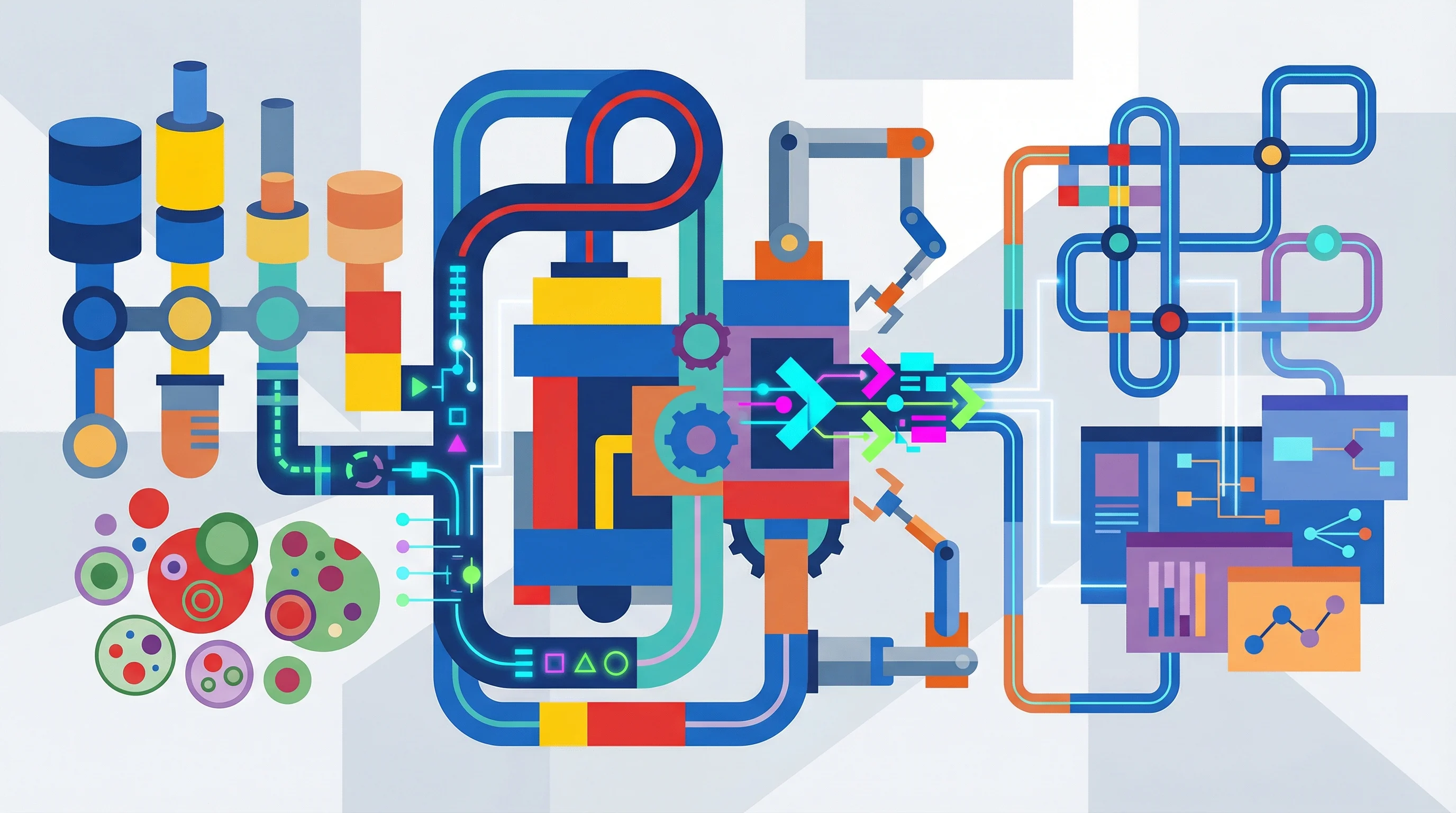
Think of it less as software you open when you need something, and more as a workspace you inhabit. Biomni Lab connects to over 300 databases, software platforms, and analytical tools—everything from Consensus for literature searches to COSMIC for cancer genomics, Addgene's plasmid repositories, and a sprawl of experimental services still being integrated. The platform lets biologists orchestrate AI agents across their entire research stack, describing problems in plain language while the system plans workflows, writes code, pulls data from disparate sources, executes analyses, and documents every decision with full provenance.
"AI-native biology requires an entirely new approach," CEO Kexin Huang said in a statement. "We're unifying the best of agent architectures with the tools biologists actually use."
It's an ambitious claim. The implied comparison—AI assistance for wet-lab scientists could mirror what GitHub Copilot did for software developers—sets a high bar. But early adopters like Ginkgo suggest the productivity gains might not be marketing speak.
Unlike standalone chatbots or narrow automation scripts (the kind that handle one task reasonably well and then sit idle), Biomni Lab is designed for the full lifecycle: planning, authoring, executing, iterating. The company emphasizes reproducibility, transparency, code references, and step-by-step validation to catch hallucinations—those moments when AI confidently generates plausible-sounding nonsense.
From GitHub to Growth Stage
Phylo didn't start with venture backing. Biomni began in June 2024 as an open-source project at Stanford, a general-purpose biomedical AI agent that quietly spread. By the company's count, more than 7,000 labs, biopharma outfits, and healthcare organizations have kicked the tires on the original version. A preprint outlining the unified agentic environment and its retrieval-augmented planning architecture landed on bioRxiv; the code still lives on GitHub under Stanford's SNAP lab.
That organic adoption caught investor attention. "It's rare to see user adoption grow from an academic research project the way Biomni has," Jorge Conde, general partner at Andreessen Horowitz, noted.
The commercial Biomni Lab builds on that foundation but layers in enterprise necessities: scalability, personalization, scientific rigor. Alpha users are already firing off thousands of queries monthly, according to Phylo, treating the environment less like an occasional assistant and more like a digital lab they occupy full-time. The platform handles large files, runs parallel tasks, manages GPU and HPC workloads, and learns user preferences while maintaining auditability and control.
Pricing? Not disclosed yet. For now, Phylo is offering a free research preview at biomni.phylo.bio, targeting academic labs, biotech startups, pharma R&D teams, and healthcare researchers.
The Performance Question

Phylo claims its agent architecture outperforms existing systems by more than 20 percent across benchmarks and long-horizon scientific evaluations. The company didn't specify which external benchmarks it tested against—a detail that may matter more as competitors sharpen their own claims.
What's clearer is the pitch: reliability at scale. Agents designed to handle complex, multi-step analyses that involve querying multiple databases, running statistical models, generating visualizations, and synthesizing results into publication-quality figures. Yuanhao Qu, the company's president, framed it as collapsing "week-long cycles into minutes" with round-the-clock expert assistance. "Biologists spend too much time on fragmented workflows and repetitive work," he said.
The scientific firepower backing Phylo is formidable. Advisors include Nobel laureate Carolyn Bertozzi, gene-editing pioneer Feng Zhang, and computational biologist Fabian Theis. Scientific co-founders Jure Leskovec and Le Cong bring deep Stanford roots.
A Crowded Field Gets More Crowded
Phylo isn't building in a vacuum.
Benchling launched Benchling AI in October 2025, positioning it as a "command center for scientific AI" with agents (Deep Research, Compose, Data Entry) baked directly into its electronic lab notebook and LIMS infrastructure. Benchling already commands a substantial installed base and announced an Anthropic partnership the same month—a relationship that now looks more complicated with Anthropic also backing Phylo.
LatchBio markets an "AI Agent for biology data analysis," powered by Claude, with public sandboxes tailored to specific assays and spatial workflows. Scispot offers "Scibot," an AI lab assistant integrated with alternative ELN/LIMS systems and instrument connectors. Automata recently partnered with CellVoyant to create closed-loop, AI-powered cell culture workflows—pushing automation closer to physical experiments, not just computation.
Even academic labs are experimenting with agentic orchestration. A preprint from the Broad Institute describes multi-agent systems controlling physical experiments with cells and organoids, a glimpse of where this could all head.
Phylo's wager is that a unified environment built from scratch for agentic biology will prove stickier than features bolted onto existing platforms or narrow point solutions. Whether that bet pays off depends on adoption velocity and how fast incumbents iterate.
What Comes Next
Matt Kraning from Menlo Ventures emphasized the broader opportunity: "platformizing AI-native productivity in the lab." Phylo's roadmap includes deeper integrations with experimental services, more powerful agents, and tighter wet-lab loops that could eventually bring autonomous control closer to the bench.
For now, though, the focus is computational. Data analysis, literature mining, figure generation, workflow automation—the tedious scaffolding of modern biology that eats up researcher time without advancing hypotheses.
The research preview is live. Phylo is targeting immediate usefulness for every biomedical scientist, regardless of computational chops. Whether the "Integrated Biology Environment" framing catches on remains to be seen. The term feels a bit manufactured, the kind of category-creation language that either crystallizes a market or fades into forgotten press releases.
But for labs like Ginkgo, already collapsing timelines by an order of magnitude, the terminology matters less than the time savings. And in a field where experiments can take months and grants are finite, those hours add up fast.


