

Three former UC Berkeley robotics researchers who once piloted autonomous IndyCars at speeds topping 160 mph have opened what they're calling the first fully autonomous factory designed to manufacture products on demand within 24 hours. The facility, a 12,000-square-foot operation in the Bay Area, represents Tensr's attempt to bring the flexibility of cloud computing to physical manufacturing.
The startup, founded by Eric Berndt, Adith Sundram, and C.K. Wolfe, emerged from the university's AI Racing Tech team and went through Y Combinator earlier this year. Now the founders are betting that the same robotics expertise that helped them navigate high-speed autonomous racing can solve one of manufacturing's most stubborn problems: the economic penalty of small production runs.
"We're building fully autonomous robotics factories at Tensr to create the AWS of manufacturing," the founders wrote in their launch announcement. The pitch is straightforward, if ambitious: manufacture one unit or one million at the same per-unit cost. In practice, this means robots operating industrial machinery, handling packaging, and shipping finished goods without human intervention. The company's website describes it, with characteristic startup bravado, as "a robotic factory that builds robots."
Whether that promise holds up at scale remains to be seen. Tensr has not made public funding rounds or customer names as of the latest data, and the operational details of how the factory achieves true unit-cost parity remain sparse. But the founders bring unusual credentials to the challenge.
Berndt's racing background included work on autonomous Indy500 vehicles at Berkeley. Wolfe served as simulation lead and team manager for the university squad, helping secure a win at the CES 2025 passing competition at speeds reaching 163 mph, according to Berkeley's VIVE Center. Technical reports from the university documented the team's autonomous racing systems exceeding 170 mph. Wolfe also edited the Berkeley AI Research Blog while completing a PhD in AI and robotics. Sundram's focus spanned robotics, machine learning, and control systems during his time at the university.
The founders argue that traditional factories were built around human workflows and retrofitted for automation, when the process should run in reverse. "Factories need to be designed from the ground up around robots, not the other way around," they wrote. Their approach replaces rigid assembly lines with modular stations capable of handling what the industry calls high-mix production environments, where product specifications change frequently.
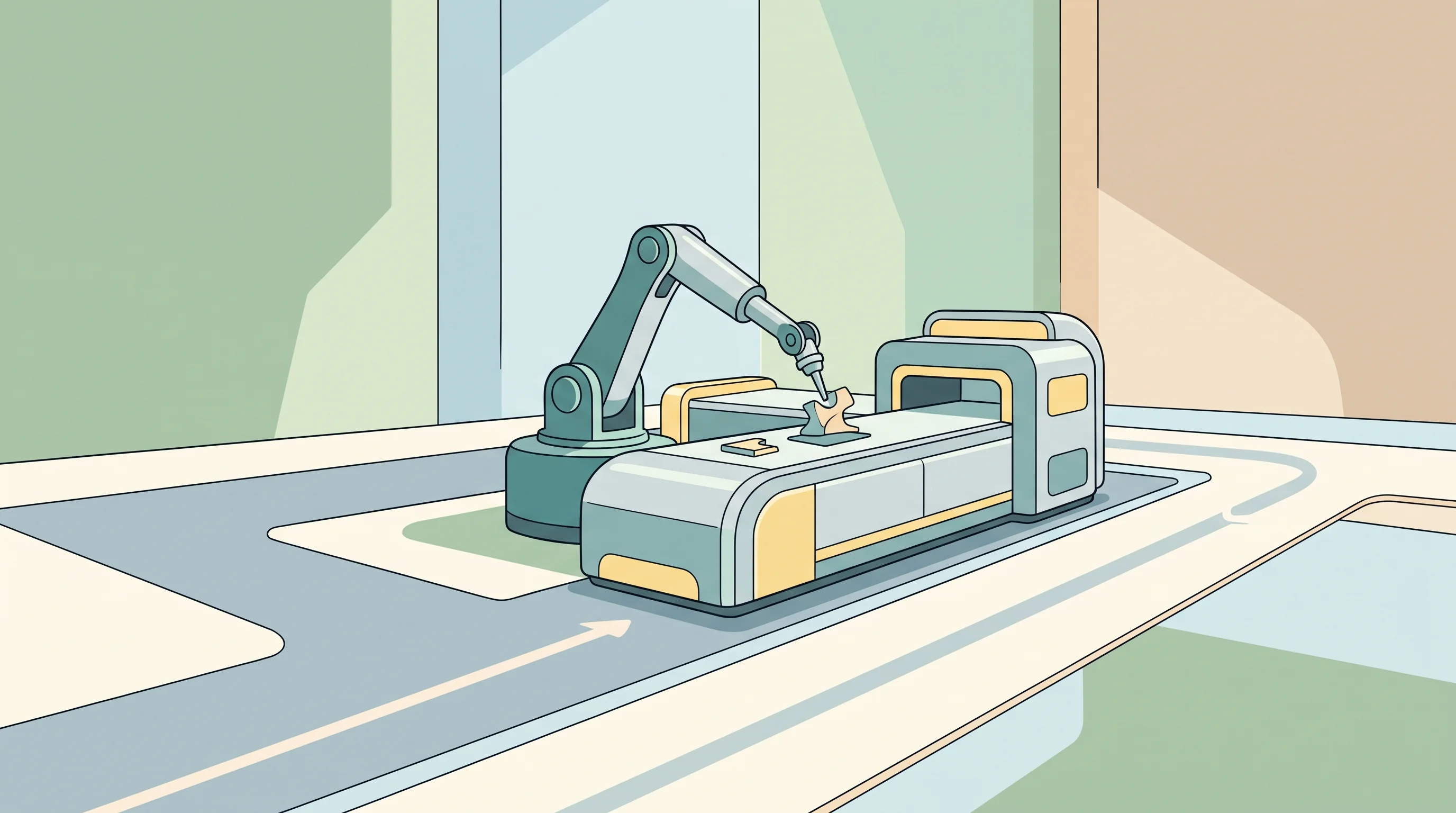
Tensr is entering a moment when the Bay Area, perhaps improbably, is becoming a hub for advanced manufacturing. Agility Robotics opened a Fremont facility for physical AI development last year, while humanoid robot maker 1X launched a factory in Hayward with plans to ship thousands of home robots. Both facilities dwarf Tensr's operation in square footage, though comparing them directly may miss the point. Tensr isn't building robots for sale so much as deploying them for contract manufacturing.
The broader manufacturing sector is grappling with similar questions about automation and reshoring. A McKinsey Global Institute analysis estimated that onshoring exposed imports would require roughly $500 billion in capital expenditure, with autonomous operations among the investment priorities. EY noted in a separate report that manufacturers were moving toward limited-human-presence factories, though legacy facility layouts and inconsistent data quality posed barriers.
Other startups have attracted substantial capital chasing versions of this vision. Hadrian, which operates precision manufacturing facilities for aerospace and defense clients, raised a $1.37 billion Series D in August 2026 at a valuation just under $8 billion. Bright Machines, focused on software-defined manufacturing systems, secured $126 million in Series C funding in June 2024.
Tensr's three-person team, at least as of mid-last year, was advertising openings across electronics, hardware, supply chain, robotics research, machine learning, and software engineering. The hiring pitch suggested the company was still in early buildout mode, staffing up to prove the model works beyond a single facility.
The skeptic's question is whether on-demand manufacturing at cloud-like economics is achievable with current robotics technology, or whether it remains a few breakthroughs away. The optimist's read is that if anyone could translate autonomous racing expertise into industrial automation, it might be engineers who've already taught machines to navigate at triple-digit speeds. Time, and perhaps more importantly customers, will tell which interpretation holds.


