Matt Khoshdarregi spent years studying intelligent manufacturing at the University of Manitoba, where he built one of Canada's leading research labs in the field. But the academic work kept bumping up against a stubborn real-world problem: welding automation required so much manual programming that many manufacturers simply couldn't justify the cost.
On August 10, 2026, his startup TetraGen Robotics announced it had raised $1.8 million CAD in an oversubscribed seed round led by Calgary's StepChange Capital, with participation from Emend Vision Fund and Jim Richardson. The company, founded in 2022, is betting it can crack that programming bottleneck with a system that uses 3D vision and artificial intelligence to guide industrial robots through welding tasks without the extensive setup that has kept automation out of reach for smaller production runs.
The timing reflects a widening crisis in skilled labor. The American Welding Society projects manufacturers will need 320,500 new welding professionals by 2029, a gap that has sent companies scrambling for alternatives that don't require armies of human workers or programmers.
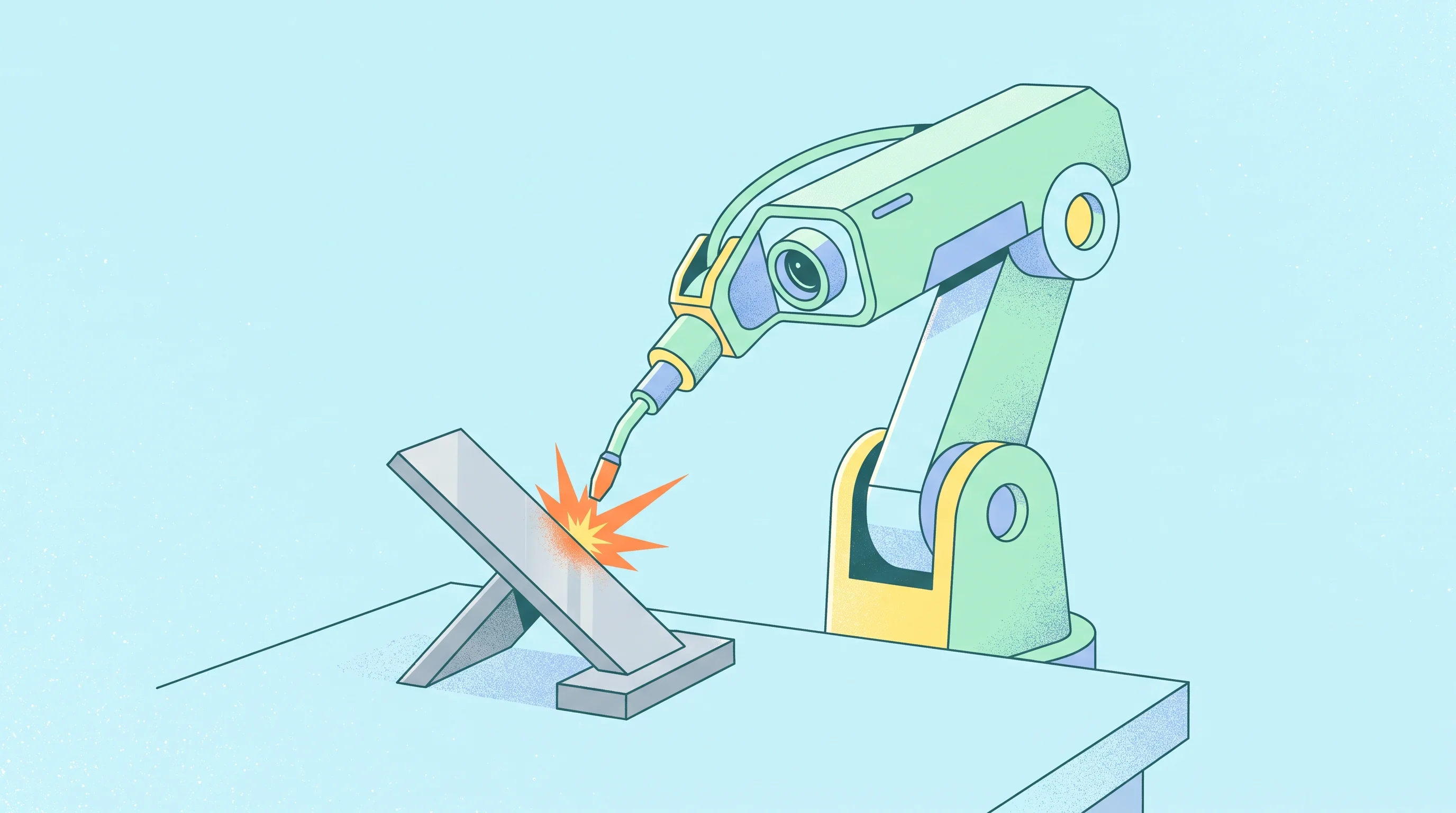
TetraGen's approach pairs an industrial robot arm with 3D vision hardware and proprietary software. Instead of hand-coding every motion, users define welding jobs through the company's interface. The vision system scans the workpiece and fixturing, then the software generates collision-free paths and adjusts on the fly for part-to-part variation. It's designed for the messy reality of high-mix manufacturing, where inconsistent fixturing or part tolerances have traditionally demanded skilled programmers to troubleshoot each job.
The startup has aligned itself with established players in industrial automation. Its website displays partnership logos from FANUC, Fronius, and Vention, though the nature of those relationships isn't detailed. Spence Manufacturing, a Manitoba fabricator, appears as a customer. "Working with TetraGen has been a game-changer for our operations," Jeff Spence, the company's president, said in a testimonial on the startup's homepage.
TetraGen plans to use the seed capital to expand deployments across North America and add to its engineering and commercial teams. The company's scale remains modest, based on available information. It previously received a $120,000 CAD grant from Canada's NRC IRAP program for the period May 1, 2025 to April 30, 2026, to enhance the autonomy of its vision-guided system, according to government records.
Khoshdarregi co-founded the venture with Michael Newman, who previously worked as a manufacturing engineer at NFI Group, North America's largest bus manufacturer. "Autonomous welding systems should adapt to manufacturers, not the other way around," Khoshdarregi said in the funding announcement.
The competitive landscape in AI-guided welding has heated up in recent years. Path Robotics, a U.S. rival, raised a $56 million Series B in May 2021 and followed it two months later with a $100 million Series C. Closer to home, Canadian competitor Novarc Technologies closed a $50 million Series B in March 2025 led by Export Development Canada, with Seaspan contributing $5 million. Those figures dwarf TetraGen's seed raise, though the Winnipeg company is targeting a different stage of the market.
Broader demand for industrial robots continues to climb. The Association for Advancing Automation reported 9,055 robot orders valued at $543 million in North America during the first quarter of 2026, with uptake spreading beyond automotive into general manufacturing sectors that have historically been slower to automate.

"TetraGen Robotics is tackling one of manufacturing's most significant automation challenges," said Eric Miller, managing director at StepChange Capital. The firm, based in Calgary, focuses on early-stage growth companies in Western Canada and sees the labor shortage as a structural tailwind for robotics startups.
TetraGen exhibited at FABTECH 2026 in Toronto in early August, posting from the show floor about its claimed participation in FANUC's authorized system integrator program. For a young company still in seed stage, the booth presence and integrator relationships suggest an effort to build credibility in an industry where buyers are cautious about unproven technology.
Whether vision-guided AI can deliver on its promise to make welding robots truly adaptive remains an open question. But with skilled welders in short supply and manufacturers under pressure to automate more of their production, startups like TetraGen are finding investors willing to bet that the software can finally solve what hardware alone couldn't.