

There's an odd paradox playing out on factory floors from Stuttgart to Shenzhen. 4,663,698 industrial robots were operating in plants worldwide by the end of 2024, according to the International Federation of Robotics—a small army of mechanical arms, grippers, and actuators humming through shifts. Yet for all that hardware, most can't handle what a temp worker figures out in an hour: adapting when a part shows up slightly misaligned, reasoning through an unfamiliar object, improvising.
It's that gap—between the sheer scale of metal deployed and the brittleness of what it can actually do—that Yash Sinha and Jalaj Shukla are calling the "intelligence bottleneck." Their startup, Intelligence Factory, emerged from Y Combinator with a straightforward pitch: the next wave of industrial automation won't be won by better arms or grippers. It'll be won by better brains.
"Hardware is converging; intelligence is the bottleneck," reads the company's positioning. Perhaps a little blunt, but the diagnosis is shared by a growing cohort of AI-first robotics startups, infrastructure players, and semiconductor giants—all racing to give factory robots something approaching human-like reasoning.
Whether they can deliver, and how quickly, will shape not just the future of manufacturing but the broader question of whether machines can truly learn to work alongside us.
When the Hardware Outpaces the Software
The numbers tell a story of momentum colliding with friction. Global industrial robot installations hit 542,076 units in 2024, marking it as the second-highest year on record after 2021. More than half a million units have been installed annually since 2021. The operational stock grew 9% year-over-year, reaching 4,663,698 robots. Asia accounts for 43% of that total; China alone operates more than 2 million.
Yet underneath those installation figures sits a stubborn problem that hasn't scaled with the hardware: flexibility.
A traditional industrial robot is programmed for specific tasks in controlled environments. Move a bin six inches to the left. Introduce a new product SKU. Change the lighting in the cell. Often, the robot fails. It requires an integrator to fly in, re-teach the motions, or outright reprogram the system. Expensive. Time-consuming. Not exactly agile.
That inflexibility compounds in high-mix production scenarios. U.S. manufacturers face persistent labor shortages—around 495,000 open manufacturing jobs in January 2026 and approximately 400,000 in February 2026, per Bureau of Labor Statistics tracking—yet they struggle to deploy automation fast enough, or in versatile enough configurations, to close the gap. The IFR's recent executive summary notes that system integrator capacity itself has become a bottleneck, slowing the pace at which companies can install and commission new robotic cells.
Intelligence Factory, founded recently and based in San Francisco, is targeting that constraint head-on. The five-person team is building what they describe as "general intelligence that works on any robot," with a focus on manipulation tasks. CEO Yash Sinha comes from ETH Zürich robotics and previously founded Kaio Labs, where he served as CTO. CTO Jalaj Shukla brings experience from manipulation and vision-language-action (VLA) work at Dimensional, plus senior robotics roles at Blue Sky Robotics and Applied Materials, along with a master's degree from UPenn's GRASP Lab.
Their thesis: the path to generalist manipulation runs through large-scale, multimodal data collection—vision, language, force, tactile sensing from human demonstrations—combined with infrastructure to train models that generalize across tasks, objects, and environments. They're building that infrastructure now, instrumenting systems for what they call "seeing, doing, and feeling."
It's ambitious. It's also not entirely novel. What makes the current moment different is how many well-funded players have arrived at the same conclusion, roughly simultaneously.
The Foundation Model Scramble
Intelligence Factory is part of a wave. A cohort of startups and research labs launched foundation-model efforts for robotics beginning around 2023 and 2024, many explicitly framing their work as bringing "human-like reasoning" to machines.
Covariant, a warehouse-focused robotics AI company, unveiled its Robotics Foundation Model (RFM-1) in March 2024. The model was trained on real-world robot datasets plus web data, designed to give commercial robots natural-language tasking and in-context learning—the ability to adapt to novel objects or scenarios without explicit reprogramming. Covariant has raised $222 million to date and deploys through integrators including ABB, KNAPP, and Bastian Solutions.
Google DeepMind introduced RT-2 in 2023, a vision-language-action model that maps images and language commands directly to robot actions. It became something of a cornerstone for the VLA paradigm, which treats robot control as a translation problem: from sensor inputs and language prompts to motor commands. The Open X-Embodiment collaboration extended that work, pooling datasets from multiple robot platforms—hundreds of thousands of episodes—to enable more generalist policies.
By mid-2024, open-source alternatives emerged. OpenVLA, released in June, was designed to outperform RT-2-X on certain benchmarks and allow easier fine-tuning. TinyVLA followed in September, optimizing for faster inference and lower data requirements.
Then NVIDIA entered in force. In March 2024, the company announced Project GR00T, a foundation model initiative for humanoid robots, alongside updates to its Isaac robotics platform. At CES in early 2025, the GR00T blueprint was refined with synthetic motion generation and Cosmos world models. By mid-March that year, NVIDIA published the GR00T N1 open research paper, and at a subsequent GTC event the company previewed later iterations as "commercially viable" for humanoids.
These aren't lab curiosities anymore. DHL Group signed a memorandum of understanding with Boston Dynamics in mid-2025 to deploy more than 1,000 Stretch robots globally, and later announced plans for over 1,000 additional robots in the UK alone. Amazon has stated publicly it operates more than 1 million robots across its fulfillment network as of 2024, a mix of mobile and fixed automation. Dexterity AI—which bills itself as a "physical AI" company—partnered with Sagawa Express in October 2025 to pilot its Mech humanoid for truck loading in Japan, and signed Sanmina to scale deployments.
The message from the market: this is happening. The question is who gets it right first, and whether the models can actually deliver on the promise of adaptability once they leave the lab.
The Tactile Frontier
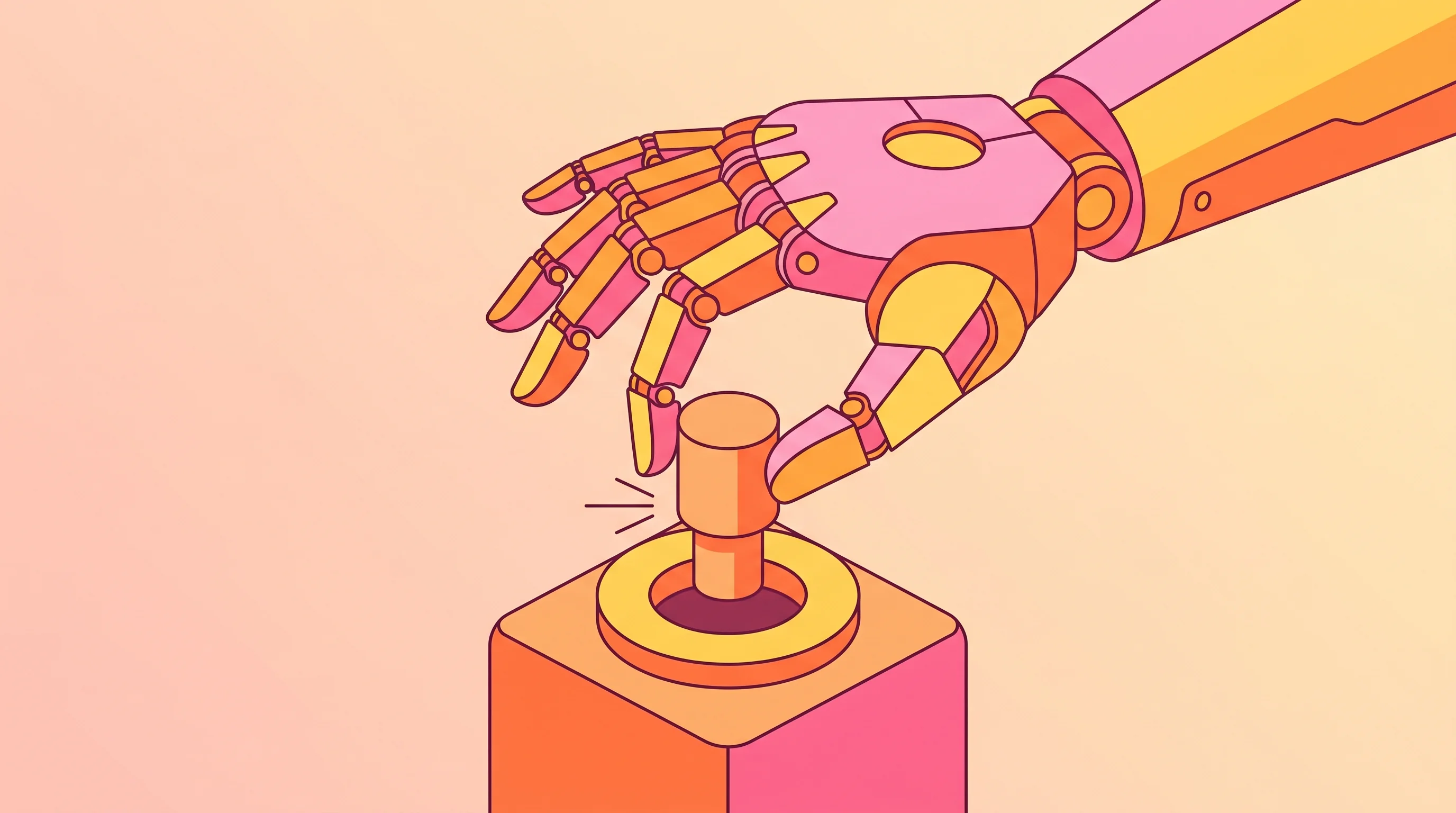
Perhaps the most significant technical shift underway—and the one that could separate hype from real industrial utility—is the integration of tactile and force sensing into foundation models.
Vision and language get a robot most of the way there. But contact-rich tasks—insertion, fastening, handling deformable materials—require force feedback to succeed reliably. You can't thread a cable or install a gasket by looking at it.
A wave of research throughout 2025 and into early periods following added tactile modalities to VLA architectures. VLA-Touch appeared in mid-2025; TacVLA, TaF-VLA, and HapticVLA followed over subsequent months. These models explicitly target the industrial use cases that have resisted pure vision-based approaches: peg-in-hole assembly, cable routing, gasket installation, and other high-precision or compliant tasks.
GelSight, a tactile-sensing specialist, won a Phase II Small Business Innovation Research contract from the U.S. Air Force in early 2026 to advance compact fingertip sensors for robotic grasping and dexterity. The company's technology provides high-resolution tactile images that can be fused with visual and force data.
Intelligence Factory is explicitly building its data infrastructure around force and tactile capture, instrumenting teleoperation rigs to record multimodal demonstrations that include what the robot "feels," not just what it sees. The company's founder updates emphasize that this is as much an infrastructure problem as a modeling one: without large-scale, diverse tactile datasets, the models remain brittle on the factory floor.
That's the bet. Whether they can collect enough data, fast enough, to train models that generalize remains an open question. So does whether enterprises will trust those models in production environments where downtime costs real money.
Platform Wars and the Integration Challenge
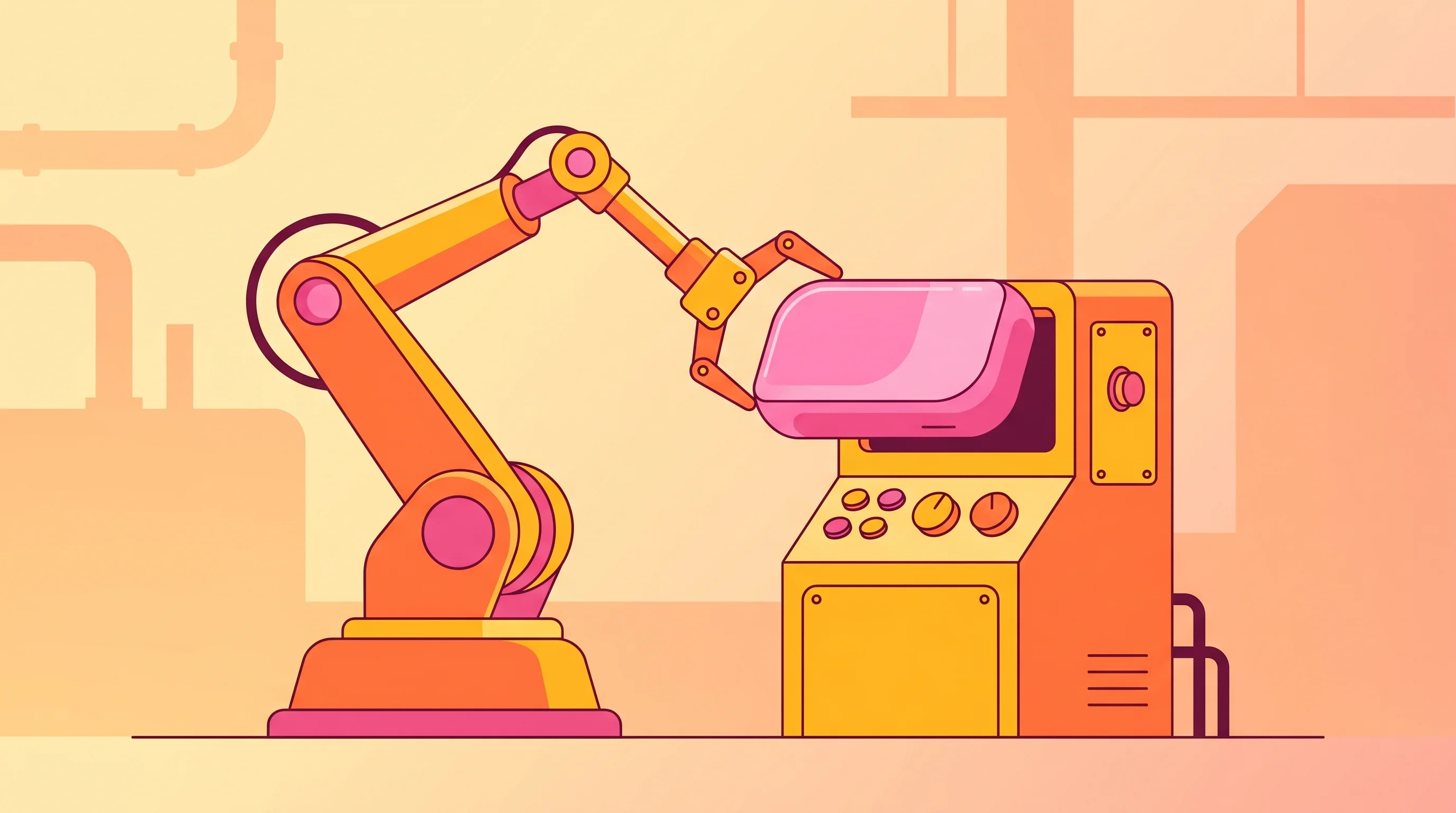
Foundation models are necessary but not sufficient—a point that becomes clear the moment you try to deploy one in an actual factory.
Getting them to run reliably in production environments, where cycle times matter, safety is non-negotiable, and integration with legacy PLCs and operational technology systems is the norm, requires a new generation of platforms and tooling.
Alphabet's Intrinsic division offers Flowstate, a web-based robotics development environment that bundles perception, motion planning, and sensor-based control. The platform incorporates NVIDIA technology and aims to simplify large-scale programming through reusable skills and modern software development practices.
Realtime Robotics launched Resolver in mid-2025, a cloud-based workcell design and optimization tool. By late June, the company had added integrations with Visual Components and MELSOFT Gemini. Resolver promises collision-free motion planning, multi-robot coordination, and compressed design-to-deploy cycles—addressing the integrator bottleneck from a different angle.
READY Robotics has pursued a brand-agnostic approach with ForgeOS, partnering with Rockwell Automation, Toyota, and NVIDIA. The company integrates Isaac Sim and Omniverse to enable sim-to-real programming, where engineers can train and validate robot behaviors in simulation before deploying to physical hardware.
Veo Robotics tackles a different layer: runtime safety. Its FreeMove system, certified to ISO 13849 PLd Category 3, provides speed-and-separation monitoring that allows robots to operate at full speed until a human enters the workspace, then automatically slow or stop. Veo has been integrated into systems deployed by Symbio and other automation providers.
These platforms reflect a shared insight: intelligence layers need to interoperate with motion planning, safety systems, and workcell orchestration. The days of standalone, siloed robot controllers are ending. The future looks more like a software stack—with all the complexity and interdependency that implies.
The Regulatory Reckoning
That software-centric future brings regulatory complexity that few startups seem prepared for.
The U.S. published ANSI/A3 R15.06-2025 recently, the first major update to American robot safety standards since 2012. The new standard aligns with revised ISO 10218 requirements and adds expanded guidance on cybersecurity and collaborative applications.
In Europe, the AI Act—adopted in May 2024, with general provisions taking effect in early February 2025—imposes risk-management, transparency, and post-market monitoring obligations on suppliers of high-risk AI systems. That includes many industrial robotics applications. Conformance assessments and ongoing documentation requirements are phasing in throughout this period.
The U.S. National Institute of Standards and Technology released its AI Risk Management Framework (AI RMF 1.0) in January 2023, followed by a Generative AI Profile in July 2024. While not binding, the frameworks are referenced in government procurement and increasingly in industry guidance for deploying AI in safety-critical environments.
For foundation-model robotics vendors, this means safety can't be an afterthought. Runtime risk controls, auditable decision logs, and the ability to document safety envelopes will be table stakes, not differentiators. Companies that can navigate ISO/TS 15066 (the technical specification for collaborative robots), EU AI Act obligations, and updated ANSI standards will have a clearer path to deployment in regulated industries like automotive, aerospace, and medical devices.
Whether Intelligence Factory and its peers have the regulatory muscle to match their technical ambition is an open question. Most five-person startups don't.
What Comes Next

The market outlook is bullish but uneven.
Deloitte's recent TMT Predictions forecast the installed industrial robot base will exceed 5 million in the near term and approach 5.5 million shortly thereafter, though the firm warns that growth depends on solving data, integration, and cybersecurity bottlenecks. Goldman Sachs projects a humanoid robotics market reaching around $6 billion by the mid-2030s in a base-case scenario, with a blue-sky estimate as high as $154 billion if design, affordability, and acceptance hurdles are cleared.
Recent installation data suggest momentum is broadening beyond automotive, which has historically dominated. Electronics accounted for 24% of installations in the most recent full-year data, automotive 23%, and metal and machinery 16%. Food and beverage installations rose 21% year-over-year in the U.S. to 2,200 units, and North American robot orders grew 6.6% over a recent twelve-month period, with strength across multiple verticals.
Yet there are headwinds. U.S. installations dropped 9% in 2024 to 34,164 units, and Europe fell 8%. China, which accounts for more than half of global installations, is pulling away: the country installed 295,045 robots in 2024, up 7%, and now operates more than five times the U.S. operational stock.
Intelligence Factory and its cohort are betting that the intelligence bottleneck—not hardware availability—is the binding constraint for the next wave. If they're right, the winners won't be the companies that build the cheapest arms or the fastest grippers. They'll be the ones that crack multimodal data collection, train models that generalize across tasks and environments, and integrate those models into platforms that system integrators and end customers can actually deploy.
Humanoid robots may arrive on factory floors at scale within a few years, as companies like Hyundai and Boston Dynamics have projected, or the timeline may slip as costs, throughput, and safety constraints reassert themselves. McKinsey estimates current humanoid unit costs range from $30,000 to $150,000, with more than 50% cost reduction needed for mass adoption.
Either way, the shift is underway: from hardcoded, brittle automation to learned, adaptive intelligence.
The race is no longer just about putting robots in factories. It's about teaching them to think. Whether a handful of startups and a few well-funded labs can pull that off—and whether the market will reward them if they do—remains the most interesting question in industrial automation today.


