

The press release from BMW landed in late June, the kind of corporate announcement that typically gets filed away under "incremental progress." Figure AI's latest humanoid robot would take on a new task—some sequencing work—at the automaker's sprawling Spartanburg plant in South Carolina. Nothing revolutionary on the surface.
Except if you read past the boilerplate, the real news was hiding in plain sight. Over the course of 2025, Figure's previous model had helped build more than 30,000 X3 SUVs, handling sheet-metal loading in the body shop. Not a carefully staged demonstration. Not a proof-of-concept run that ended when the cameras left. Production work, the kind that runs day after day in one of the most demanding manufacturing environments on earth.
That same week, Agility Robotics—maker of Digit, the robot that looks like it stepped out of a low-budget sci-fi film—announced it would go public via a SPAC merger. Valuation: $2.5 billion, according to AP News. Its robots had been shuffling boxes in GXO logistics warehouses since mid-2024, with customer names like Toyota and Mercado Libre now attached. Just two years prior, humanoid robots in factories were PowerPoint fantasies and university research projects. Now they're filing paperwork with the SEC.
But a five-person team fresh out of Y Combinator's spring cohort thinks the real race hasn't even started.
Intelligence Factory—the name isn't subtle—has a blunt pitch: hardware is converging, and intelligence is the chokepoint. While established robotics companies race to ship metal and motors, founders Yash Sinha and Jalaj Shukla, both with deep backgrounds in manipulation systems and control theory, are building what they call "data factories." The idea is to teach robots dexterous skills by capturing what humans do naturally, then retarget that motion across different robot bodies—from five-fingered hands to industrial grippers.
It's an ambitious claim from a startup that lists five employees on its website. Yet the thesis echoes what everyone from NVIDIA to billion-dollar robotics unicorns now repeats like a mantra: the hardware problem is mostly solved. The intelligence layer will separate winners from footnotes.
Where the Industry Stands Now
Start with the baseline. The global installed base of industrial robots hit 4.28 million units in 2023, up 10% year-over-year, according to the International Federation of Robotics. New installations in 2023 totaled just over 541,000 robots, with Asia absorbing 70% of deployments, Europe 17%, the Americas the remaining 10%. Those figures cover traditional industrial arms—welders, pick-and-place units, palletizers—machines engineered for repetitive tasks in highly structured environments.
Humanoids represent a fundamentally different wager. They're designed for messiness: warehouses where layouts shift weekly, grocery stores, data centers where infrastructure was built for humans and retrofitting for purpose-built automation would cost too much. The form factor debate hasn't been settled—Agility's Melonee Wise noted publicly in 2025 that the industry remains genuinely split on whether humanoid shapes make sense—but commercial deployments are accelerating anyway.
Figure operates inside BMW's Spartanburg facility. Agility's Digit handles logistics tasks at GXO. 1X Technologies, the Norwegian startup backed by OpenAI, kicked off full-scale production of its Neo robot in April, with a manufacturing agreement targeting up to 10,000 units through 2030. Boston Dynamics, now a Hyundai subsidiary, announced in January 2026 plans to deploy its all-electric Atlas in factory settings starting in 2028, aiming for production of roughly 30,000 humanoids annually by that point.
The market is transitioning from pilots to something closer to scale. What these robots can actually do once deployed, however, remains the open question. And perhaps the more interesting one.
Why Intelligence Became the Narrative
Jensen Huang framed it starkly at Computex in June: "For agentic systems and physical AI, data is the hardest problem." NVIDIA had just announced partnerships with Unitree and Sharpa on a humanoid reference design, plus updates to its Isaac GR00T foundation model and Cosmos world models. Translation: hardware platforms are converging fast, but the software to make them useful is wide open territory.
The shift from task-specific policies to generalist models mirrors what happened with large language models in the digital realm. Google DeepMind's RT-2, introduced in July 2023, showed that vision-language models could translate natural language commands into robot actions. NVIDIA's Isaac GR00T N1, released in March 2025 and updated to version 1.6 by January, positioned itself as an "open, fully customizable" foundation model for humanoids. Covariant released RFM-1 in March 2024, billing it as "ChatGPT for robots," focused on warehouse manipulation tasks.
Then there's Skild AI, which has emerged as the most aggressive bet in this space. The company raised a $1.4 billion Series C in January, hitting a $14 billion valuation—a stunning jump from the $4.5 billion to $4.7 billion range it commanded just months earlier. Skild's pitch: a foundation model that works across "any embodiment," with partnerships announced alongside NVIDIA, ABB, Universal Robots, and Mobile Industrial Robots in March.
The economic drivers aren't subtle. U.S. manufacturing faces a projected shortfall of 2.1 million workers by 2030, according to research from Deloitte and the Manufacturing Institute. The Bureau of Labor Statistics' April 2026 JOLTS data showed sustained job openings across manufacturing sectors—a structural mismatch that automation is uniquely positioned to address. Goldman Sachs estimated in early 2024 that the humanoid robotics market could reach $6 billion by 2035 in a base case, with optimistic scenarios pushing toward $154 billion if adoption accelerated. A June 2026 update from the bank revised its 2035 estimate upward to roughly $38 billion.
Regulatory frameworks are catching up, if slowly. The EU AI Act entered force in August 2024, with staggered compliance timelines extending through 2027 for high-risk AI systems. The EU's Machinery Regulation, set to apply in 2027, creates a certification pathway for robotics in regulated sectors. In the United States, ANSI updated its R15.06 standard in 2025, aligning with ISO 10218 for industrial robot safety and collaborative operation guidance under ISO/TS 15066.
These aren't just compliance checkboxes. They're infrastructure—the kind needed to deploy AI-powered robots at scale in production environments where liability and safety certification actually matter.
How the Startups Are Playing It
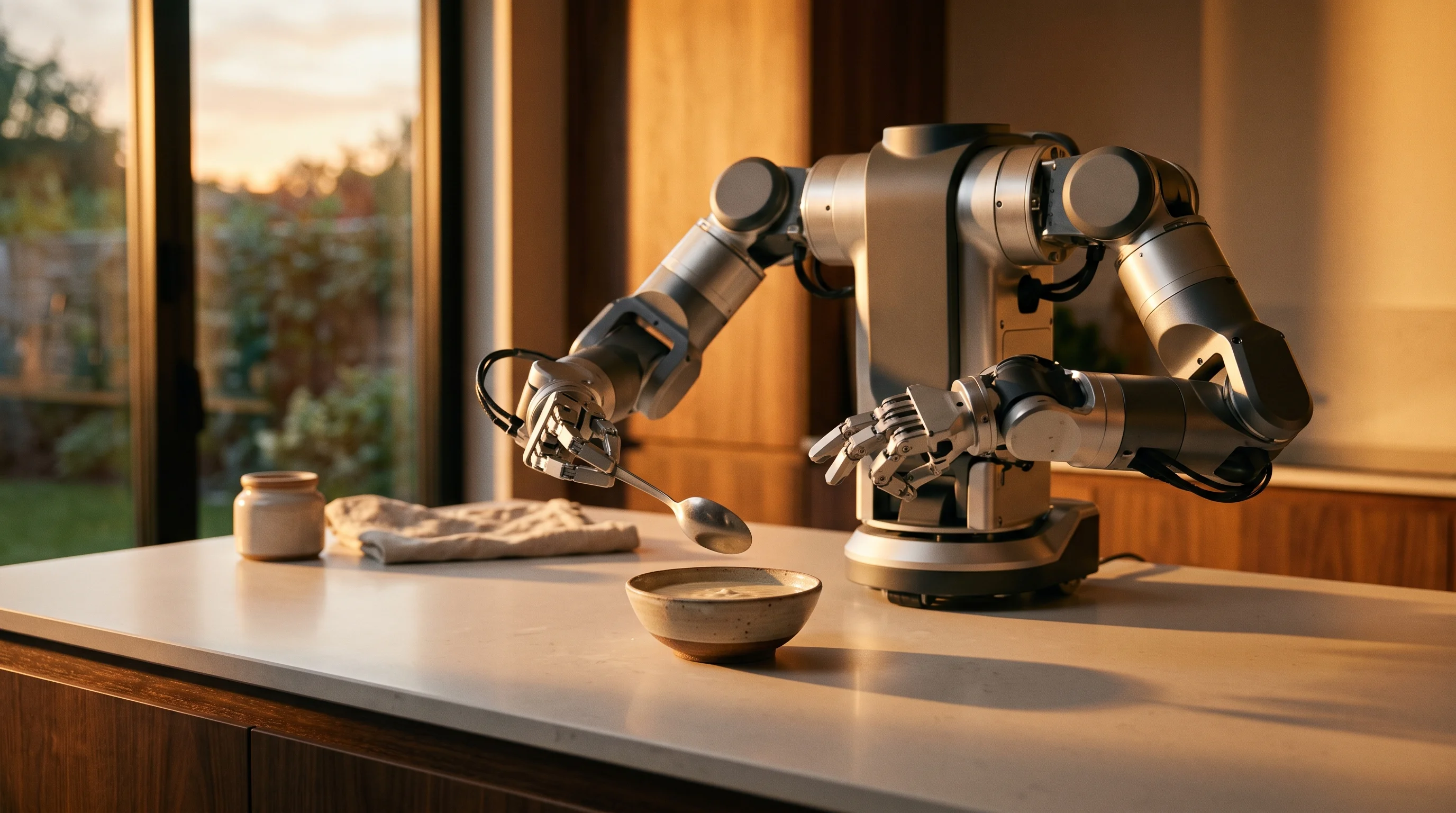
Intelligence Factory's approach reflects a broader industry convergence around demonstration-based learning. The academic precedent is Mobile ALOHA, research published in January 2024 showing that a low-cost bimanual mobile robot could achieve roughly 90% success rates on kitchen and lab tasks after training on about 50 human demonstrations. The implication, at least in controlled settings: with enough high-quality human data, robots could learn dexterous manipulation far faster than through traditional programming or pure reinforcement learning.
Intelligence Factory is trying to industrialize that insight. Operators wearing custom gloves perform tasks in controlled environments, capturing multimodal data—visual input, hand motion, force feedback—that gets retargeted to robot hardware. The goal is generalization: train on human demonstrations, deploy across different robot morphologies, from anthropomorphic hands to two-finger grippers. Target environments include warehouses, grocery stores, data centers—all settings where variability and clutter make traditional automation brittle.
It's early. The company lists five employees and is hiring founding engineers at equity bands (0.10% to 5.00%) that signal pre-product or early pilot stage. But the architecture they're pursuing—human teleoperation feeding vision-language-action models, with simulation evaluation before real-world deployment—matches the pipeline others are scaling.
Figure's deployment with BMW illustrates how this plays out when it works. Figure 02's initial deployment supported over 30,000 vehicles across ten months, handling sheet-metal loading in the body shop. The company has since deployed Figure 03, which features upgraded tactile hands, palm-mounted cameras, softer components for safer human interaction, wireless charging, and audio capabilities for speech-to-speech communication. The new sequencing use case at Spartanburg represents a step up in task complexity from the initial loading work.
Agility's Robot-as-a-Service model at GXO, launched in June 2024, took a different commercial tack. Rather than selling robots outright, Agility deploys Digit units under multi-year service agreements, handling maintenance and updates. The SPAC announcement positions Agility as potentially the first publicly traded pure-play humanoid robotics company—a market validation signal that investor appetite exists for near-term commercialization stories, even if the path to profitability remains fuzzy.
Foundation model providers are racing to offer plug-and-play intelligence layers. NVIDIA's GR00T roadmap includes iterative updates (N1.6 released in January, with industry chatter suggesting an N2 version may ship by late this year) alongside Cosmos, a suite of world models designed to enable reasoning and contextual understanding in physical AI systems. Skild's eye-watering valuation reflects a belief that the "operating system for robots"—a model trained across diverse embodiments and environments—could command platform-level economics akin to mobile OS players.
The open-source and academic community continues to push boundaries, often ahead of commercial players. The Open X-Embodiment project aggregated multi-robot demonstration data in 2023. Octo, released in May 2024, offered an open generalist robot policy. These efforts create a public commons of techniques and datasets, even as commercial players build proprietary moats through scale and deployment partnerships.
What Happens Next
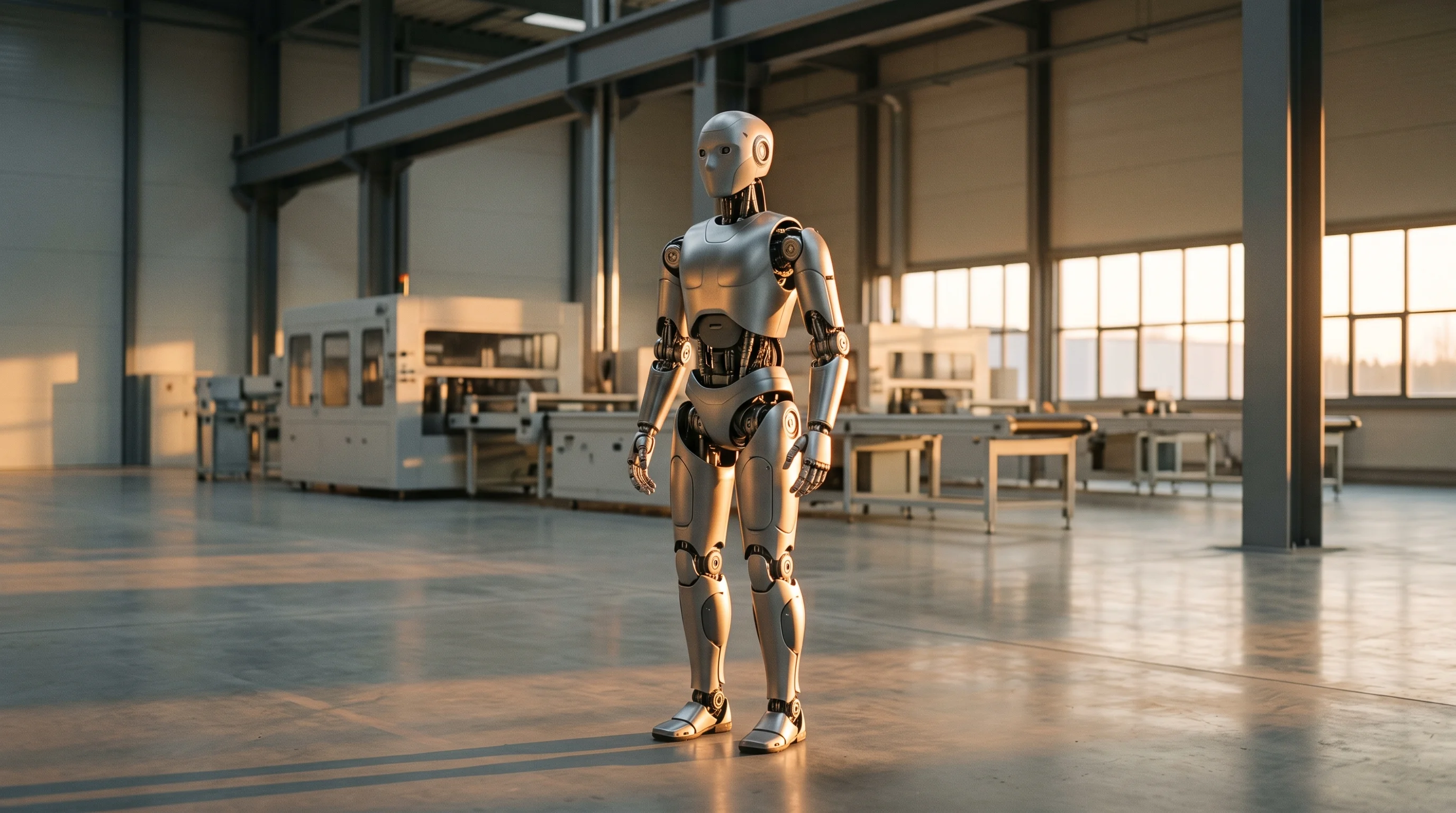
The next 18 to 24 months will clarify whether "intelligence is the bottleneck" is insight or hype cycle. Several inflection points loom.
Boston Dynamics and Hyundai have signaled 2028 as the target for meaningful Atlas deployments in industrial settings, with annual production ramping toward 30,000 units by then. If that timeline holds—and manufacturing timelines rarely do—it sets a benchmark for humanoid adoption at scale in automotive and heavy manufacturing. 1X's Neo production, reportedly shipping by year-end, will test whether humanoid robots can handle variability in less controlled environments than automotive production lines.
Foundation model maturation matters as much as hardware, maybe more. NVIDIA's iterative GR00T updates, Skild's $14 billion valuation, Covariant's logistics-focused RFM-1—all represent bets that a sufficiently general manipulation policy, trained on enough diverse data, can unlock deployment at scale. The demonstration-data pipeline that Intelligence Factory and others are pursuing is central to that thesis. If human teleoperation and retargeting prove to be bottlenecks—expensive, slow to scale, hard to generalize beyond narrow task distributions—then pure sim-to-real or other data-generation strategies may dominate instead.
Regulation will shape deployment speed in high-stakes environments, though how much remains an open question. The EU's AI Act and Machinery Regulation, along with updated U.S. standards like ANSI R15.06-2025, provide a compliance framework but also add cost and certification timelines. Startups moving fast in unregulated or lightly regulated sectors—warehouses, e-commerce fulfillment—may gain traction faster than those targeting automotive or aerospace, where safety certification cycles are measured in years, not quarters.
Market structure questions remain genuinely open. Does the industry consolidate around a few platform providers—NVIDIA for compute and models, a handful of OEMs for hardware—or does specialization by vertical create room for niche players? Intelligence Factory's cross-embodiment retargeting ambition suggests a belief in horizontal scalability: train once, deploy everywhere. If that works, intelligence providers could capture value across hardware platforms. If task-specific tuning proves necessary, the economics favor tighter vertical integration. We'll know which world we're in soon enough.
For founders, the opportunity is now—or at least that's the pitch. The installed base of 4.28 million industrial robots represents potential retrofit and augmentation revenue if intelligence software can be deployed on existing hardware. Greenfield deployments in warehouses, data centers, and retail offer faster adoption cycles but face real-world variability that current models struggle with. Investors are paying attention: Agility's $2.5 billion SPAC valuation and Skild's $14 billion raise signal that capital is available for companies demonstrating commercial traction or credible paths to generalization.
The race isn't to build better arms or legs. Those problems, while not trivial, are increasingly well understood. The race is to give robots the ability to reason through novel situations, adapt to clutter and variability, and learn new tasks without months of re-engineering. Hardware convergence is creating the conditions for an intelligence layer to matter in ways it hasn't before.
Whether a five-person startup in San Francisco or a billion-dollar unicorn captures that value will depend on whose data pipelines, models, and deployment playbooks prove out in the next wave of factory floors and fulfillment centers. The bottleneck is real. How it breaks—and who breaks it—is the story of the next two years in robotics. Possibly longer, if the industry's track record is any guide.


