

The pitch sounds like satire. Clip a camera to your toilet rim, let it watch you do your business, pay six bucks a month for the privilege. Yet here we are.
Throne, an Austin startup founded by WHOOP's former chief product officer, just closed a $10 million Series A round—reported by the Austin Business Journal in late July 2026—with shipping targeted for customers who paid $399 for what the company calls the next evolution in preventive health. The device tracks stool consistency, hydration levels, and urinary flow. All from a perch above your toilet bowl.
It's hard to know whether to file this under "inevitable" or "absurd." Maybe both.
The Throne One looks unassuming enough: a curved unit that clips to the rim of any standard residential toilet, no plumbing hookups required. Battery lasts a month. Wi-Fi and Bluetooth keep it connected. Inside, according to the company's own descriptions, sit more than a dozen AI models trained to analyze what most of us would prefer to flush and forget. The hardware was targeted to ship in February 2026 after a CES debut in January 2026 where Engadget got an early look, courtesy of co-founder John Capodilupo.
What It Actually Monitors (and How)
Each time a registered user sits, the sensor activates. Images. Audio. Computer vision algorithms classify stool against the Bristol Stool Scale—yes, that's a real clinical tool—and track bowel movement frequency. Urine color gets analyzed for hydration proxies. Acoustic sensors measure flow rate, estimate voided volume, even count nighttime bathroom trips.
The data appears in the companion app within minutes, Throne says. For that service, users pay $5.99 monthly, or $70 annually if they commit upfront. The first three months come free with purchase. Up to six household members can register, identified either by Bluetooth proximity or two physical buttons on the device itself. Guests who haven't paired their phones? No recording, the company insists.
Throne updated its privacy policy in February 2026, spelling out encryption protocols and promising that raw audio and visual data get wrapped in transit and at rest. Privacy filters supposedly minimize anatomical capture, though the company hasn't released technical specifics on what that filtering entails.
One thing Throne won't claim: medical diagnostic capability. The device is positioned strictly as a wellness product. HSA and FSA eligible, ships only within the United States, carries a two-year warranty with 30-day returns.
The Man Behind the Sensor Has His Reasons
Capodilupo co-founded WHOOP, the wearables darling that convinced athletes and Type A executives to obsess over recovery scores and pay monthly for the privilege. He also lives with ulcerative colitis, a chronic inflammatory bowel disease that demands near-constant vigilance. When Throne announced its $4 million seed round in May 2025—Moxxie Ventures led, with participants including cyclist Lance Armstrong—TechCrunch reported Capodilupo had joined as chief product officer. CEO Scott Hickle and CTO Tim Blumberg rounded out the founding trio.
Dr. Karan Rajan came aboard as Chief of Science in December 2025. LinkedIn pegs the company at somewhere between two and ten employees as of this summer, though follower counts hint at consumer curiosity outpacing headcount growth. Throne also struck a partnership with the Crohn's & Colitis Foundation, donating 5% of gross sales during a three-month window from October 2025 through January 2026.
Questions remain about whether that patient advocacy will translate into medical credibility.
The Privacy Conversation No One Really Wants
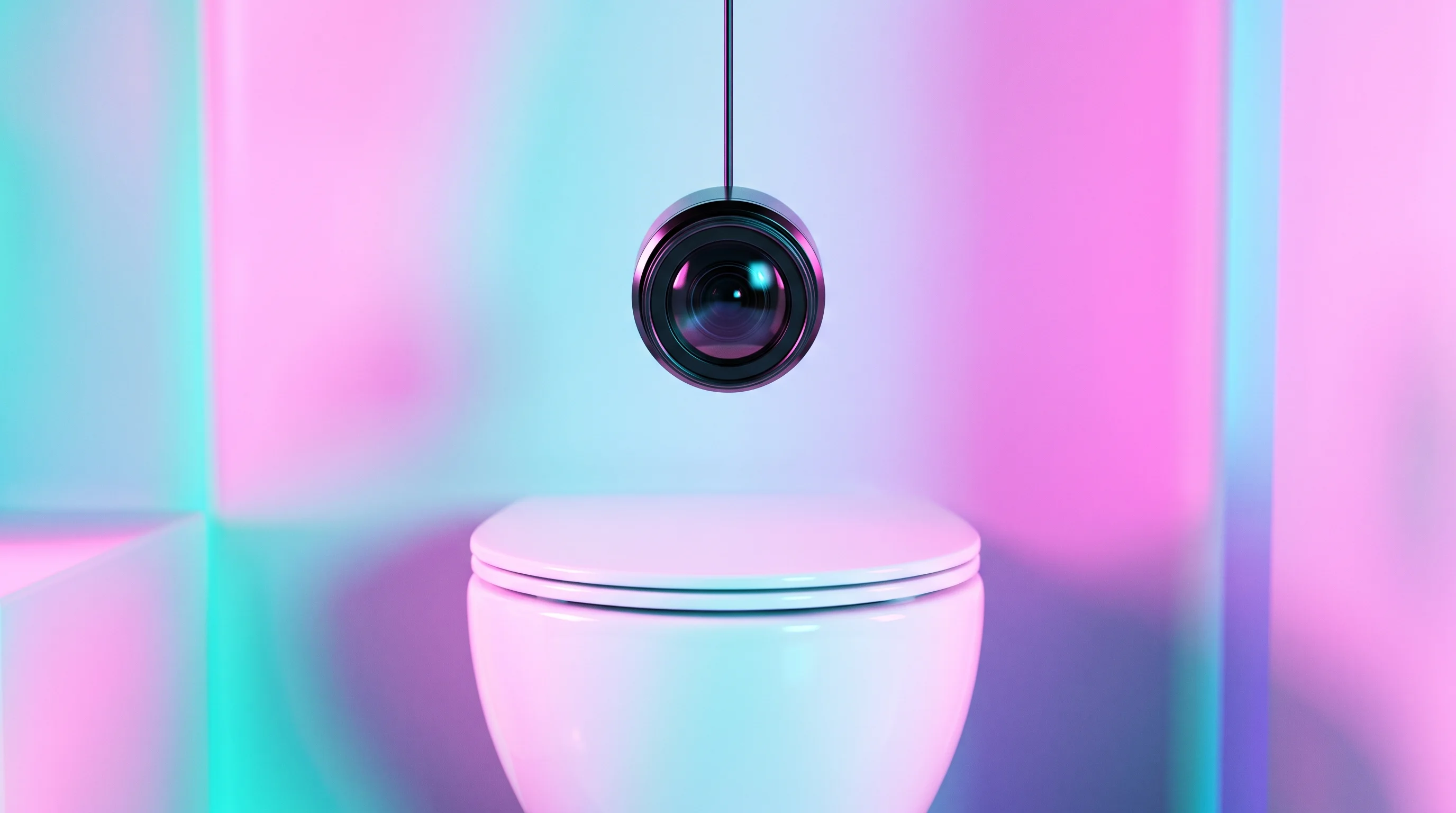
A camera. In the bathroom. Watching.
The New York Post had predictable fun with the concept in April 2026, running a headline that leaned hard on the "camera on your bowl" framing. Most coverage since has circled back to the same discomfort. Throne's response has been consistent: optics face downward only, activation happens solely for registered users, encryption covers all transmissions. De-identified data might train future AI models, but users can opt out of features like the generative "Gut Health Coach."
Still. You're trusting a startup—and by extension, its cloud infrastructure, its security practices, its eventual acquirer or bankruptcy trustee—with footage and audio from perhaps the single most private ritual in daily life.
As of mid-2026, Throne hasn't published peer-reviewed validation of its hydration proxies, stool classification accuracy, or urinary flow metrics. TechCrunch noted research partnerships with the University of Washington and University of Chicago in its May 2025 seed coverage. No public results have emerged since.
The Longer Game: From Wellness Gadget to Cancer Detector

CEO Hickle described Throne to the Austin Business Journal as a "smoke detector for colon cancer." The ambition is detecting microscopic blood in stool, an early warning system for colorectal cancer that could, in theory, save lives through earlier intervention.
That vision, though, remains firmly in the aspirational column. The current product tracks wellness signals—hydration, bowel regularity, urinary patterns—not disease. Men's Fitness highlighted the hydration score in a July piece on performance and dehydration. GQ unpacked the "dozen different AI models" in March. The device is real, it's shipping, it's collecting data.
But moving from consumer wellness gadget to clinically validated diagnostic tool requires the kind of rigorous validation studies Throne hasn't yet made public. And that gap—between what the product does today and what Hickle envisions tomorrow—is where skepticism enters.
Not Exactly a Blue Ocean

Throne has company in the smart toilet space, which is either encouraging or concerning depending on how you view nascent markets.
Withings launched U-Scan stateside in November 2025: a $379.95 puck that sits in the bowl analyzing urine chemistry for ketones, vitamin C, hydration markers. Kohler's Dekoda, priced at $599 and launched in October 2025, uses machine learning for gut health, hydration, and blood detection. Toi Labs deploys TrueLoo in eldercare facilities for fall prevention and health monitoring. Olive Diagnostics offers hands-free urinalysis. OutSense Diagnostics focuses on occult blood detection using optical sensors.
The market is forming, perhaps. Or it's fragmenting into a dozen incompatible approaches, none of which gain enough traction to matter. Hard to say which.
Will We Normalize This?
Throne now has $10 million more runway to answer a question that probably sounded ridiculous five years ago and might sound obvious five years from now: Will consumers clip a camera to their toilets in exchange for daily gut and hydration feedback?
The device ships. The subscription renews monthly. The AI models process each session, learning and refining with every flush. What remains genuinely unclear is whether bathroom surveillance becomes as unremarkable as wrist-worn heart rate monitors—something we glance at, shrug about, maybe act on occasionally—or whether it stays firmly in the "too weird, no thanks" category.
WHOOP convinced people to wear a band 24/7 and pay for the privilege. Capodilupo helped build that behavior change. Whether he can do it again in a far more intimate setting is the bet Throne's investors just made.
And the rest of us? We'll find out soon enough if the bathroom becomes the next frontier in the quantified self movement, or if some frontiers are better left unexplored.


