

A drone that recharges on power lines sounds like the sort of thing a well-caffeinated engineering student might sketch on a whiteboard at 2 a.m. Which, in a sense, is exactly how it started.
Voltair, a San Francisco startup that emerged from the University of Washington's engineering labs, is betting that utilities desperate to inspect thousands of miles of transmission lines—ideally before the next catastrophic wildfire—will embrace what amounts to a radical infrastructure play: autonomous aircraft that pull power directly from the grid itself, sidestepping the battery limitations that hobble conventional drone operations.
The company was announced in mid-January as part of Y Combinator's Winter 2026 cohort, pitching what founders describe as continuous aerial surveillance. "We build drones that charge directly on transmission lines," the announcement read, adding that the approach would let aircraft "remain deployed indefinitely." It's the kind of audacious claim that makes seasoned utility engineers raise an eyebrow—in an industry where flight time is usually measured in minutes, indefinitely is a loaded word.
Selling Data, Not Just Drones
Voltair doesn't particularly want to be seen as a hardware company. The framing, instead, is infrastructure-as-a-service: inspection imagery and analytics piped to utility engineering teams within minutes, not the days or weeks that truck-based inspections typically require.
The aircraft itself—a hybrid fixed-wing VTOL design equipped with RGB, thermal, and LiDAR sensors—can handle 70-mile corridor missions at speeds up to 80 mph. The company claims 5-minute response times to trouble spots, assuming enough charging pads dot the landscape. Conventional enough, as drones go.
What distinguishes Voltair, at least in theory, is the charging infrastructure. Current marketing materials describe "solid-state inductive charging pads" that enable continuous remote operations with no battery swaps. An earlier utility-focused webpage from late last year, though, used more cautious language: "patent-pending recharging IP" that "when fully developed, would allow our system to recharge off an AC powerline of any voltage using inductive charging."
That conditional phrasing—when fully developed—is doing a lot of work. It suggests the headline-grabbing vision of drones perching on high-voltage lines to sip power remains somewhere between prototype and aspiration. The company hasn't named utility customers or disclosed active pilot programs, though its January announcement invited utilities to join early testing. Y Combinator's Demo Day for the Winter 2026 cohort is scheduled for March 24, which means investor conversations are likely still fluid.
University Roots, Startup Ambitions

The founding quartet—Ronan Nopp, Hayden Gosch, Warren Weissbluth, and Avi Gotskind—built the early concept at the University of Washington, where it earned validation before YC came calling. Voltair claimed the $25,000 grand prize at UW's Dempsey Startup Competition last May, plus a $5,000 IoT award. A month prior, the team picked up $15,000 at the university's Environmental Innovation Challenge.
The startup lists five employees and has job postings for mechanical engineers, field operations leads, and drone pilots on the YC board. No outside funding beyond accelerator participation has been announced, though that's fairly standard for a batch still working the Demo Day circuit.
The Long Flight Arms Race
Voltair isn't the only company chasing extended airtime through unconventional charging schemes. Munich-based Nomadic Drones raised $1.6 million last October for its own power-line charging system, claiming field tests on 220-kilovolt grids. An academic paper presented at a robotics conference in March 2024 demonstrated autonomous recharging cycles on live outdoor power lines, lending some technical credibility to the broader idea.
The "infinite flight" concept has also drawn interest from wireless power ventures. PowerLight announced kilowatt-class laser beaming technology this past January. And established drone companies like Percepto and Airobotics already offer drone-in-a-box solutions with ground-based charging—though those lack the spatial flexibility that line-perching systems promise.
Perhaps the bigger obstacle isn't technical. Regulatory constraints loom. Beyond-visual-line-of-sight operations remain tightly restricted in the U.S., and utilities can't roll out autonomous inspection networks at scale without FAA waivers. A December report from the Small UAV Coalition underscored the economic stakes, noting how BVLOS approvals could unlock persistent monitoring applications. Voltair's vision of indefinitely deployed drones assumes those regulatory gates eventually open.
The Near-Term Reality
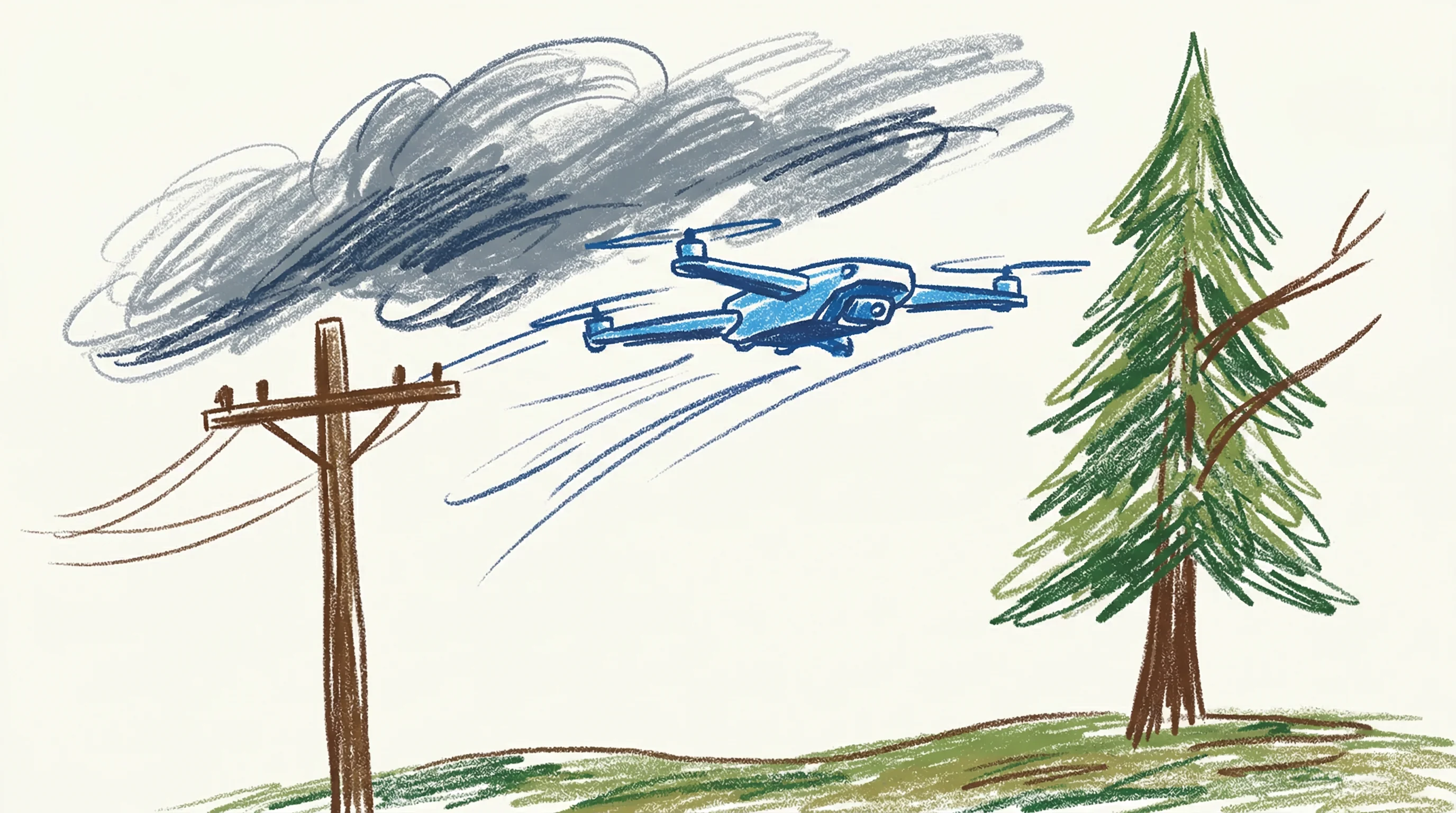
For all the talk of power-line perching, Voltair's go-to-market pitch focuses on something more immediate: speed. The company is targeting storm response, outage investigation, wildfire risk assessment, vegetation management—scenarios where utilities currently dispatch crews in trucks, a process that can stretch across hours or days. Voltair calls them "virtual truck rolls," positioning the charging infrastructure as enabling technology, not the headline feature.
Which raises a practical question: Does the startup actually need the power-line charging breakthrough to build a viable business? Perhaps not immediately. A hybrid aircraft shuttling between ground-based charging pads along transmission corridors, delivering inspection data faster than crewed alternatives, is a defensible wedge even without the "infinite range" flourish.
The real test is whether Voltair can convert pilot interest into signed contracts before competitors with deeper pockets—or tighter utility relationships—stake the same claim. The charging breakthrough may still be on the roadmap. The market problem, though, is here now.
With Demo Day a week out, the company is taking pitches and courting utilities willing to test the platform. In wildfire-prone regions where inspection backlogs stretch for months, the appeal is obvious. Whether the technology can deliver on the promise is the story still being written.


