

The dime sits 200 miles away. Hold a laser pointer on it, perfectly still, for 15 seconds straight. That's roughly the pointing stability the James Webb Space Telescope achieves—one milli-arcsecond, a feat of engineering that took decades to refine through reaction wheels, passive isolators, fine steering mirrors, and control loop architectures that read like spacecraft design textbooks.
Now a San Francisco startup says it can deliver that precision to commercial satellites circling Earth. Without the reaction wheels.
It's an audacious claim, perhaps even an improbable one. Reaction wheels have been the backbone of spacecraft attitude control since the 1960s—simple, reliable, proven across thousands of missions. But Samara Aerospace, freshly armed with a $10 million seed round closed this January, argues those spinning masses have outlived their usefulness. Or at least their monopoly.
The company's Hummingbird satellite bus replaces conventional reaction wheels and control moment gyroscopes with something called MSAC: Multifunctional Structures for Attitude Control. Think piezoelectric actuators embedded in the hinges of deployable solar panels, commanding rapid micro-motions that generate angular momentum for slewing maneuvers while executing equal-and-opposite vibrations to cancel jitter throughout the bus.
Published specs claim 0.08 arcsecond pointing stability for the two-panel configuration, with the system designed to reach milli-arcsecond-class precision through active cancellation. If those numbers hold up on-orbit—and that's still an if—the timing couldn't be better.
When Vibration Becomes the Problem
Earth observation markets are projected to exceed $8 billion by 2033, per Novaspace. Optical inter-satellite links, which demand micro-radian pointing accuracy, are becoming standard equipment on major constellations. Starlink operates somewhere between 9,300 and 9,600 satellites now, with laser crosslinks spreading across later generations. Amazon's Project Kuiper has committed to equipping every satellite with optical terminals after demonstrating 100 Gbps links over 1,000 kilometers in prototype tests.
Both applications run into the same wall: the spacecraft bus itself won't stop shaking.
Reaction wheels vibrate. It's physics. The spinning masses create harmonics that propagate through structures, and for Earth observation satellites—especially those using pushbroom imagers with sub-millisecond integration times—those vibrations blur imagery. Studies on missions like Yaogan-26 document measurable degradation from wheel-induced jitter. Add a cryocooler, which the HyTI CubeSat mission did for long-wave infrared imaging, and the jitter budget balloons. HyTI allocated 2.89 arcseconds over 0.5 millisecond integration windows, with three reaction wheels and that cryocooler as the primary culprits.
The industry hasn't been sitting idle. Blue Canyon Technologies and Rocket Lab's Sinclair division have introduced lower-disturbance wheels. ESA is funding gas-bearing ultra-low-vibration models through programs like Veoware. Moog and others supply elastomeric isolators, tuned mass dampers, payload isolation platforms—all designed to decouple sensitive optics from noisy buses.
These solutions work. They're flying. But they add mass, cost, complexity. They manage the problem rather than eliminate it.
For optical communications, the stakes climb higher still. Laser terminals require pointing accuracy measured in micro-radians or better; misalignment and platform jitter directly throttle achievable data rates and link margins. NASA's Deep Space Optical Communications demonstration wrapped in September 2025 after transmitting video from 307 million miles away, underscoring what ultra-stable pointing looks like at scale. The Space Development Agency's Optical Communications Terminal standard, now in version 4.0, drives interoperability across the Department of Defense's Proliferated Warfighter Space Architecture. That standard implicitly demands stable platforms beneath those terminals.
Mynaric has delivered over 100 CONDOR Mk3 terminals by mid-2025, targeting up to 100 Gbps in the Mk3.1 variant. TESAT reports 46 optical communication terminals on-orbit. Honeywell markets coarse pointing assemblies specifically for optical inter-satellite links. The hardware ecosystem is maturing fast.
What these terminals need, more than anything, is a bus that doesn't fight them.
Eliminating the Wheel
Samara's approach dispenses with reaction wheels entirely.
"We're using piezoelectric actuators in solar panel hinges to rapidly stabilize and reconfigure flat panels," CTO Vedant, who holds a PhD in aerospace engineering from the University of Illinois and invented the MSAC concept, told SpaceNews.
The physics differ in a meaningful way from conventional systems. Control authority scales with panel size—larger panels provide more torque with more available power. That inverts the traditional trade-off between power generation and agility. The company claims this architecture enables "1,000 times more stable" performance than traditional systems, though that figure comes from founder interviews and awaits independent validation on-orbit. Claims are one thing. Data from space, quite another.
Two peer-reviewed papers presented at the 2023 IEEE Aerospace Conference detail the modeling and potential applications. One paper, "Multifunctional Oscillating Structures for Slewing and Active Jitter Cancellation," positions MSAC as an alternative to wheels and CMGs. A companion paper discusses new spacecraft architectures enabled by the technology—Disksats, sail configurations—and asserts potential sub-milli-arcsecond pointing performance.
The Hummingbird bus comes in 2-, 4-, 6-, and 8-panel variants. Published specs for the two-panel configuration show pointing stability of 0.08 arcseconds, pointing knowledge and accuracy of 10 and 20 arcseconds respectively, maximum slew rates of 3.5 degrees per second, and peak power of 1.2 kilowatts. The design targets 10-year operational life in low Earth orbit.
Perhaps the boldest claim: bringing "JWST pointing precision to commercial LEO market" at commercial price points and production timelines. Webb achieves roughly one milli-arcsecond line-of-sight stability through reaction wheels mounted on 7 Hz passive isolators, a secondary 1 Hz telescope tower isolator, and a Fine Guidance Sensor-driven fine steering mirror loop running at approximately 2 Hz. It's a dedicated observatory architecture developed over decades, optimized for deep space. Matching that performance in a flat-pack satellite bus designed for volume manufacturing? That would represent a genuine step change.
Or an expensive lesson in orbital physics.
Market Forces and Fortuitous Timing
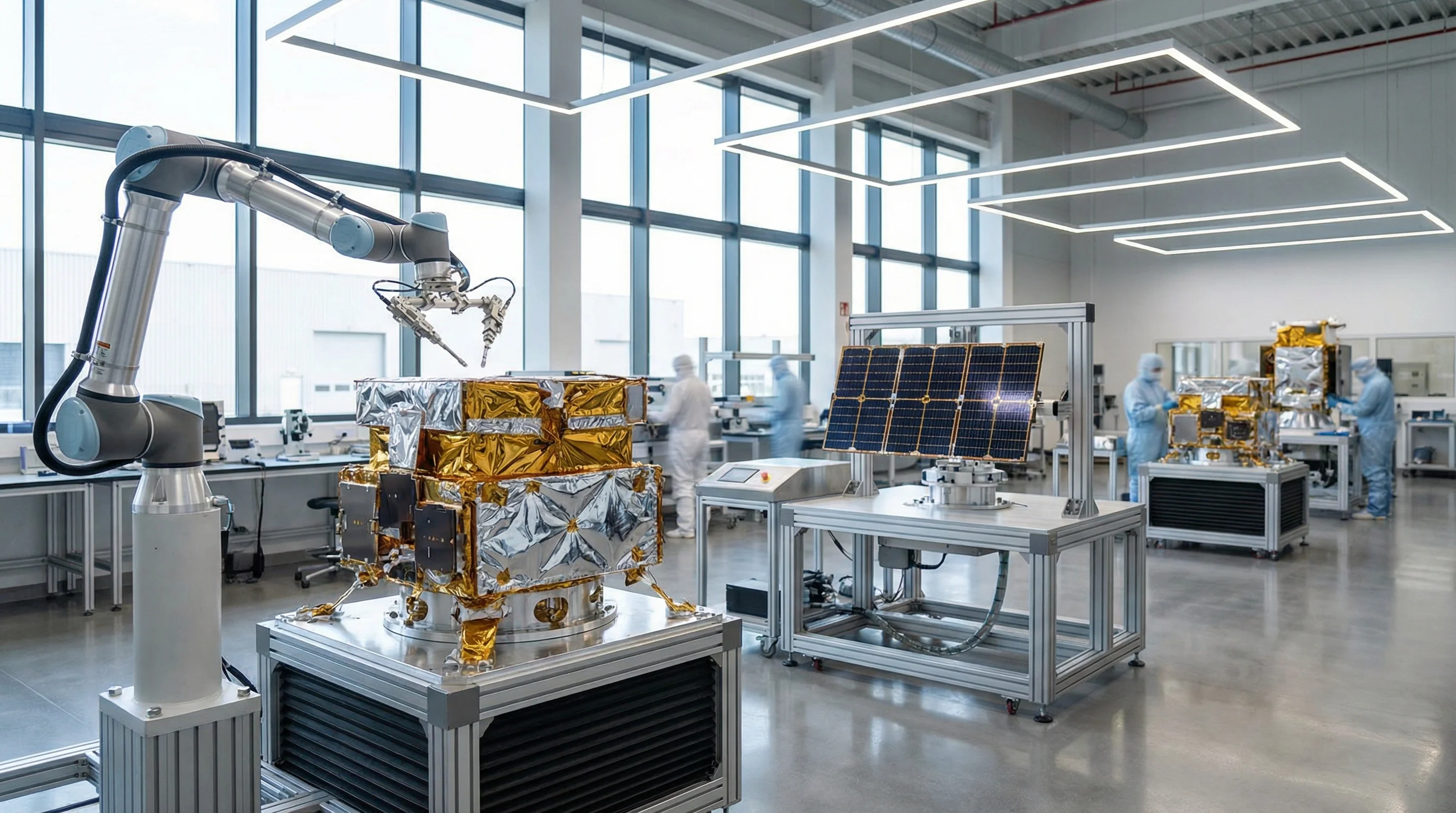
The Earth observation sector is tightening requirements just as Samara scales production. NOAA's 2023 elimination of many Tier-3 licensing restrictions—including X-band SAR limitations—has accelerated U.S. commercial competitiveness. Companies like Umbra can now deploy 16-centimeter SAR systems without regulatory friction that previously added months to licensing timelines.
Higher-fidelity payloads create demand for more stable platforms. Video from orbit, hyperspectral imaging, next-generation synthetic aperture radar—all benefit from reduced jitter. Grand View Research projects the Earth observation market growing from $5.10 billion in 2024 to $7.24 billion by 2030, a 6.2 percent compound annual growth rate. Not explosive growth, but steady demand.
Optical communications present a parallel, perhaps more lucrative opportunity. Market research firms project rapid expansion, though estimates vary depending on methodology. MarketsandMarkets forecasts the optical satellite communication market expanding from $620 million in 2025 to $1.56 billion by 2030, a 20.4 percent CAGR, with approximately 19,484 terminals deployed by 2030. Fortune Business Insights projects a more aggressive trajectory: roughly $2.64 billion in 2025 growing to $7.44 billion by 2034.
Those are projections, of course. Markets rarely grow in straight lines.
The SDA's standardization efforts are catalyzing the supplier ecosystem regardless. CACI's CrossBeam terminal passed interoperability tests. TESAT's terminals achieved version 3 compliance. The department is soliciting industry input on version 4.0 updates, signaling sustained commitment to multi-vendor interoperability for the Transport and Tracking layers of its proliferated LEO architecture.
Industry commentary suggests optical communications will become mainstream in the early 2030s as ground station networks and standards mature. Constellation operators are already committing capital. The question shifts from whether optical links will proliferate to which bus technologies will support them at scale—and at what cost.
CEO Patrick Haddox, who holds a master's in aerospace engineering from the University of Illinois and brings over 12 years of spacecraft technology experience, framed the company's SpaceWERX Direct-to-Phase II contract bluntly: improving pointing accuracy for a 200-to-500-kilogram Earth-imaging spacecraft. The Air Force contract, running from August 2024 through May 2026, targets critical design review, validation testing, and delivery of flight hardware to a commercial satellite partner.
That contract represents one piece of a broader funding mosaic. Samara has secured a $274,993 NSF STTR Phase I award in 2024, plus SpaceWERX and TACFI awards totaling over $5 million publicized through 2025. The $10 million seed round announced this January, led by Balerion Space Ventures, supports scaling the company's 11,200-square-foot San Francisco facility and doubling the team—which LinkedIn profiles suggest currently numbers between two and ten employees, depending on how you count contractors.
Small teams can move fast. They can also hit scaling walls.
Proving It Works
The company delivered its Cicada payload to Impulse Space's Mira spacecraft for first in-space validation of MSAC technology. Samara delivered the hardware in under four months—a timeline that underscores manufacturing velocity, if nothing else. On-orbit evaluation is planned via a LEO rideshare arrangement.
Results from Cicada will provide the first independent data on MSAC performance in the space environment. Until those results arrive, the technology remains unproven at orbital scale, however compelling the laboratory demonstrations and modeling work. That's just how spaceflight works. Models break. Hardware surprises you. Vacuum and thermal cycling expose assumptions.
Hummingbird-1, the company's first full satellite bus, targets launch in summer 2027. That mission will serve as the primary validation platform and proof-of-concept for commercial customers.
Meanwhile, the competitive landscape continues evolving. Micro-Newton thrusters represent one alternative path—NASA's Engineering and Safety Center has assessed microthrusters as a potential solution for large space telescopes, eliminating wheel-induced jitter during fine pointing operations. ESA's LISA Pathfinder and Gaia missions demonstrated drag-free and fine pointing control using micro-propulsion heritage.
Advanced reaction wheel development hasn't stopped either. ESA is funding gas-bearing wheels promising reduced micro-vibrations and electromagnetic interference. Companies are refining magnetic shielding and bearing technologies. The incumbent technology isn't standing still, in other words.
Active and passive isolation systems—Moog's tuned dampers, wheel isolators, payload isolation platforms—represent mature, flight-proven mitigation strategies. They don't solve jitter at the source, but they work well enough that most operators accept the mass and cost penalties rather than gamble on unproven alternatives.
Samara's bet is that eliminating wheels altogether, rather than refining or isolating them, creates architectural advantages beyond pointing stability alone. The flat-pack form factor of Hummingbird, with panels serving simultaneously as power generation, structure, and attitude control hardware, simplifies integration and potentially reduces launch volume. If the active jitter cancellation performs as modeled, secondary systems like isolation platforms become unnecessary, recovering mass budget elsewhere.
Those are attractive propositions on paper. Space has a way of testing propositions rigorously.
What Comes Next
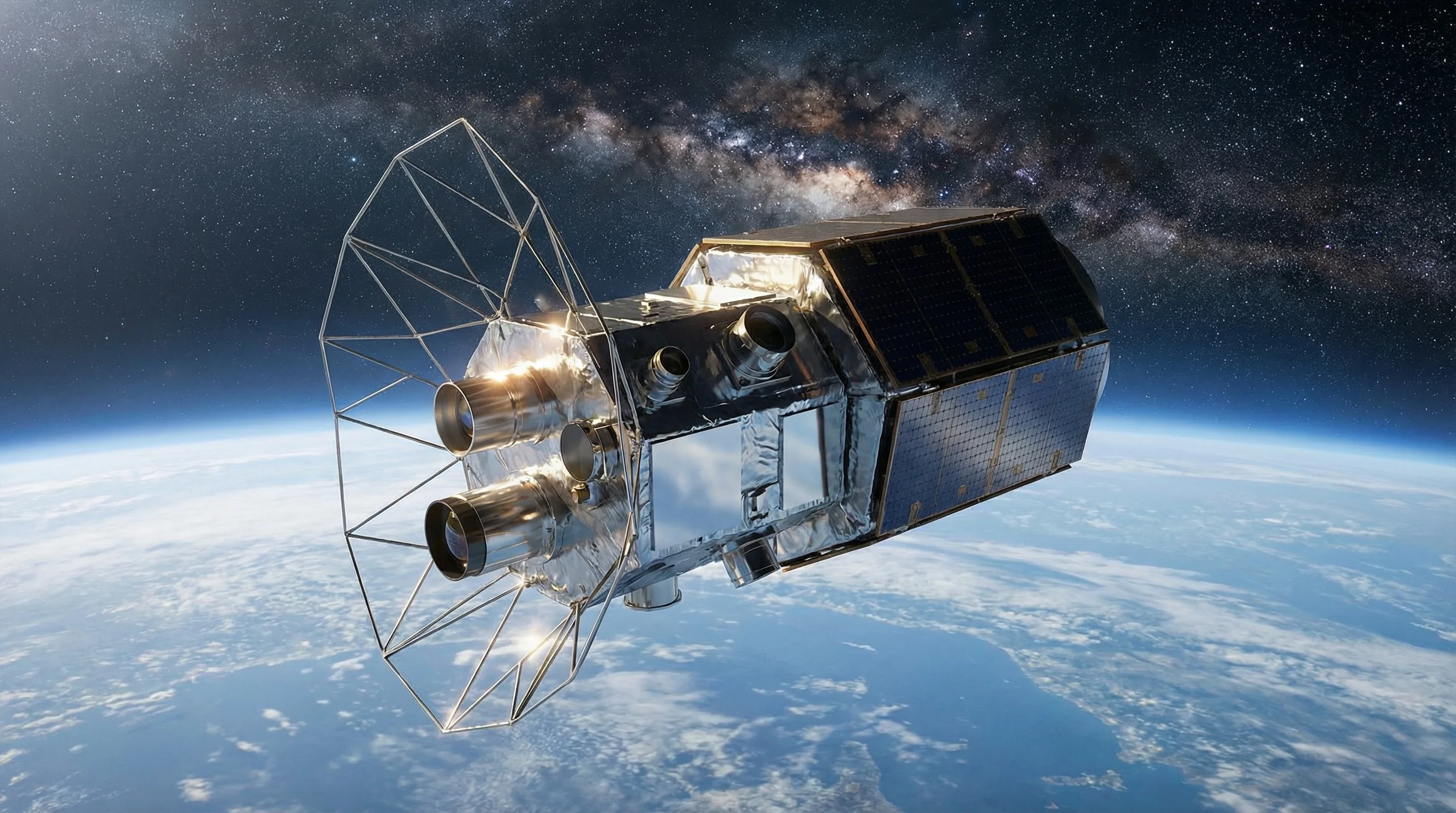
The next 18 months will clarify whether MSAC delivers on its headline claims. Cicada's on-orbit evaluation will provide initial validation data. Hummingbird-1 in 2027 will demonstrate the technology at full satellite scale. Air Force contract milestone deliveries will show whether the system meets operational requirements for a commercial imaging partner.
What seems clear already is that demand exists. Earth observation operators want sharper images without heavier buses. Constellation operators deploying optical terminals want stable platforms that don't require heroic engineering to achieve micro-radian pointing. The Space Development Agency wants interoperable optical terminals fielded at volume—which implicitly means bus suppliers who can deliver stable platforms at commercial price points and timelines.
Whether Samara's approach ultimately displaces reaction wheels or becomes a high-performance niche option for premium applications remains to be seen. The company's trajectory reflects broader industry trends regardless: satellite design moving toward integrated, multifunctional structures; pointing requirements tightening across both Earth observation and communications markets; economic pressure to field capable systems faster and cheaper showing no signs of letting up.
Webb-level precision in a commercial satellite would be remarkable. Getting there without reaction wheels would be elegant engineering. Doing both while maintaining manufacturability at commercial scale would reshape expectations across the industry.
The hardware is built. The launch manifest is filling. Demonstrations are coming.
Now the physics gets to vote.


