

The neurons didn't know they were playing Doom. Two hundred thousand of them, cultured from human stem cells and spread across a microelectrode array in an Australian laboratory, received electrical impulses and fired back responses. Slowly, haltingly, they learned to navigate the pixelated corridors of a first-person shooter—no graphics card required, no traditional processor in sight. Just living brain cells, adapting in real time.
That demonstration, conducted earlier this year by Cortical Labs, represents something more than a clever laboratory trick. It's become a proof point for an industry argument that's gaining traction in unlikely corners of the data center world: that living neurons, properly harnessed, might offer a way out of the infrastructure crisis now gripping artificial intelligence.
The timing is hardly accidental. Global data center electricity demand is projected to roughly double by 2030, from approximately 415–485 terawatt-hours in 2024 to somewhere between 945 and 1,000 terawatt-hours, according to the International Energy Agency's recent assessments. AI-focused facilities are growing faster still—some scenarios show demand tripling by decade's end. McKinsey puts the global data center buildout at $6.7 to $7 trillion over the same period, with hyperscaler capital expenditures alone surpassing $700 billion in 2026, the lion's share earmarked for AI infrastructure. S&P Global, looking just at U.S. utilities, forecasts roughly $1.3 trillion in capital needs from 2026 through 2030 to keep pace with the rising large-load demands from data centers.
Against that backdrop, a small cohort of biocomputing startups is racing to commercialize what was, until recently, academic curiosity. They're building platforms, opening APIs, and pitching data center operators on the prospect of neuronal racks that sip watts instead of gulping megawatts. Whether this turns out to be a niche research tool or the opening act of a genuine alternative to silicon remains very much an open question. But the infrastructure crisis is real enough that people are listening—perhaps more than the founders themselves expected.
The Watt Problem
The numbers driving interest in what the industry calls "wetware computing" are, on their face, straightforward. A typical GPU-heavy AI workload can burn through hundreds of kilowatts per rack. Cortical Labs, the Australian outfit behind the Doom demo, claims its CL1 units—each housing cultured human neurons on high-density microelectrode arrays—draw around 30 watts per unit. If those claims hold at scale, the efficiency gap is dramatic.
But efficiency metrics in this space remain contentious, to put it mildly. Intactis Bio, a German startup that unveiled a Tetris-playing neuron demo last July, claims up to 3 million times the energy efficiency per decision compared to silicon, along with 90 percent cost savings for customers burning more than $20,000 monthly on compute. As of mid-2026, those figures haven't been independently validated in peer-reviewed literature at anything approaching application-relevant scale. The companies are publishing demos, not benchmarks.
The broader AI infrastructure market is under pressure from multiple angles. McKinsey's July 2026 analysis highlights a shift toward inference-heavy workloads, where specialized hardware stacks—neuromorphic chips, photonic optical neural networks, and now biocomputing—are all angling for pilot deployments. One investor thesis suggests an 80/20 split favoring inference over training in future workloads, though this too remains more claim than measured trend. What's not in dispute is that hyperscalers are hunting for anything that can bend the cost and power curves downward, and they're hunting urgently.
From Laboratory Curiosity to Data Center Pitch
Wetware computing isn't new in principle. The foundational "DishBrain" paper, published in 2022 by researchers affiliated with Cortical Labs, demonstrated cultured neurons learning to play Pong through closed-loop stimulation and recording—electrical signals in, neural responses out, feedback shaping behavior over time. A 2023 Nature Electronics study on "Brainoware" used 3D brain organoids for reservoir computing tasks like speech recognition and time-series prediction. These were lab experiments, proofs that living neurons could process information and adapt in response to structured inputs.
By 2025 and into 2026, the shift was toward commercialization. Cortical Labs launched its CL1 "biological computer" at Mobile World Congress Barcelona in March 2025, then opened API access the following year alongside the Doom demonstrations that drew mainstream media coverage. In March 2026, the company announced a prototype biological data center in Melbourne housing roughly 120 CL1 units, and a multi-phase deployment partnership with DayOne DC in Singapore.
The Register interviewed Cortical Labs staff around that time, noting that daily operations include exchanging cerebrospinal-like fluid to keep the neurons alive. It's a maintenance burden that doesn't exist for silicon—a detail that tends to get glossed over in the pitch decks but looms large when you start thinking about lights-out data center operations.
FinalSpark, a Swiss startup, launched what it calls the Neuroplatform in May 2024, marketing it as the first remote research platform using living human neurons for biocomputing. Pricing at the time was listed at $500 per month. The platform has been continuously updated through 2025 and 2026, with multiple universities gaining access for experiments. It's positioned as research infrastructure rather than a commercial compute product, but it established the notion of biocompute-as-a-service—neurons in the cloud, accessible via API, billed by the month.
The Startup Cohort
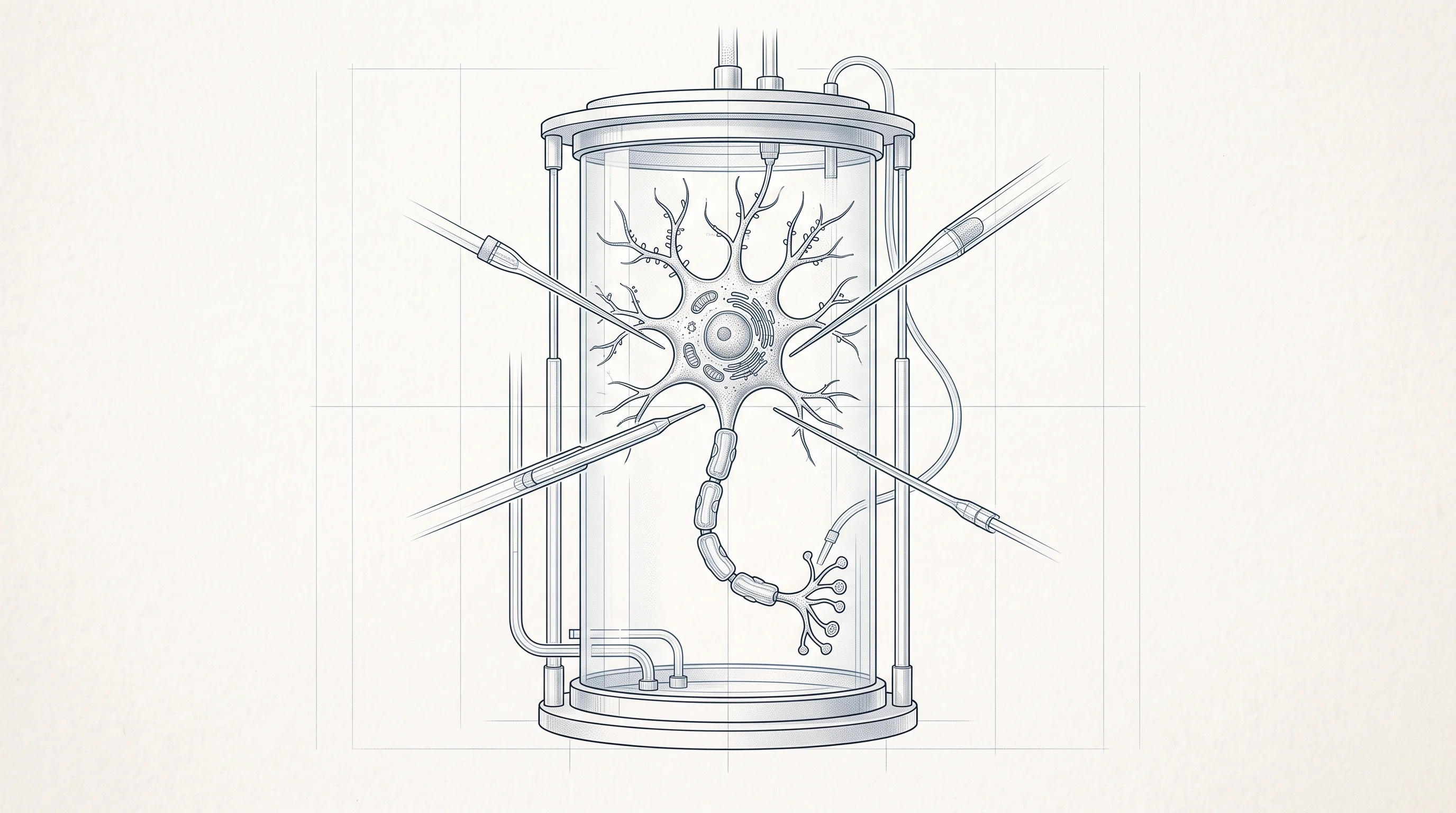
The group of companies pursuing wetware computing is small but growing, each with a distinct angle on the problem.
Parasma, founded in 2026 and part of Y Combinator's Summer batch that year, describes its mission simply: "we train brain cells for compute." The company is based in San Francisco, founded by Sean Cole. Team size on its YC profile is listed as one, though further expansion may not be reflected in that initial entry. Parasma's website claims demonstrations of token prediction—decoding neuronal responses into tokens without a GPU—and reinforcement learning control tasks including, yes, Doom.
On June 18, 2026, the company published a detailed note addressing consciousness and suffering head-on. It argues that its small-scale cultures—around 200,000 neurons—lack the anatomical features associated with sentience or pain pathways. The note describes conservative stimulation protocols using biphasic pulses scaled to neuronal surprise signals, drawing on free energy principle concepts. Parasma's YC jobs page lists an open "Founding Scientist" role with compensation shown as "$1M; 1–3% equity; 11+ years." The salary figure is atypical for such listings and should be verified directly.
Cortical Labs has moved furthest toward commercial deployment. Having previously raised a $10 million seed round in 2023, the company in March 2026 secured a new investment round—amount undisclosed—led by Horizon Ventures and 3C, with participation from Gobi Partners and Tom Oxley. The CL1 units are marketed as biological computers capable of adaptive learning with dramatically lower energy consumption than silicon reinforcement learning systems, though comprehensive head-to-head benchmarks on real workloads haven't been published.
The Doom demos in February and March 2026—200,000 human neurons navigating a first-person shooter—generated coverage from The Guardian, Popular Science, ABC News Australia, and various YouTube channels. An LBC UK radio segment in June profiled the work as "the 24-year-old student who taught cells to play video games," referencing both Cortical Labs' platform and independent developer contributions. The media narrative has consistently focused on the novelty factor. Whether the technology can deliver on the efficiency claims at scale is a different story.
The Biological Computing Company emerged from stealth in February 2026 with a reported $25 million seed round led by Primary Ventures. The team numbers around 23, focused on building adapters and algorithms that integrate biocompute with frontier AI models for tasks like computer vision and video generation. In an April 2026 GamesBeat interview, founders Alex Ksendsovsky and Jon Pomeraniec outlined a 20-year roadmap, with plans to achieve real-time compute integration within five to ten years. The pitch is less about replacing silicon entirely and more about augmenting existing model inference pipelines with neuronal co-processors—a more realistic stance, perhaps, than the full-replacement narrative.
Intactis Bio, based in Germany, launched its public Tetris demo in July 2026, marketing what it calls "Biohybrid Processing Units" (BPUs) for data center racks. The company has raised around $1 million since 2024 from investors including RPV and Convoi, plus grants, and reports a team of about 13. Founder Daniel Rodriguez-Granrose targets customers currently spending over $20,000 per month on compute, positioning early cloud access as a stepping stone to rack-level deployments. The efficiency and cost claims, again, remain unverified by independent technical audits.
FinalSpark continues to operate primarily as a research platform rather than a commercial product, though its Neuroplatform has expanded access and released data through 2025 and into 2026. It represents the academic end of the spectrum, enabling experiments without requiring labs to build their own neuron-electrode infrastructure.
A handful of related efforts are also in motion. Koniku has pursued neuron-based olfactory sensing for applications like airport security, marketing "smell processors" rather than general AI compute. Princeton Engineering reported a 3D biohybrid device combining living brain cells and electronics in April 2026. MIT researchers published findings in March 2026 showing that neurons receive precisely tailored teaching signals during learning, with implications for neuro-inspired AI architectures—though those insights may end up informing silicon-based neuromorphic chips as much as they inform wetware platforms.
The Technical Reality
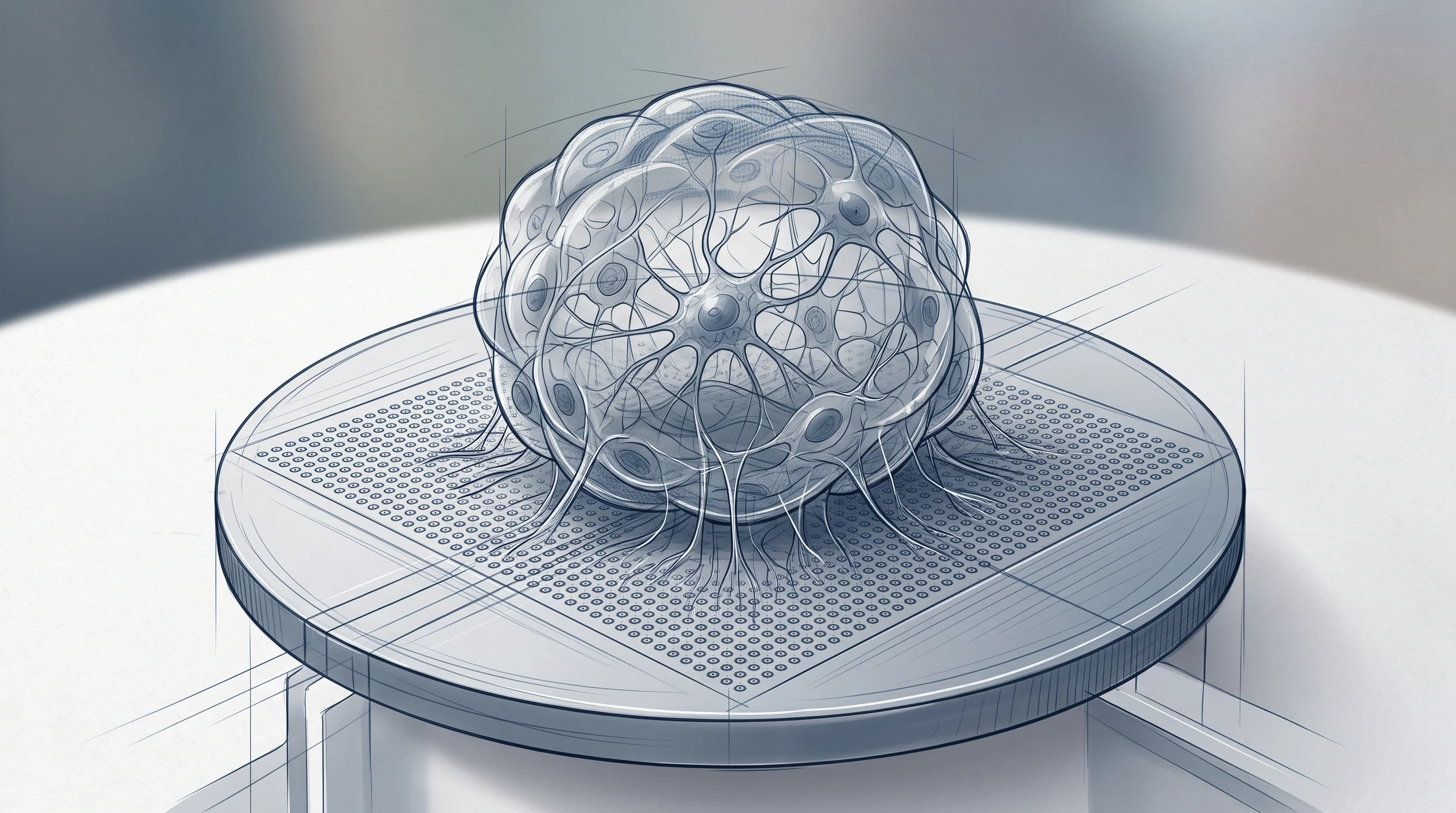
The core technology rests on high-density microelectrode arrays (HD-MEAs) that interface with cultured neurons—either 2D monolayers or 3D organoids. MaxWell Biosystems' MaxOne and MaxTwo systems are widely used across many studies and commercial platforms, including the DishBrain and organoid research cited in publications from 2022 through 2026.
The process involves stimulating neurons with carefully controlled electrical pulses and recording their collective firing patterns. Training loops resemble reinforcement learning: inputs are encoded as stimulation patterns, neuronal responses are decoded, and reward or punishment signals guide adaptation over time. Parasma's June 2026 note details surprise-scaled biphasic pulses at 1–3 microamps and 3–100 Hz, charge-balanced to avoid tissue damage. Cortical Labs and others use similar protocols, informed by decades of neuroscience research on safe stimulation limits.
The neurons aren't blank slates. They carry intrinsic dynamics—connectivity patterns, excitatory and inhibitory balances, homeostatic plasticity mechanisms—that enable them to learn and adapt without explicit programming. A 2024 arXiv preprint suggested that biological neurons might achieve sample efficiency in certain learning tasks that deep reinforcement learning models can't match, though the comparison is complicated by differences in task design and input modalities. It's a tantalizing claim, but one that needs more rigorous validation.
What these systems can't do, at least not yet, is scale to the complexity of modern large language models or vision transformers. The Doom and Tetris demos are impressive as proofs of concept, but they're control tasks with relatively low-dimensional input spaces. The Biological Computing Company's strategy of using neurons as co-processors for specific inference subtasks—rather than trying to replace entire model stacks—may be the more realistic path forward in the near term.
The Operational Headache
Daily maintenance is non-negotiable. Neurons require fresh growth medium, temperature control, and sterile handling. Cortical Labs staff exchange fluids daily—a labor burden that doesn't translate well to lights-out data center operations. Culture viability degrades over months under sustained stimulation, as noted in Parasma's June 2026 documentation. Contamination risk, biosecurity protocols, and ethical sourcing of donor cells add layers of complexity that silicon racks simply don't face.
Standardization is still nascent. Interface protocols, electrode densities, stimulation safety parameters, and task encoding schemes vary across labs and companies. The field lacks the equivalent of PCIe or NVLink—common standards that would allow wetware compute modules to plug into existing infrastructure seamlessly. That's a problem if you're trying to convince a hyperscaler to deploy racks of living neurons alongside their GPU clusters.
Independent validation of efficiency claims remains limited, to be generous about it. The 30-watt figure for CL1 units and the 3-million-times multiplier for Intactis Bio's BPUs appear in press releases and vendor materials, but comprehensive lifecycle analyses accounting for culture preparation, maintenance energy, equipment overhead, and computational throughput at application-relevant scale haven't been peer-reviewed as of mid-2026. Skepticism is warranted until those numbers can be reproduced by third parties.
Reproducibility and benchmarking are also concerns. Few peer-reviewed studies have published head-to-head comparisons of wetware systems versus GPUs or neuromorphic chips on real-world inference workloads—large language model queries, vision tasks at production scale, or latency-sensitive control loops. The demos that do exist (Pong, Doom, Tetris) are research artifacts, not commercial benchmarks. They prove the concept works in principle. Whether it works in practice, at the scale and reliability required for production deployments, is a different question entirely.
Then there's the competition. Neuromorphic silicon like HiAER-Spike, reported in 2025–2026 arXiv papers as supporting 160 million spiking neurons, offers energy efficiency gains without the biological overhead. Photonic optical neural networks, including a 41-million-neuron metasurface ONN reported in 2025, promise similar advantages. Brain-data-trained models, proposed in a January 2026 arXiv paper under the framework of "Reinforcement Learning from Human Brain" (RLHB), suggest yet another path to leverage biological intelligence without embedding live cells in racks. The wetware startups are racing not just to prove their technology works, but to prove it works better than the alternatives now emerging from materials science and neuromorphic engineering labs.
The Ethics Question Nobody's Solved
The conversation around consciousness and suffering in wetware computing is unavoidable—and deeply uncomfortable. Parasma's June 2026 note argues that 200,000-neuron cultures lack the anatomical substrates for pain or awareness—no nociceptors, no integrated pain pathways, no cortical organization associated with conscious experience. The company positions its stimulation protocols as conservative and its scale as far below any plausible threshold for sentience.
Cortical Labs leadership has publicly engaged with ethics concerns, citing the origins of the DishBrain ethics discussions back in 2022. Yet the debate persists, and for good reason. A July 2026 Nature editorial warned that organoid computing research emerging from computer science and engineering departments often falls outside existing stem cell oversight frameworks. Traditional institutional review boards and bioethics committees are tuned for human subjects research or animal models, not for hybrid systems that blur the lines between biological tissue and computational infrastructure.
The International Society for Stem Cell Research (ISSCR) Guidelines, updated in August 2025, note that there is currently no biological evidence for pain or consciousness in organoids at typical scales, but urge vigilance as complexity increases. The UK's Nuffield Council on Bioethics issued recommendations on neural organoids in May 2026, emphasizing governance gaps as the technology moves from academic labs to commercial applications.
The European Union's AI Act entered general applicability on August 2, 2026, introducing risk-based regimes for AI systems. Whether wetware computing platforms fall under high-risk categories, and how providers navigate GDPR, the Cyber Resilience Act, and sectoral regulations, remains unclear. The U.S. operates under the Common Rule (45 CFR 46) for human subjects research, but wetware compute platforms developed by startups may not trigger those review pathways if the cells are sourced from commercial biobanks under existing consent frameworks.
The ethical sourcing and consent protocols for donor cells are another layer. Are donors fully informed that their neurons might train an AI model? Are there limits on commercial use? Do consent forms need updating when the intended use shifts from medical research to commercial compute infrastructure? The 2026 Nature editorial and various bioethics commentaries call for proactive governance before the technology scales. The startups, meanwhile, are moving faster than the regulatory frameworks can keep pace.
What Happens Next
The near-term outlook for wetware computing hinges on pilot deployments and early customers willing to take a chance on unproven technology. Cortical Labs' Melbourne prototype and Singapore data center partnership with DayOne DC represent the first attempts to deploy biocompute racks in commercial settings. FinalSpark's remote platform and Intactis Bio's cloud access pilots will generate data on usability, performance, and cost-effectiveness—assuming the pilots succeed and the data gets published. The Biological Computing Company's focus on adapters for frontier models may deliver smaller, more specialized wins: edge cases where neuronal co-processors outperform silicon on specific inference subtasks.
By 2030, the IEA projects AI-focused data center power demand will triple from 2024 levels. McKinsey's analysis suggests that hyperscalers will continue to explore alternative compute architectures to mitigate infrastructure bottlenecks. Industry experts and commentators suggest that the adoption of wetware technology depends on factors the startups are still figuring out in real time: Can cultures remain viable for weeks or months under continuous load? Can interfaces standardize enough to integrate with existing software stacks? Can independent benchmarks confirm the efficiency claims?
Regulatory and ethical frameworks will evolve in parallel—probably slower than the technology itself, if history is any guide. If organoid computing scales to larger, more complex systems, the oversight gaps flagged in 2026 will need to close. Consensus on what constitutes acceptable complexity, appropriate consent mechanisms, and humane treatment protocols will shape what gets deployed and where. The industry may end up with a patchwork of regional regulations, much like it did with data privacy and AI governance.
For founders and investors, wetware computing represents a high-risk, high-uncertainty bet. The science is compelling—neurons are energy-efficient, adaptive, and capable of learning in ways that silicon struggles to replicate. The infrastructure pressure is real, and growing. But the operational challenges, unverified performance claims, and ethical ambiguities are equally real. Early pilots over the next few years will decide whether this is a viable alternative compute substrate or a fascinating research dead end that generates some interesting papers and a few headlines before fading out.
The broader lesson, perhaps, is that the AI infrastructure crisis is forcing the industry to consider substrates it would have dismissed a decade ago. Living neurons playing Doom is strange enough to grab headlines and raise venture rounds. Whether they can run inference at scale, survive daily medium exchanges, and earn a place in production data centers is the question that will define the next chapter of this field. The neurons, for their part, aren't aware of the stakes. They just fire and adapt, one stimulation pattern at a time.


