

The pitch sounds almost too convenient: build a fusion reactor not for the world's electrical infrastructure—where the technology has been perpetually thirty years away—but for cargo ships, where the power demands are modest and the economics might actually pencil out within a decade.
That's the contrarian bet Maritime Fusion is making. The San Francisco startup closed a $4.5 million seed round in late November, led by Trucks VC with backing from Y Combinator, Paul Graham, and a cluster of strategic angels who apparently found the thesis compelling enough to wire money. The company's founders, Justin Cohen and Jason Kaufmann, both alumni of Tesla and SpaceX, argue that fusion will prove itself at sea long before it replaces a coal plant in Ohio.
It's an unconventional angle in a sector littered with grand ambitions. But perhaps there's method in the madness.
Why Ships, Why Now
Cohen and Kaufmann aren't naive about fusion's history of overpromise. They're simply reframing the problem. Commercial ships, they point out, need somewhere between 10 and 15 times less power than a utility-scale reactor. Uptime requirements? Lower. Deployment complexity? Still daunting, but arguably less so than retrofitting entire electrical grids.
The two founders crossed paths during radiation testing for SpaceX's Starship electronics—Cohen brought the plasma physics credentials from stints at Princeton Plasma Physics Laboratory and Columbia, while Kaufmann contributed engineering chops honed on Tesla's Cybertruck and Optimus projects. After Y Combinator's Winter 2025 cohort, they emerged with a design philosophy centered on what they're calling Yinsen: a tokamak reactor tailored for maritime constraints.
Yinsen is designed to occupy roughly 6,000 to 7,000 cubic meters of ship space and deliver between 25 and 70 megawatts of electric output. Initial deployments would target closer to 30 MW, a figure that sounds modest until you consider that even demonstrating stable fusion at that scale would represent a meaningful technical milestone. The company estimates first-of-a-kind capital costs around $1.1 billion—with magnets alone eating up about 40 percent of the budget—and projects a levelized cost of energy near $125 per megawatt-hour once production scales.
Those numbers invite skepticism, naturally. Fusion's track record on cost projections is not stellar.
The Cable That Might Matter More
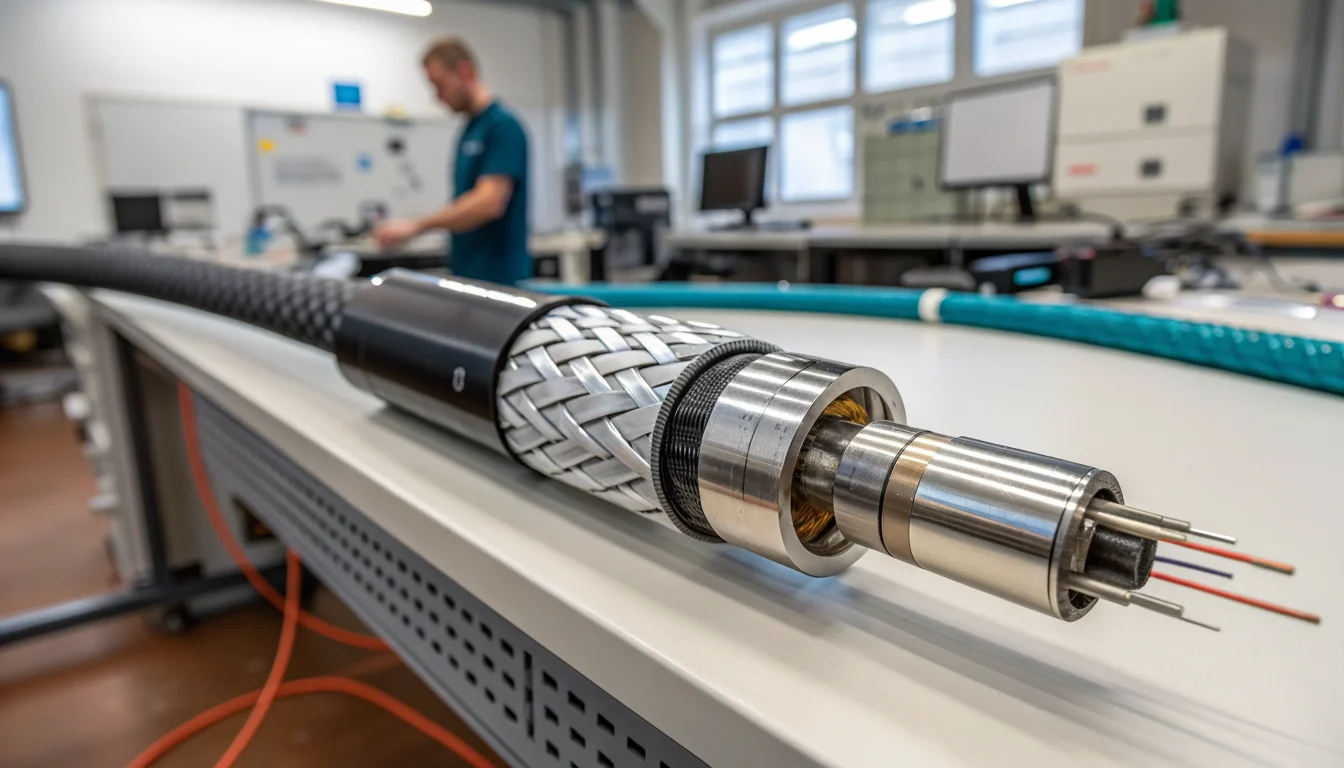
Buried in Maritime Fusion's pitch is what might turn out to be its near-term lifeline: a superconducting cable technology the company calls SHIELD. It's a high-temperature superconducting (HTS) architecture that, according to the startup's claims, can handle up to 8,000 amps at 77 Kelvin in self-field conditions, all within a cross-section smaller than a quarter (not counting the cryostat).
The team says it hit 5,000 amps in bench testing at 77 K—a respectable proof-of-concept if the data holds. For context, achieving the same current capacity with copper would demand more than 2,000 square millimeters of cross-section, triple the mass, and significant resistive losses. It's the kind of performance leap that could matter in dense power environments, which is why Maritime Fusion plans to sell SHIELD cables well before any reactor goes to sea.
The target markets? AI data centers and fusion magnet applications—both sectors desperate for better ways to move large amounts of electricity in tight spaces. Selling cables won't fund a billion-dollar reactor, but it might keep the lights on while the hard physics gets worked out. It's a hedge that feels both pragmatic and slightly defensive, an acknowledgment that fusion timelines remain stubbornly uncertain.
Access and Alliances
Maritime Fusion has secured research partnerships that lend some institutional weight. There's a collaboration with Columbia University's Fusion Research Center focused on tokamak pulse design for maritime scenarios—specifically, how reactors behave during long idle periods and low-power operation. The startup also landed user access to the Department of Energy's DIII-D National Fusion Facility in California, the largest operating tokamak in North America, where real experimental time could prove invaluable.
These aren't guarantees, of course, but they suggest the founders have navigated the bureaucratic maze well enough to gain credibility within the fusion research community.
The 2032 Deadline and Market Pressure

Maritime Fusion is targeting deployment by 2032, a timeline that conveniently aligns with tightening emissions regulations for international shipping. The International Maritime Organization set a net-zero target for "by or around 2050," with interim checkpoints looming in 2030 and 2040. Industry chatter increasingly revolves around a potential global maritime carbon price—some estimates put it around $100 per ton—which would fundamentally alter the cost structure of conventional marine fuels.
Enter ammonia and hydrogen, the current frontrunners in zero-emission propulsion. Both face challenges: ammonia is toxic and corrosive, hydrogen requires cryogenic storage, and neither has the bunkering infrastructure to support a global fleet. Fusion, for all its uncertainties, at least promises energy density and operational simplicity once—if—the reactors work reliably.
Cohen and Kaufmann are betting that ships represent a more forgiving testbed than the electrical grid, where a single outage can cascade into blackouts and regulatory fury. At sea, a reactor could fail without crashing a city's power supply. The tolerance for experimentation is higher, even if the engineering is no less difficult.
Whether that logic holds up by 2032 remains an open question. Fusion has humbled optimists before. But in a sector where most startups chase the same utility-scale dream, Maritime Fusion's maritime focus at least offers a different kind of failure mode—and maybe, just maybe, a faster path to proving the technology works outside a lab.
For now, the company has its seed funding, its cable technology, and a thesis that shipping might be fusion's killer app. The next few years will reveal whether that's visionary or just another expensive detour in fusion's long, winding road to commercial relevance.


