

The press release landed with a carefully calibrated boast. When District Ventures Capital announced its $20 million investment in Huha this past November, the firm didn't bury the lede: largest Dragons' Den deal in the CBC show's two-decade run. A milestone for Canadian consumer brands, certainly. The kind of superlative that gets picked up.
But rewind six years. Alexa Suter is scraping together a Kickstarter campaign, ultimately raising $25,997 to launch underwear designed, as she put it then, "with vaginas in mind." The distance between those two moments—between a modest crowdfunding campaign and a multi-million-dollar institutional round—tells you something about both the opportunity in intimate apparel and the specific bet Suter made. Zinc-infused fabrics. A retail footprint that now includes Simons. And a founder comfortable enough to discuss urinary tract infections in public.
That last part matters more than you'd think.
When the Product Problem Is Personal
Suter's origin story doesn't involve a eureka moment so much as persistent discomfort. Recurring UTIs, which she eventually connected to synthetic underwear that trapped heat and moisture. By 2016, she was running Studio Media, a social media and marketing agency with clients like Jack Daniel's and L'Oréal Professionnel. Brand strategy was the day job. This wasn't that. This was a materials problem disguised as a wardrobe problem.
The solution she landed on involved two specialty fibers, both with capital letters and origin stories of their own. TENCEL—a branded lyocell spun from wood pulp—handled breathability. SMARTCEL sensitive, manufactured by Germany's Smartfiber AG, is lyocell embedded with pharmaceutical-grade zinc oxide through what the supplier calls a patented process. The zinc oxide, marketed for antimicrobial and skin-protective properties, became Huha's hook. Suter designed a fuller-coverage, seam-free gusset running front to back.
Health first. Fashion second, if at all.
The October 2019 Kickstarter campaign cleared its $10,700 goal and closed with 250 backers. Some early coverage cited roughly $31,000 raised and 1,300 pairs sold at launch—discrepancies that speak to the fuzzy accounting of crowdfunding milestones. The Kickstarter page itself shows the lower figure. Either way, it was validation, not a war chest.
Building Around Minerals (and Letting Everyone Know It)
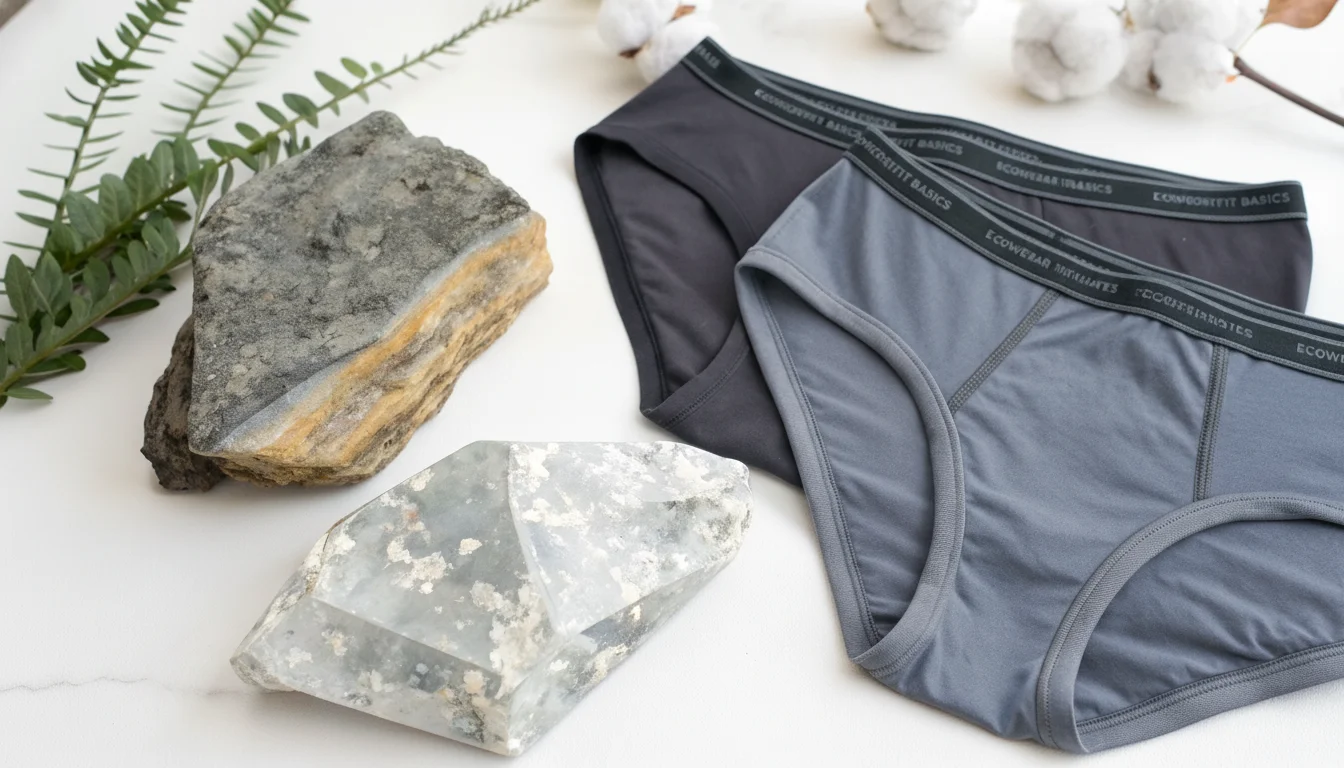
Huha started life as Mineral Undies, a name that telegraphed the pitch. The branding leaned into materials science hard enough that product pages now carry warnings for customers with zinc oxide allergies. Retail partners note the line is "responsibly made in China" and designed in Canada—a phrasing that does some diplomatic lifting. Prices sit firmly in premium territory: thongs around $28, boxers pushing $54 depending on style.
By 2022, the company had moved into bras. The Tata bralette and triangle styles used the same TENCEL-and-zinc construction, extending the materials thesis beyond underwear. Then came the Mineral Tops line—a cami and crop tank that blurred the boundary between intimate apparel and outerwear. Whether that's category expansion or mission creep depends on how the margins work out.
Huha's retail strategy splits between direct-to-consumer e-commerce and selective wholesale. Products now appear at Simons, the Quebec-based department store chain, and across dozens of independent boutiques in Canada. The company even sells a cardboard counter display on its own site, designed to hold 27 units—the kind of detail that signals a formal wholesale program. Orders ship from the U.S., which sidesteps duties for North American customers but also suggests fulfillment infrastructure deliberately placed outside Canada.
Third-party e-commerce trackers have lobbed estimates of annual revenue in the single-digit millions, though anyone who's worked with those tools knows they're glorified guesswork. In September, Suter told Women of Influence—as part of her RBC Canadian Women Entrepreneur Awards finalist profile—that the company was tracking toward more than $40 million in revenue for 2025, with a team of 12-plus employees. That figure hasn't been independently audited. It's also the only number on record from the company itself, which means it's what we have.
The Pitch That Kept Paying Off
Huha appeared on Dragons' Den during Season 18, which aired between September 2023 and February 2024. According to District Ventures, Suter struck a deal with Arlene Dickinson, the venture capitalist who founded District Ventures and remains its managing partner. CBC's episode guides don't list companies by name—a frustrating quirk for anyone trying to reverse-engineer the pitch—so the specifics remain murky. What Suter asked for, what the Dragons offered, how the negotiations actually unfolded: opaque.
What's undeniable is that the relationship held. Dickinson's firm circled back 18 months later with a check that dwarfs the typical Dragons' Den investment by an order of magnitude.
The November 2025 round brought in $20 million, led by District Ventures with participation from Export Development Canada. District framed it as the largest investment in Dragons' Den history—a claim that hinges on connecting the Season 18 pitch to this institutional round. Does that framing hold up under scrutiny? Depends how you define a "Dragons' Den deal." The investment happened well after the cameras stopped rolling, after due diligence, after term sheets. But the narrative is the narrative, and narratives have value. Huha got its headline.
What $20 Million Actually Buys

The press release gestures toward "product innovation, category leadership, and market expansion." Standard boilerplate. The sharper question is whether Huha can maintain gross margins while scaling distribution. Premium DTC brands often stumble when they move into wholesale channels that demand different pricing architectures. And Huha's materials aren't cheap. SMARTCEL is a specialty fiber with IP behind it. TENCEL costs more than cotton. The product warnings about zinc allergies suggest a customer education burden that doesn't evaporate at scale.
Suter has emphasized, in interviews, the importance of IP protection and supply chain diligence. A Forbes profile in March highlighted those themes. Many of Huha's product listings note "Industrial Design Pending," which indicates the company is building some defensibility around form factor if not formula. But intimate apparel is a crowded, cutthroat space. Knix, also Canadian, has raised significant capital and built a similar DTC-plus-retail model. Parade and ThirdLove in the U.S. compete on comfort and inclusivity messaging. Huha's zinc angle is novel. Whether novel is defensible in a category where margins matter more than patents—that's the open question.
The path forward likely involves deeper retail partnerships, a genuine push into the U.S. beyond wholesale, and continued spend on customer acquisition. The self-reported $40 million revenue figure, if it's accurate, suggests Huha has found product-market fit. Whether that fit scales linearly or whether the brand hits a ceiling where zinc-infused underwear remains a niche—well, that's what $20 million is supposed to answer.
Suter seems aware of the tension. In her Women of Influence Q&A, she described resilience and adaptability as core to the business. Founder-speak, maybe. But it also reflects the reality of building consumer brands in 2025, when the landscape is littered with DTC darlings that grew fast and flamed out faster.
The Zinc Ceiling
For now, Huha has capital, a clear product thesis, and a founder willing to lead with personal story in an industry where personal stories move product. The Dragons' Den halo doesn't hurt, even if the mechanics of that halo are deliberately fuzzy. Whether the company can turn $20 million into a sustainable, category-defining brand will depend less on the zinc itself and more on execution: supply chain resilience, retail negotiations, the unglamorous work of repeat purchase rates and customer lifetime value.
Underwear is a repeat-purchase product, which helps. Then again, so is everything else in the drawer. And that drawer is getting crowded.


