

Polytag's invisible UV tags are turning up in milk cartons at Ocado and on shelves at Waitrose. The question is whether regulators will force the rest of the industry to follow.
DEESIDE, Wales — When Alice Rackley took over as chief executive of Polytag in late 2021, the company's pitch was straightforward, if not exactly glamorous: convince brands to print invisible ultraviolet tags on their packaging, install scanners at recycling plants, and suddenly you'd know which yogurt containers actually made it through the sorting line.
Three years later, that unglamorous pitch has landed the Welsh traceability startup £3.0 million in seed funding (roughly $3.7 million), with backing from Collateral Good, Knop Ventures, and even Ocado—the online grocer that has already rolled out Polytag's system across its entire milk range. The round closed as UK packaging regulations began shifting from theory to billing reality, creating what investors describe as a narrow but lucrative window for anyone who can prove what happens after the bin lorry drives away.
The timing may be everything. Starting in 2025, Britain's Extended Producer Responsibility rules will charge brands up to £423 per tonne for plastic packaging, with modulated fees kicking in a year later based on actual recyclability. That's not a hypothetical surcharge. It's real money, and it's forcing procurement teams to ask questions they've historically avoided: Does our packaging actually get recycled? Can we prove it?
Polytag thinks it has the answer, though perhaps not the one brands were hoping for.
The Technology: Invisible Ink Meets Material Reality
The system pairs GS1-approved QR codes—visible to consumers—with UV watermarks embedded in label artwork. Think of it as a dual-layer tracking mechanism. Shoppers scan the QR code for rewards or recycling instructions; industrial scanners at material recovery facilities read the UV tags using machine vision as items tumble down sorting lines at speed.
Polytag has now installed what it calls Plastic Detection Units at 12 facilities across Britain, partnering with waste processors like Biffa and Re-Gen. The company claims coverage of more than half the nation's household recycling stream, though that figure depends on how you weight regional processing volumes.
The scanners capture SKU-level data—brand, product type, material composition—as packaging flows through the system. In theory, this lets a brand like Marks & Spencer know not just that 70% of its milk bottles get sorted correctly, but which specific bottle designs fail at which facilities. The company can then tweak materials, swap label adhesives, or lobby for equipment upgrades. It's granular in a way that recycling data has never been.
What it isn't, at least not yet, is cheap to scale. Installing detection units, integrating with facility operators, and managing the data infrastructure requires capital—hence the fundraise. Women Angels of Wales contributed £100,000, matched by the Wales Angel Co-Investment Fund. Rachel Ashley, who led that investment, recently won a UK Business Angels Association award for the deal, a recognition that underscores how female-led climate tech startups remain the exception rather than the rule.
Ocado Moves First, Others Watch Closely
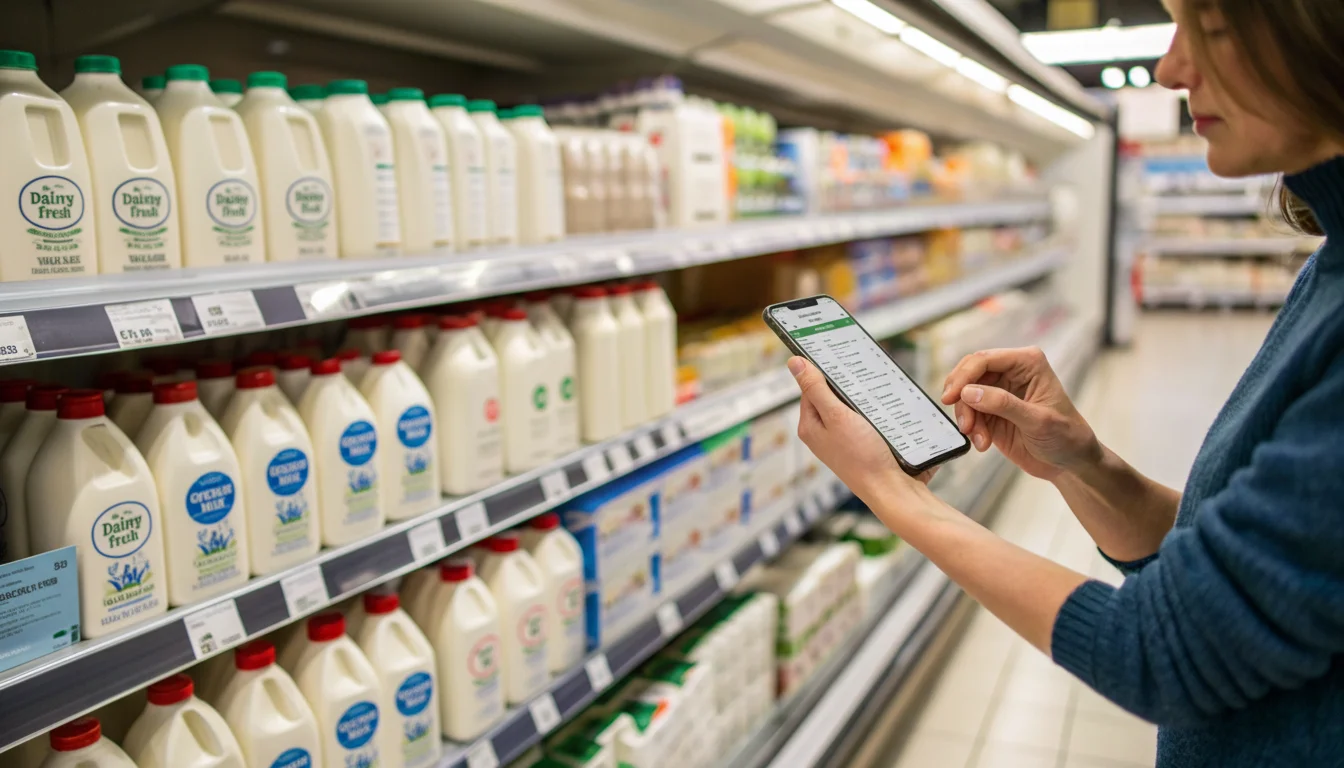
Ocado Retail has emerged as Polytag's most aggressive adopter. The grocer ran an early pilot using Polytag's QR-based digital deposit return system between 2022 and 2023, generating 20,000 cash reward redemptions. Last July, it scaled UV tags across all own-brand milk products—a significant vote of confidence, even if milk cartons represent a relatively homogenous product category.
Marks & Spencer signed on as the inaugural member of Polytag's Ecotrace Programme in May 2024. Waitrose joined this past April. Three of Britain's top grocers on board sounds impressive until you remember there are only a handful of major players. The real test will be whether Tesco, Sainsbury's, or Asda follow suit—or whether they wait to see if compliance pressure forces the issue.
Rackley, who spent years at M&S and GS1 UK before joining Polytag, has been careful to position the technology not as a compliance burden but as a competitive edge. Brands that can document high recyclability rates may qualify for lower EPR fees, she argues, turning traceability into a potential cost saver. It's a compelling pitch, though it assumes regulators will reward precision over rough estimates—an assumption that remains untested.
France Is Watching, and So Is the EU

Polytag isn't limiting its ambitions to the UK. Last May, the company partnered with Pellenc ST, a French manufacturer of sorting equipment, to integrate UV watermark data with sensor-based systems. The collaboration reached Technology Readiness Level 7, industry shorthand for "tested in operational environments but not yet commercialized."
More telling: Citeo, France's extended producer responsibility organization, has run industrial trials of Polytag's technology at French recycling centres. That's significant because the European Union's Ecodesign for Sustainable Products Regulation is gradually phasing in Digital Product Passport requirements, with packaging recyclability mandates targeting 2030. If Brussels decides traceability should be standardized across member states, Polytag's early partnerships could position it as a default infrastructure provider.
The company achieved ISO 9001 and ISO 27001 certifications last year—table stakes for any firm hoping to sell into industrial supply chains. It also secured a £100,000 grant from the Welsh Government in September 2024 to install four detection units across Wales, covering 146,000 tonnes of annual waste. (Reconomy and Casepak announced in November they'd integrate Polytag's UV detection at a Midlands facility, expanding the network beyond Wales for the first time.)
The Regulatory Bet
Strip away the technology specs and partnership announcements, and Polytag's business model rests on a straightforward wager: that governments will eventually require packaging traceability, and that brands will prefer a proven system over building their own. It's not a wild bet. Extended producer responsibility schemes are proliferating globally, and packaging waste remains politically salient in a way that, say, industrial emissions do not.
But it's also not a sure thing. Regulators could decide that aggregate data—tonnage collected by material type—is sufficient. They could mandate an open-source standard rather than proprietary UV tags. Or they could simply delay implementation, as governments often do when industry pushback intensifies.
For now, Polytag is moving ahead, deploying scanners and signing retail partners while the regulatory window remains open. Whether that window stays open—and whether the company can scale fast enough to matter—will determine if this £3 million bet turns into a category-defining platform or a footnote in the messy story of packaging reform.
Rackley isn't waiting to find out. She's already talking about the next phase: proving that traceability data can influence product design in real time, closing the loop between what gets recycled and what gets manufactured. It's an appealing vision, assuming the economics cooperate. And assuming, of course, that anyone's still willing to pay for milk in traceable cartons when the novelty wears off.


