

It's two in the morning at a Beijing pharmacy, and the only employee on duty has six arms and no medical degree.
The robot—stocky, methodical, utterly unbothered by the hour—slides between tightly packed shelves. Somewhere among thousands of prescription bottles, it needs to find one specific SKU. No barcode scan, no pre-programmed coordinates. Just a request, in natural language, and the machine figures out the rest. Dual manipulators extend, grasp precisely, retrieve. The entire sequence happens without a single line of task-specific code telling it how.
This isn't the robotics industry we've known for six decades. Since the first Unimate arm started welding car frames in a New Jersey General Motors plant in 1961, industrial robots have excelled at one thing: doing the same task, the same way, forever. Variability was their nemesis. Ask a factory robot to pick up an object it hadn't been explicitly trained on, and you'd likely be waiting a while.
What's changed? A confluence of advances that sounds almost too neat to be true—massive synthetic datasets, multimodal AI models that fuse vision and language, and enough compute firepower to train systems on scenarios that don't yet exist in the real world. The result is something called a Vision-Language-Action model, and it's being commercialized faster than most industry watchers expected.
Between Google DeepMind's RT-2 breakthrough in July 2023 and NVIDIA's open-weight GR00T N1 release this past March, embodied AI has vaulted from academic curiosity to commercial deployment. Beijing-based Galbot—the company behind that nocturnal pharmacy robot—already operates more than 10 autonomous stores and claims it will hit 100 retail locations by the end of this year. Logistics behemoths GXO and Mercado Libre are quietly testing humanoid robots in live fulfillment centers. Figure AI is posting videos of its systems handling deformable packages at speeds inching toward human pace.
Whether the economics actually work at scale is another question entirely.
Money Talks, Eventually
The market projections sound almost giddy. Goldman Sachs pegs the humanoid robot market at $38 billion by 2035. UBS goes further: 300 million humanoid robots deployed by 2050, a figure that would exceed the current global population of passenger cars by a comfortable margin. Even the more conservative estimates—Future Market Insights puts the sector at $7.8 billion this year, growing to $181.9 billion by 2035—suggest a 37 percent compound annual growth rate.
NVIDIA CEO Jensen Huang certainly thinks something big is happening. At the company's GTC conference in March, he declared this "the age of generalist robotics," framing it with the kind of enthusiasm usually reserved for graphics card launches. Then again, NVIDIA has reasons to be optimistic; its Isaac Sim platform has become the de facto training ground for companies building these systems.
But market enthusiasm and operational reality don't always align, especially in robotics. The industry has cycled through hype before—remember when every warehouse was supposedly going to be run by Kiva robots? (Amazon bought Kiva in 2012, rebranded it, and largely kept the technology to itself.) The question isn't whether VLAs represent a technical leap. They clearly do. It's whether anyone can make the unit economics work outside of venture-funded pilots.
Three Paths Forward, Maybe Four
The technical approaches have splintered into distinct camps, each with different bets about what matters most.
Google DeepMind lit the fuse with RT-2, a Transformer model that ingests both internet data and robotics demonstrations, then outputs actions directly. The architecture improved task generalization from 32 percent to 62 percent compared to its predecessor—a meaningful jump, though "generalization" in robotics benchmarks often means "can handle objects it's seen before in slightly different positions." Still, RT-2 proved that training on web-scale data could transfer to physical manipulation tasks without hand-engineered features.
The open-source community answered with OpenVLA, a 7-billion-parameter model trained on roughly one million trajectories from the Open-X-Embodiment dataset. Smaller than the proprietary systems, scrappier, but increasingly effective. Then came diffusion-based approaches like RDT-1B and flow-matching architectures such as π0, both showing particular strength in bimanual tasks—the kind of coordinated two-handed manipulation that humans take for granted and robots struggle with.
Each approach makes trade-offs. Autoregressive models (like early RT-2) can reason step-by-step but introduce latency. Diffusion models generate smoother motion but require more compute at inference time. Flow-matching splits the difference. Pick your poison based on whether you care more about reasoning depth, control precision, or deployment constraints.
There's a fourth path too, though it's less a distinct architecture than a deployment philosophy: train massive models on synthetic data, then fine-tune with minimal real-world demonstrations. This is where Galbot has placed its bet.
The Beijing Gambit
Beijing Galaxy General Robot Co.—Galbot, for those who prefer syllables over bureaucracy—isn't subtle about its ambitions. Founded by He Wang, a Peking University assistant professor with a Stanford PhD and a knack for both technical depth and capital raising, the company closed a roughly RMB 700 million angel round in 2024. That's approximately $98 million, though currency fluctuations and the opacity of Chinese venture rounds make precision difficult. Either way, it was the largest seed investment in Chinese embodied AI at the time.
Follow-on funding of $151 million in mid-2025, then over $300 million in December, brought the valuation to around $3 billion. Strategic backers include CATL, the battery giant, and Bosch's Boyuan investment arm—players with manufacturing footprints and supply chain exposure, not just financial interest.
Galbot's technical strategy centers on what it calls "scenario-first" VLA deployment. Rather than building a general-purpose robot that can do anything (a fantasy that has consumed billions in robotics R&D over the decades), the company targets specific environments: pharmacies, grocery stores, precision manufacturing floors. For each, it develops a tailored VLA model—GraspVLA for manipulation, GroceryVLA for retail, TrackVLA for navigation. All are reportedly trained on "hundreds of billions of high-quality synthetic data points," a claim that remains vendor marketing pending independent validation.
He Wang framed the economics plainly in a mid-2025 interview: "We can teach the robot to recognize and manipulate specific SKUs with roughly 200 demonstration shots in a single afternoon." For a 24-hour pharmacy that would otherwise require three human shifts, the ROI calculation becomes straightforward—assuming, of course, that the upfront capital cost doesn't sink the whole endeavor.
The company's "Galaxy Space Capsule" retail pods illustrate the concept. Each is a 50-square-meter store handling over 5,000 SKUs, deployable in under 24 hours (according to Galbot). The real test will be whether labor cost savings offset robot maintenance, software updates, and the inevitable edge cases where the system needs human intervention.
In January, Galbot scored a cultural coup: it was designated the "embodied large-model robot partner" for China Media Group's 2026 Spring Festival Gala, the most-watched annual broadcast in the world. This isn't just technical validation. It's nation-state signaling about indigenous AI capability, a reminder that embodied intelligence has geopolitical dimensions.
Synthetic Data, Real Consequences

The synthetic data revolution underpins everything happening in VLAs right now. Traditional robotics relied on painstaking real-world data collection—every grasp, every motion, captured by cameras and sensors, then labeled by humans. It didn't scale. You simply couldn't collect enough examples to cover the variability of everyday environments.
Modern VLA architectures flip the model: train on massive synthetic datasets generated in simulation (NVIDIA's Isaac Sim is the most common platform), then fine-tune with minimal real-world data. The academic GraspVLA project—distinct from Galbot's commercial model but often cited alongside it—demonstrated this with SynGrasp-1B, a billion-frame synthetic grasping dataset that enabled zero-shot sim-to-real transfer. Translation: robots trained entirely in simulation could successfully manipulate real objects they'd never physically encountered.
The skeptic's question, and it's a fair one, is whether synthetic data introduces its own biases. Simulations are clean. Reality is messy—scratched surfaces, inconsistent lighting, objects that deform or slide unpredictably. Early results suggest the transfer works better than expected, but "better than expected" isn't the same as robust. Systems achieving 90-plus percent success in controlled benchmarks often see sharp drops when lighting changes or background clutter increases.
This is the memorization problem, and it isn't unique to VLAs. Machine learning systems excel at pattern matching within their training distribution. Push them outside it, and performance degrades. The question is how wide that distribution needs to be before a robot can handle the full chaos of a retail pharmacy at 2 AM.
The West Moves, Just More Slowly
Western logistics giants are advancing, but with the caution of companies that have shareholders to answer to and liability insurance to maintain.
GXO Logistics, one of the world's largest contract logistics providers, is piloting humanoid robots from Agility, Apptronik, and Reflex in live warehouses. At an Atlanta facility, Digit robots from Agility are performing tote movements—picking up standardized containers, moving them between shelves, basic but repetitive work that tests both manipulation and navigation. Mercado Libre, Latin America's e-commerce giant, started testing Digit units at a San Antonio fulfillment center in late 2025, evaluating for broader deployment across its network.
These pilots remain supervised. Humans watch, intervene when things go wrong, collect data on failure modes. They're not autonomous generalists; they're robots learning specific tasks in specific spaces, with engineering teams tracking every stumble. But they're accumulating operational data at commercial scale, which is worth something.
Figure AI's Helix system offers a different architectural bet: a dual-system VLA that separates reasoning from action. Recent demonstrations show improved accuracy on logistics tasks like barcode orientation and handling deformable packages. The company claims it's progressing toward "human-speed manipulation," though that remains a moving target. Unlike Galbot's synthetic-first approach, Figure emphasizes human corrective feedback loops—essentially, operators show the robot when it makes mistakes, and the system learns incrementally.
There's something almost philosophical about the different approaches. Galbot is betting that you can pre-train your way to robustness; Figure believes that real-world feedback is irreplaceable. Both might be right for different use cases.
The Open-Source Counter-Narrative

While well-funded startups race toward commercial deployment, the open-source community is quietly advancing the state of the art in ways that matter for everyone.
OpenVLA-OFT, an optimized fine-tuning recipe released in 2025, pushed average success rates on the LIBERO benchmark to 97.1 percent with 25-50× faster inference. That's not just an academic improvement; it's the kind of efficiency gain that makes edge deployment feasible. RDT-1B, a 1-billion-parameter diffusion Transformer trained on over one million multi-robot episodes, targets bimanual dexterity—the coordinated manipulation required for tasks like laundry folding or assembling multi-part objects.
These models aren't ready for unsupervised commercial deployment. But they're narrowing the gap between research and application, and they ensure that smaller companies without billion-dollar compute budgets have a path forward. Platform consolidation is inevitable—NVIDIA's open-weight GR00T models, Google's SDKs, Microsoft's Rho-alpha (a Phi-series derivative targeting tactile sensing)—but the open-source ecosystem provides a critical counterweight against vendor lock-in.
It's also where the most honest conversations about limitations happen. Academic labs publish failure modes. They run robustness variants of benchmarks—LIBERO-PRO, LIBERO-X—that expose brittleness under distribution shifts. Companies building products tend to showcase successes. Researchers building models highlight where things break. Both are necessary.
Regulation as Reality Check
The regulatory landscape is tightening, and that matters more than most technical discussions acknowledge.
The EU AI Act's high-risk provisions take effect August 2, 2026, with additional obligations phasing in through 2027. Systems operating in shared human-robot workspaces will face conformity assessments, transparency requirements, and post-market monitoring. That's not voluntary guidance. That's binding law, with fines and market access at stake.
The U.S. remains standards-driven rather than prescriptive. UL 3300 for service robots was finalized in 2024, providing safety benchmarks that aren't legally mandatory but increasingly shape insurance contracts and procurement decisions. NIST's AI Risk Management Framework offers voluntary guidelines that large enterprises often adopt anyway, if only for liability mitigation. The practical result is de facto compliance even without federal mandates.
China is accelerating technical standards development through the Ministry of Industry and Information Technology and municipal bodies, viewing embodied AI as strategically significant. The specifics of conformity assessment for humanoid systems aren't yet public, but the direction is clear: this isn't a wild-west market. Safety certifications will become gating factors for deployment at scale.
Any company planning multi-region humanoid rollouts needs parallel compliance strategies, which adds cost and complexity. It also favors vertically integrated players with legal teams and regulatory affairs staff—another force pushing toward consolidation.
What Happens Next, Maybe
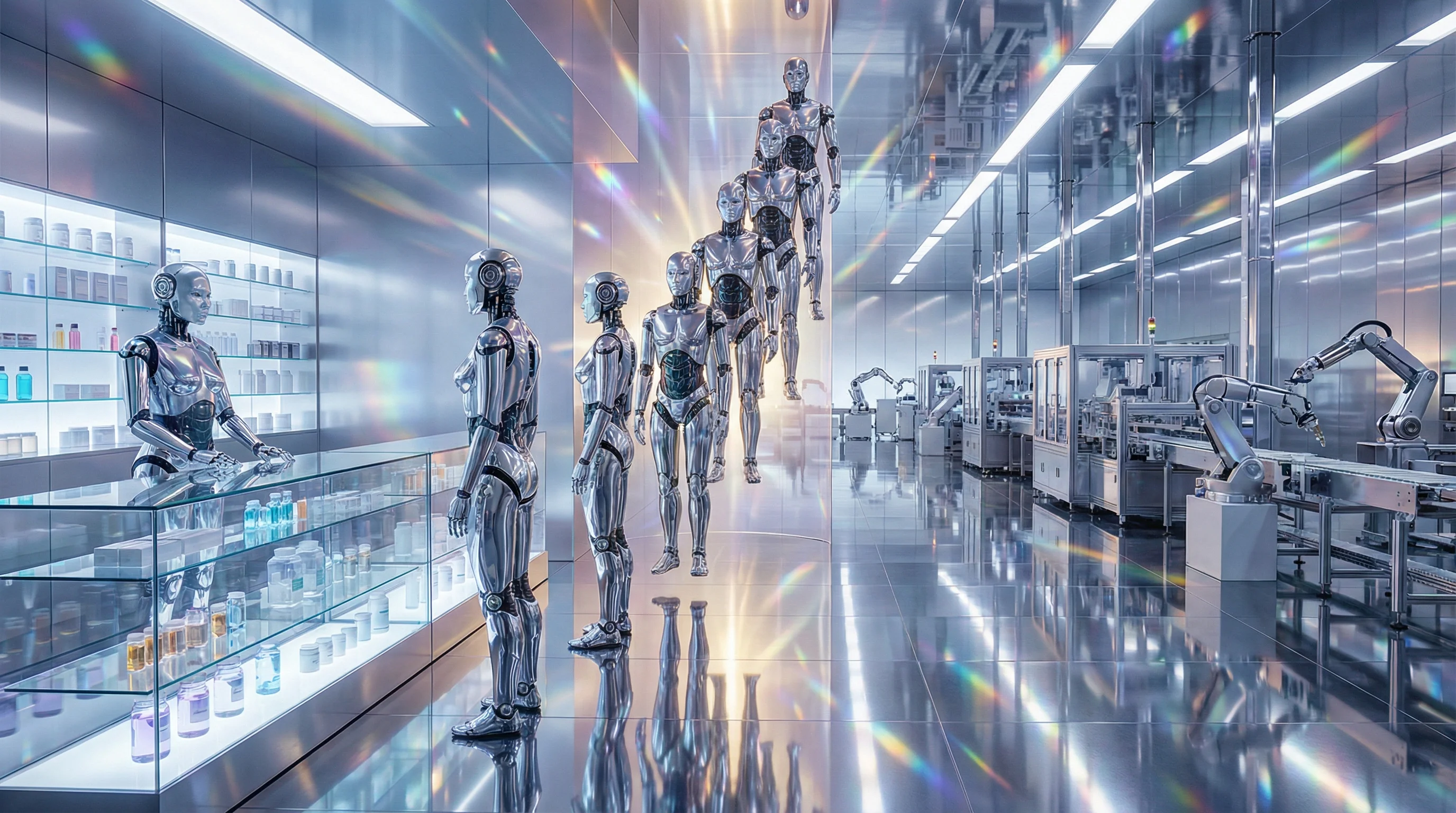
The next 18 months will either validate the current trajectory or force a recalibration. Galbot's stated plan—10 pharmacy locations to 100 retail sites, plus 1,000 industrial units in precision manufacturing through its Baida partnership—would represent a step-function increase in embodied AI commercialization. If those numbers materialize, we'll see thousands of VLA-powered robots in commercial operation by mid-2026.
That's enough to generate real failure data, stress-test safety systems, and reveal whether the unit economics close without perpetual venture subsidy. It's also enough to expose regulatory gaps, trigger the first serious liability cases, and clarify which use cases actually benefit from humanoid form factors versus traditional automation.
If the deployments don't materialize at those scales—if the units stay in supervised pilots, if the economics don't work, if edge cases prove more problematic than simulations predicted—the market will recalibrate quickly. Venture capital has limited patience for hardware companies burning cash without clear paths to profitability. The humanoid market forecasts—$38 billion by 2035, $181.9 billion, pick your favorite analyst—assume cost curves that haven't fully materialized and regulatory pathways that aren't finalized.
On the technical side, several trends seem likely. On-device and hybrid inference architectures will proliferate as latency requirements collide with edge compute constraints. Google DeepMind's claim that its on-device VLA "nearly matches" cloud performance with 50-100 demonstrations for new tasks suggests practical viability. AsyncVLA's split architecture—heavy reasoning offboard, fast control onboard—offers another path. Either way, pure cloud-based VLAs likely represent a transitional form.
Data engines will continue favoring synthetic-plus-teleop pipelines, the combination of massive simulation pretraining and targeted real-world fine-tuning that has become NVIDIA's GR00T workflow and Galbot's "scenario-first" framing. The question isn't whether that works for narrow task distributions—it clearly does. The question is whether it scales to the full complexity of real-world environments without exponentially increasing the synthetic data requirements.
The Real Question
VLAs have solved the technical generalization problem in constrained, meaningful ways. A robot can now grasp novel objects without explicit programming. It can navigate unfamiliar spaces using natural language instructions. It can coordinate dual-arm manipulation for tasks that require more than simple pick-and-place.
That's genuine progress, the kind that makes you reconsider what robots might be capable of in five years.
But technical capability and commercial viability remain distinct questions. The deployment problems—cost, maintenance, edge cases, human acceptance—haven't been solved yet. The regulatory problems are just beginning to crystallize as systems move from labs to shared public spaces. The economic problems, most crucially, depend on cost curves and reliability metrics that won't be clear until these systems operate at scale for months, not days.
Perhaps the most honest framing is this: if even half of the announced deployments happen on schedule, 2026 will be the year we find out whether VLA-powered robots can actually deliver on their promise outside of controlled demonstrations. If they can, the industry transforms. If they can't, we'll have learned expensive lessons about the gap between simulation and reality.
Either way, that Beijing pharmacy robot will keep working its overnight shift, picking bottles from crowded shelves, unbothered by the larger questions of market viability and regulatory compliance. For now, at least, it has a job to do.


