

Picture a drone that never comes home. It perches on a transmission line somewhere in the backcountry, draws power directly from the electricity humming through the wire, and launches again to scan for overgrown vegetation or damaged insulators. Repeat indefinitely.
That's the pitch from Voltair, a startup that emerged from Y Combinator's Winter 2026 cohort with technology the company claims could upend how utilities monitor thousands of miles of grid infrastructure. The idea sounds almost too elegant: eliminate the battery problem entirely by turning the very infrastructure you're inspecting into a fuel source.
Whether it actually works at scale is another matter.
Charging From Thin Air—Sort Of
Voltair's founders describe what they call "patent-pending recharging IP" that uses inductive charging to pull power from AC transmission lines. Think of it as wireless charging, except the charging pad is a live wire carrying tens of thousands of volts.
The underlying science isn't new. Researchers at the University of Southern Denmark published findings in 2024 showing autonomous drones could perch on overhead lines and harvest energy using split-core current transformers. What Voltair appears to be attempting is something harder: making the concept work reliably enough for commercial deployment across utility grids where downtime, regulatory scrutiny, and safety stakes are considerably higher than in a lab.
The value proposition is clear enough. Utilities spend substantial sums on manual line inspections and vegetation management—work that's both tedious and crucial, especially in fire-prone regions where a tree branch brushing against a conductor can spark a catastrophe. Drones help, but battery life remains a constraint. Most commercial drones manage 20 to 40 minutes of flight time before they need to return to a charging station or land for a battery swap.
Voltair promises to break that cycle. Drones that stay in the field, recharging as needed from the grid itself, theoretically enable on-demand inspections without the logistical overhead of retrieving aircraft, swapping batteries, or maintaining ground-based charging infrastructure in remote terrain.
Theoretically.
The University of Washington Connection
The founding team coalesced at the University of Washington, initially focused on wildfire prevention. By spring 2025, they'd racked up a $15,000 prize at UW's Environmental Innovation Challenge. Two months later, they claimed the $25,000 grand prize at the Dempsey Startup Competition. A July feature from UW Engineering described their prototype as a "self-charging clamp" designed to latch onto power lines.
The five founders bring disparate backgrounds. CEO Ronan Nopp had been tuning flight controls for a manned electric vertical takeoff and landing aircraft before joining Voltair—and reportedly turned down a role on SpaceX's Starship program to do so. CTO Hayden Gosch studied power electronics at UW and logged stints at Seattle City Light and Schweitzer Engineering Labs, firms where understanding high-voltage equipment isn't optional. Avi Gotskind, the chief government officer, previously navigated regulatory corridors at ExoAnalytic, Virgin Galactic, and Amazon's Kuiper satellite project. COO Warren Weissbluth studied operations research at Rice.
It's a group that, on paper at least, understands both the technical challenges of autonomous flight near live electrical infrastructure and the bureaucratic maze of getting regulators to bless such operations.
A Messaging Puzzle
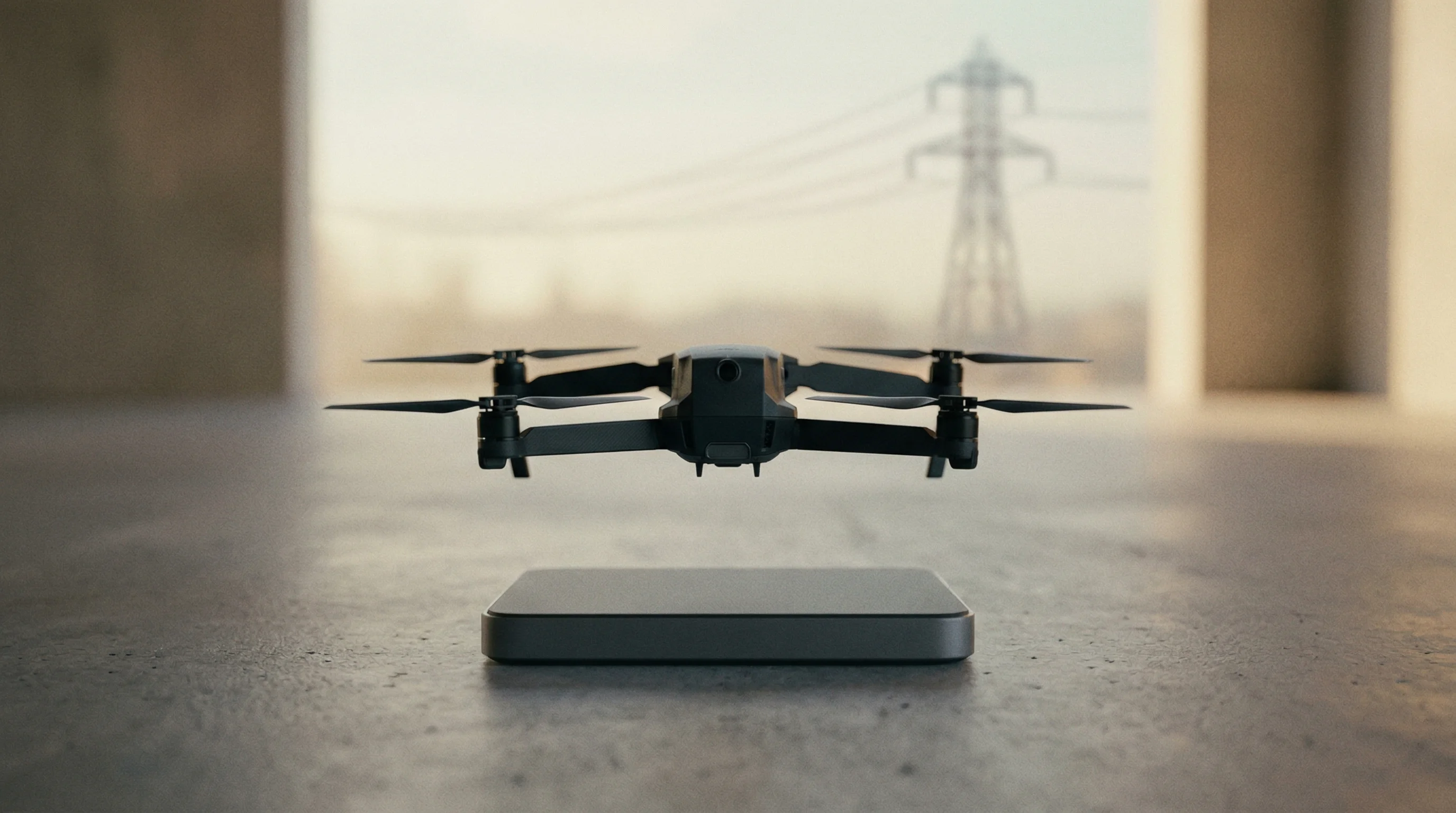
Here's where things get murky. When Voltair announced itself in January, the story centered on drones perching directly on transmission lines to recharge. The company's current website and Y Combinator profile, however, emphasize a different approach: "solid state inductive charging pads installed directly on utility poles." Each pad, the company says, unlocks coverage of roughly 1,000 square miles.
So which is it? Pads mounted on poles, or drones clamping onto live wires?
The company's job postings still reference "perching on live power lines to inductively recharge," suggesting the line-clamping vision remains active. But the shift in messaging raises questions. Is the pad-based system a near-term compromise while the more technically audacious line-perching capability stays in development? Or did the founders discover that persuading utilities to let autonomous drones land on energized conductors is, perhaps predictably, a tougher sell than anticipated?
Voltair hasn't disclosed critical details. What line voltages can the system handle? How long does a recharge take? What safety interlocks prevent a malfunction from creating an arc flash or worse? Has the Federal Aviation Administration weighed in on the safety case for perching drones on transmission infrastructure? Silence on those fronts doesn't inspire confidence, though it's also possible the company is simply being tight-lipped while the technology matures.
The drones themselves are described as "hybrid fixed-wing" designs with autonomous flight capability—a choice that makes sense if the goal is covering large swaths of territory between charges. Fixed-wing aircraft are far more energy-efficient over distance than multirotors, which burn through batteries hovering or transitioning between waypoints.
A Crowded Market
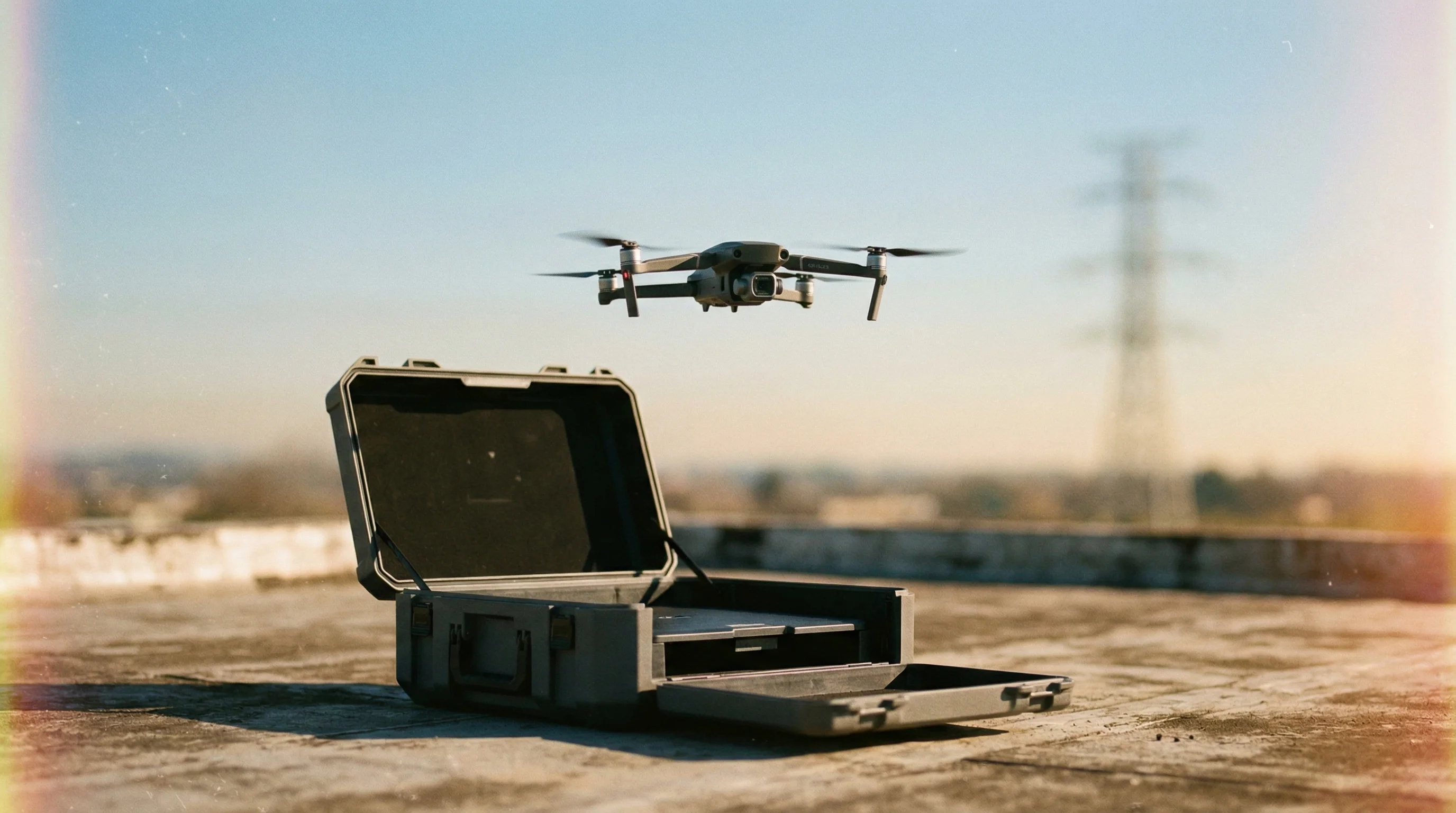
Voltair isn't stepping into empty terrain. The utility drone inspection market already has established players with mature products and real deployments.
Percepto operates "drone-in-a-box" systems that have secured FAA approval for remote operations without direct visual line of sight—no small regulatory feat. Skydio, the California drone maker, launched its Dock for X10 model in Japan last September and maintains substantial programs with U.S. utilities. DJI introduced its Dock 3 system in February. All three rely on ground-based charging stations, which require site prep, installation, and often some degree of ongoing maintenance.
Voltair's angle is that line-charging infrastructure—whether pads or perching—sidesteps those constraints. No need to pour a concrete pad or run power to a remote charging station. Install pads on existing poles, or let drones land on the wires themselves, and suddenly you have charging infrastructure wherever the grid already goes.
It's an appealing vision, especially for utilities managing corridors that snake through rugged or inaccessible landscapes where traditional drone docks are impractical. The company positions itself not as a drone vendor but as a data service: "We operate, you receive data." That's a familiar playbook in the infrastructure monitoring world—offload the complexity of managing hardware and just deliver actionable imagery and analytics.
But as of late March, Voltair hasn't announced any named utility customers or formal pilot programs. The company is headquartered in Pullman, Washington, with operations in Spokane, and recent job listings for field operations roles show hourly pay between $25 and $45. Not exactly the compensation profile of a company flush with revenue contracts.
The Commercialization Question
Voltair presented at Y Combinator's Demo Day on March 24. No follow-on funding announcements have surfaced beyond the standard YC backing. That's not unusual—plenty of Demo Day companies close funding rounds quietly weeks or months later. But it does mean the company's financial runway and customer traction remain unknown.
The hurdles ahead are real. Autonomous drones operating beyond visual line of sight require FAA waivers that take months to secure and demand rigorous safety documentation. Proving that drones can safely interact with live high-voltage lines—whether landing on them or docking at pole-mounted pads—will require extensive testing and likely close collaboration with utility engineering teams who are, understandably, cautious about anything that could compromise grid reliability.
Weather adds another layer. Transmission lines in wildfire-prone regions are often in areas with high winds, dust, and temperature extremes. Can the charging mechanism work reliably in those conditions? Will ice accumulation or debris interfere with perching? These aren't hypothetical concerns—they're the kinds of edge cases that turn promising prototypes into footnotes.
Still, the operational pain point Voltair is targeting is genuine. Utilities do struggle with the logistics of inspecting remote infrastructure. Traditional helicopter flyovers are expensive. Ground-based crews are slow. Battery-limited drones help but only partially solve the problem.
If Voltair can demonstrate that its line-charging approach—whichever version ultimately prevails—works reliably in real-world conditions and can navigate the regulatory gauntlet, the company has a shot at changing how utilities think about aerial inspection. If not, it joins a long list of ambitious hardware startups that solved a problem in the lab but couldn't make the leap to commercial viability.
The academic research confirms that siphoning power from transmission lines is feasible. What remains uncertain is whether Voltair can transform that possibility into a product utilities will trust with their grids. That's a question that won't be answered in a pitch deck or a Demo Day presentation. It'll be answered in the field, over months of testing, iteration, and hard-won customer deployments.
Or it won't be answered at all.


